


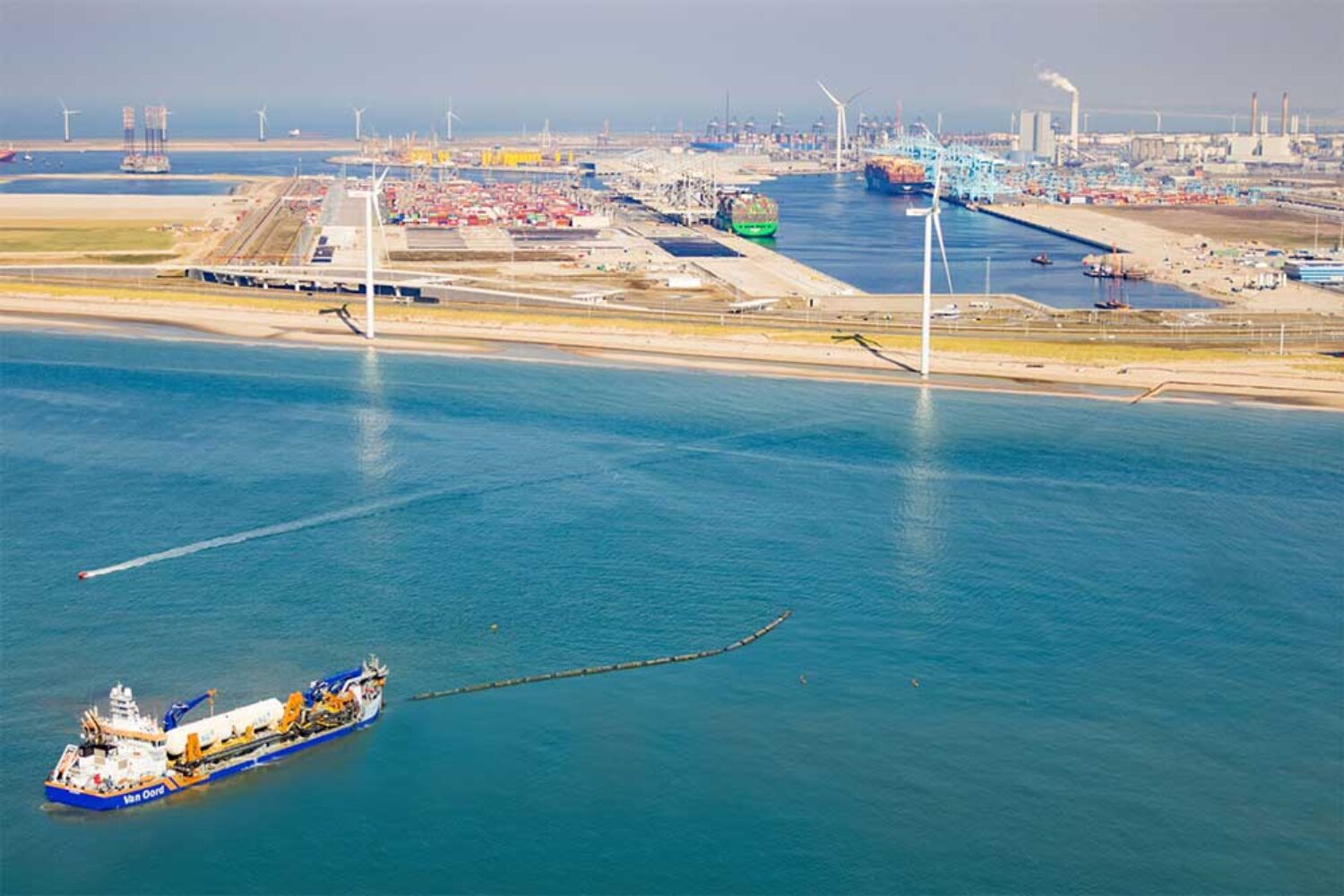
It’s about 1 million m³ of sand: the dredging and offshore shipping company Van Oord has started a harbour protection project at Maasvlakte 2 in Rotterdam.
The aim is to ensure “that nature itself protects the port area and the hinterland of Rotterdam from the sea” by means of “sand enrichment” in the Maasvlakte 2 port development area.
The project was commissioned by Rijkswaterstaat, the executive agency of the Dutch Ministry of Infrastructure and Water Management, and is part of a broader program to protect and strengthen the Dutch coastline, Van Oord has now announced.
The shipping company is using the LNG suction dredger “Vox Apolonia” to carry out the project. A total of 1 million m³ of sand from the North Sea will be deposited on the beach of Maasvlakte 2 and on the seabed off the coast.
The “Vox Apolonia” will initially dredge sand from selected sections of the seabed at a distance of more than 10 km from the coast. It will then deposit some of this sand on the seabed off the coast (foreshore enrichment). The sand will also be pumped onto the beach using a pressure pipeline (beach nourishment), where bulldozers and excavators will spread it. In the following months, some of the sand will be transported to the dunes by wind and weather, so that the coast will be strengthened by the forces of nature.
“Familiar territory” Maasvlakte
Maasvlakte 2 is a familiar area for Van Oord. From 2008 to 2013, the company was part of the consortium that developed and implemented this enormous port expansion project. Since then, Van Oord has carried out other projects in this port area, including the construction of the Prinses Amaliahaven container port and the expansion of the Yangtze Canal.
“The special thing about this project,” continues Van Oord, “is that the Vox Apolonia is powered by liquefied natural gas (LNG), a more sustainable fuel alternative that reduces sulphur and particulate emissions to a minimum. The combustion process is also different to that of MGO, which results in lower nitrogen dioxide emissions. “By switching the fleet to this alternative fuel, Van Oord is one step closer to its goal of zero emissions by 2050, in line with the Paris Climate Agreement,” says the shipping company.