



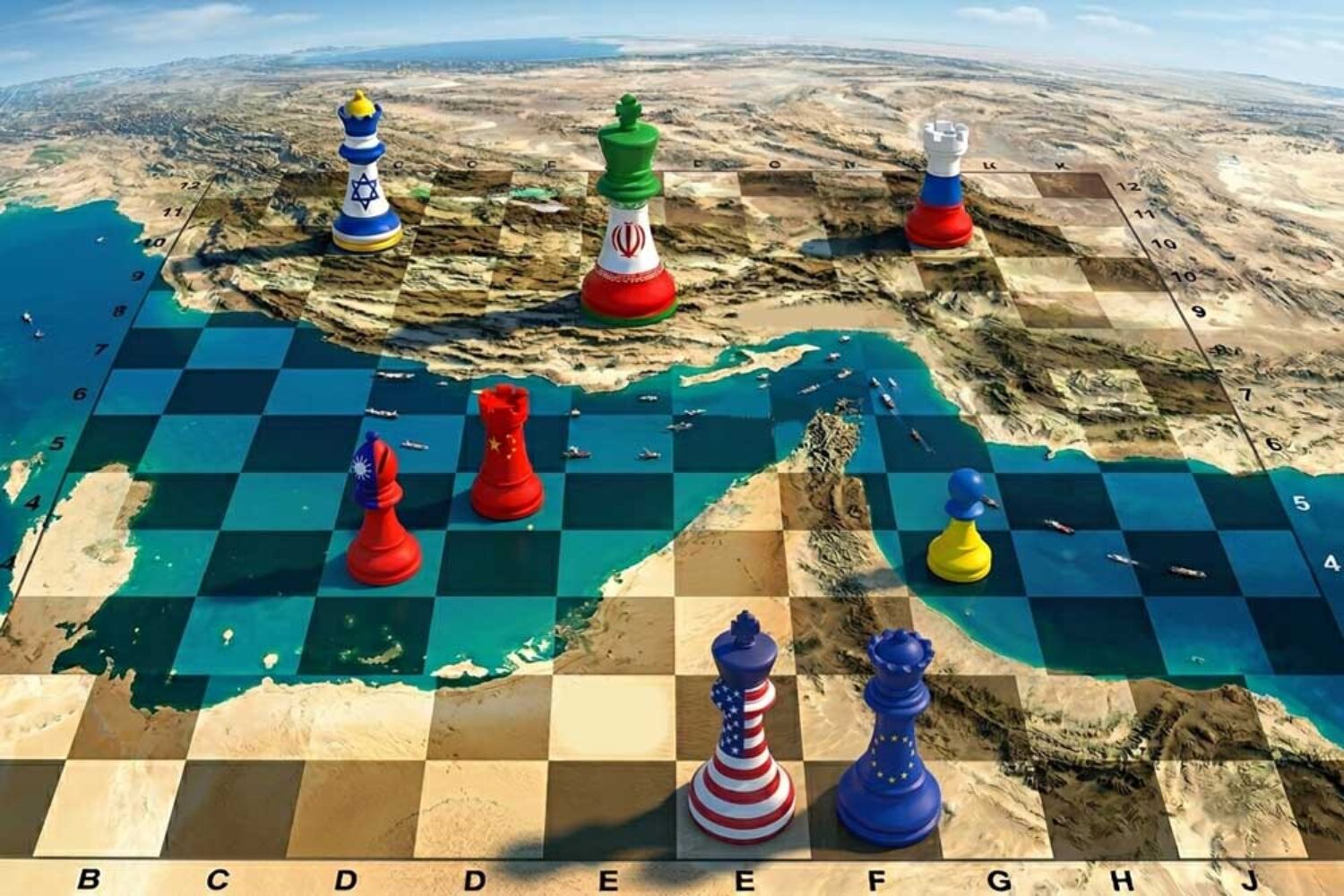
In the fifth week of the war, it is becoming clear that events in the Iran war amount to more than a confrontation with Iran. If read as a chess game played on three levels, the upper board pits Washington against China, the middle board covers the conflict in Iran and at sea around the choke points of Hormuz and Bab el-Mandeb, while the lower board concerns the consequences for Europe and Ukraine. By Hans Uwe Mergener
In concrete terms, the upper board is about the future balance of power in the Indo-Pacific, the middle one about air strikes, toll regimes and coercive signalling in the Gulf, and the lower one about munition stocks, Russia’s war chest and Europe’s ability to act.
US President Trump has by now conceded this shift: securing the Strait of Hormuz is “the world’s problem”, and other states will in future have to protect their own tankers – making it clear that his real objective is not the long-term order in the Gulf, but rather a rapid refocus on China and domestic politics.
Upper board: The Indo-Pacific as the real objective
On the upper board, it is not Tehran but Beijing that is facing Washington. The United States is showing which trigger it can use to target China’s vulnerability. For Beijing, Tokyo, Seoul and New Delhi, the Iran war is therefore above all a test of how far Washington is prepared to tolerate disruption to Gulf routes – knowing that Asia is vastly more dependent on Hormuz in energy terms than the United States itself.
According to current analyses, around 84% of the oil transported through the Strait of Hormuz flows to Asia, above all to China, Japan, South Korea and India. Bruegel estimates that China alone sources around 45–50% of its crude oil imports from the Gulf region, almost entirely via the Persian Gulf and Hormuz. By contrast, the United States is a net exporter of petroleum products. Its imports from the Middle East are now only in the low double-digit percentage range.
This asymmetry is the key point on the upper board: if, in the Iran war, Washington is willing to accept that Hormuz effectively shifts from a free sea lane to a politicised corridor dominated by Iran and burdened with massive price premiums, it is simultaneously sending Beijing a signal as to what a future pressure scenario might look like. Even if the US and Europe suffer from high prices, a prolonged disruption of Hormuz or a selectively controlled passage would be, in strategic terms, above all a problem for China and other Asian buyers – not for US supply security.
Part of the US establishment sees the strike against Iran as flank protection for the real competition with China: if Iran’s missile, drone and naval capabilities are significantly degraded within a limited time frame, then from a US perspective the risk declines that Tehran could escalate in the Gulf during a crisis over Taiwan or in the South China Sea in order to put pressure on Asian allies.
In Washington, the phrase circulating is that one must “act hard and briefly now in order to have one’s back clear afterwards” – whereby “having one’s back clear” refers less to one’s own oil supply than to the number of simultaneous theatres of crisis and the vulnerability of partners in Asia, whose energy supply depends on Hormuz for around 84%.
Against this backdrop, Trump’s willingness to end the war if necessary without militarily restoring free passage through Hormuz can also be read in this way: the United States is preserving for itself the option of politically exploiting the “Hormuz switch” in future great-power scenarios without itself being structurally dependent on Gulf oil.
For China, the war is a complex mix of risk and opportunity. On the one hand, energy prices and supply chain risks are rising. On the other, Beijing is securing access to critical resources and sea routes through bilateral deals – for example through the preferred use of the Iranian-controlled Larak corridor for COSCO container ships, the Chinese state-owned shipping company.
Although only achieved at the second attempt, it is politically revealing that Beijing and Tehran have negotiated selective transit rights for Chinese state-controlled tonnage while Western shipowners remain largely excluded. Chinese analysts cited by Asia Times also regard the war as a “dress rehearsal” from which they can draw conclusions about US carrier operations, munition expenditure and coalition dynamics – factors that will later feed into any Taiwan calculation.
Russia initially benefits on this board from higher oil prices and sanctioned competition from Iran and Venezuela, but must organise its export flows with growing difficulty under Ukrainian drone strikes and mounting pressure on the shadow fleet. India, meanwhile, gains political weight but also becomes more vulnerable to maritime and insurance risks in Hormuz and Bab el-Mandeb, and must recalibrate its balance between Russia, Iran, the Gulf states and the United States. This strategic equation is translated on the next board into very concrete strikes and countermeasures in the Gulf.
Middle board: Iran war, toll regime and new choke points
This is where the actual confrontation is taking place: US air strikes, the deployment of maritime forces, Iran’s response through the selective closure of Hormuz, and the late, initially above all symbolic entry of the Houthis into the war, turning Bab el-Mandeb into a second threatened bottleneck.
US Navy: Seapower in operational mode
Operationally, the United States is underpinning its approach with two carriers plus two amphibious toolkits. Alongside the “Abraham Lincoln”, deployed in the Arabian Sea and/or the Gulf of Oman, another carrier strike group centred on “USS George H. W. Bush” (CVN-77) is being moved into theatre. On 31 March she departed Norfolk eastbound accompanied by the Arleigh Burke-class destroyers “USS Ross” (DDG-71), “USS Donald Cook” (DDG-75) and “USS Mason” (DDG-87). Several sources associate the group with Operation Epic Fury.
“USS Gerald R. Ford” has been withdrawn from operations following a fire on board. After a short repair stop in Souda Bay, she is now in Split, Croatia – outside the Iran war, with the prospect of a longer shipyard period.
The US force disposition is supplemented by the Tripoli ARG (31st MEU) and the Boxer ARG (11th MEU) as flexible platforms for limited amphibious and security operations. In US analyses, the options under discussion range from pinpoint strikes against IRGC bases, mine depots and fast-attack craft bases along the Strait of Hormuz, to symbolic presence off Kharg Island and humanitarian assistance roles. A large-scale ground invasion remains theoretical for the time being.
Hormuz – screening at Tehran’s discretion
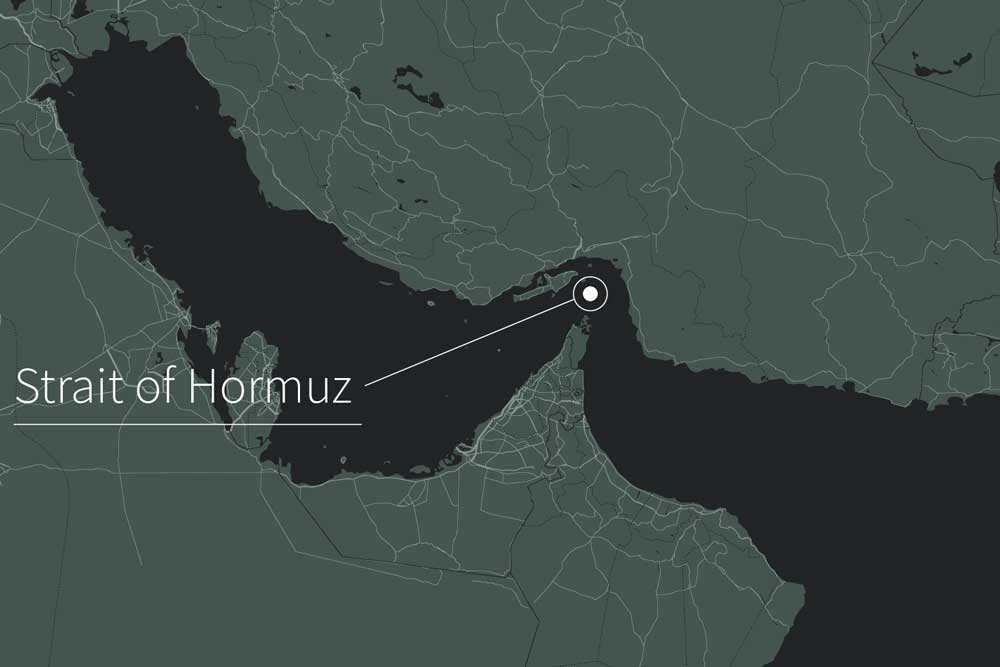
At the same time, Iran has transformed the Strait of Hormuz from an open sea lane into a politicised toll and corridor system. Lloyd’s briefings show that since 15 March not a single transit by a large merchant vessel has taken place via the traditional fairway. All 57 passages recorded since 13 March have been routed via the Larak detour controlled by the Revolutionary Guards. Since 1 March, Lloyd’s has recorded 201 transits by merchant vessels of more than 10,000 tonnes, of which 138 were eastbound and 63 westbound. The breakdown is 46 crude tankers, 32 product tankers, 22 gas carriers, 24 container ships and 67 bulk carriers. By origin, Iranian flag or ownership accounts for 25%, Greece 16% and China 10%.
By now, 71% of all voyages have an Iran nexus, whether through ownership, flag, sanctions, shadow fleet links or Iranian ports, and among tankers and gas carriers the shadow fleet accounted for 88% of all recorded transits in the last week of March – an almost complete displacement of regular, Western-insured tonnage. At the same time, Tehran is codifying a legislative package that lays down “fee regulations in rial” for transit through Hormuz, thereby politically and legally underpinning the toll regime already being practised. Reports also point to a planned cooperation with Oman.
Tehran’s signal to the Gulf states
The attack on the fully laden “Al Salmi”, with a deadweight of 319,660 tonnes, flying the Kuwaiti flag and owned by KPC, 31 nautical miles off Dubai – reportedly by Iranian drones – shows that Iran is prepared to target even large, state-owned tankers belonging to Gulf partners in order to underline its de facto control over the wider Hormuz area.
Hormuz leverage hits Asia
From the energy dimension, Iran’s leverage thus clearly shifts towards Asia: according to calculations by Zero Carbon Analytics, Reuters and Bruegel, around 84% of the oil flows shipped through Hormuz go to Asia – above all China, Japan, South Korea and India – whereas Europe and the United States are physically far less directly affected.
The US is now a net exporter of oil products, and its crude imports from the Middle East are at a low point. A permanently Iranian-controlled toll and selective transit regime in Hormuz is therefore, in strategic terms, above all an instrument of pressure against Beijing and Asian consumers – and a price shock for Europe – rather than an immediate bottleneck for American supply.
Tehran’s escalation reserve
With the Houthis’ delayed but now de facto entry into the war, the danger of a second strait politicised by the Iran camp is growing. The Yemeni movement claims missile and drone attacks on Israel and openly threatens to close Bab el-Mandeb to ships of “hostile states” should Iran continue to be attacked or Hormuz be opened by force.
International and regional think tanks see the Houthis as a deliberately deployable escalation reserve for Tehran. A card that can be played if needed in order to shut off the southern access to the Red Sea while separate negotiations with Saudi Arabia continue. Some analysts speak of a nightmare scenario in which a Hormuz corridor usable only selectively and a Houthi threat posture over Bab el-Mandeb take effect at the same time – with corresponding consequences for oil prices, war-risk premiums and supply chains from Europe to Asia.
US exit without reopening Hormuz?
Particularly explosive is the fact that, according to the Wall Street Journal, Washington is seriously considering ending the war without militarily reopening Hormuz. How realistic that scenario is is illustrated by the warning of former US Secretary of Defense Jim Mattis in Axios on 23 March: if the United States were now to declare victory and withdraw, Iran would in effect claim control of the strait; some form of “ship tax” for every vessel would then be conceivable – a situation that would be untenable for global markets.
Trump says the strait is “the world’s problem” and announces that the US could leave Iran in “two or three weeks” after, in his view, Iran’s military has been weakened for “15 to 20 years”. This fits with the fact that on 26 March he once again extended his deadline for reopening Hormuz to 6 April and for the time being suspended new strikes on Iranian energy infrastructure – officially because of ongoing talks, but in practice also in order to preserve his political and military room for manoeuvre. Politically, that would be a deliberately chosen endgame move before the middle board – the maritime order in the Gulf – is restored to a condition of free passage; strategically, it plays into the upper board.
What is decided on the two upper levels has an immediate impact on the third board: Europe’s security, the Kremlin’s war chest and Ukraine’s prospects.
Lower board: Europe, Ukraine and economic warfare
On the lower board, everything that ultimately matters for Europe and Ukraine comes together: weapons deliveries, supply chains and Russia’s revenues. Militarily, the Iran war is competing with Ukraine for the same high-end assets – Patriot and SM-3 interceptors, as well as modern air- and anti-surface munitions. Politico and others report that the Pentagon is examining whether to divert PURL stocks and air-defence packages intended for Kyiv to the Middle East. Partners are to be prepared for possible delays. Think tanks and members of Congress openly speak of the need to “rob Peter to pay Paul”.
The first impression: Moscow as a wartime profiteer
Economically, the Iran war initially gives Moscow a strong rouble bonus. Because of the Hormuz crisis and the global risk premium, oil prices have risen significantly, while the discount on Russian crude versus Brent has narrowed. Bloomberg, Irish public broadcaster RTÉ and Euronews speak of a four-year high in Russian oil revenues and estimate the theoretical additional gain from the Iran crisis at USD 80–100 billion per year as long as Brent remains in triple digits.
However, this theoretical three-digit billion-dollar effect is constrained by two factors. First, Ukrainian drone strikes on export hubs such as Ust-Luga and Primorsk are at times reducing Russian export capacity by up to 40% and depressing outflows from the Baltic. In addition, the environment for Russia’s shadow fleet is visibly becoming harsher: more listed vessels, tougher port state controls and the first seizures – logistical friction is increasing. Russia is therefore earning more per barrel, but is increasingly occupied with getting enough barrels out of its ports at all.
The opportunity for Kyiv
At the same time, Ukraine is trying to upgrade its own role: away from being merely a recipient of Western assistance and towards becoming a provider of specialised capabilities in a conflict that also affects it indirectly. According to converging media reports, Zelenskyy has concluded defence agreements with Saudi Arabia, Qatar and the UAE covering training, air defence, anti-drone software and technical expertise against Iranian Shahed drones.
More than 200 Ukrainian specialists are said already to be operating in Gulf states. French media have also picked up the possibility that Ukrainian maritime drone technology – Magura and the like – could in the medium term also play a role in the Strait of Hormuz, whether through export, advisory support or operational presence.
Europe – Asia
For Europe, the Hormuz shock is felt primarily through prices, insurance premiums and indirect demand effects from Asia – in physical terms the EU states are far less directly dependent on Gulf oil than China, Japan or South Korea. This intensifies inflationary and competitive pressure, but in energy terms it constitutes a different quality of vulnerability from that seen in Asia.
For Europe, this third board means two things. First, the Iran war increases the need to ramp up its own industrial and military capacities if Washington gradually shifts its focus back towards Asia. Second, Ukraine’s role in the Gulf opens up new long-term security and defence-industrial entanglements that will extend beyond the current war.
Conclusion
Taken as a whole, this produces a picture in which every move on one board – another US strike against Iran, a Ukrainian drone hit on Ust-Luga, a Houthi attack in the Red Sea or a Chinese “transit deal” via Larak – immediately reverberates across the other two: in the financing of the Ukraine war, in China’s assessment of American freedom of action and in a maritime order that is shifting from free transit rights to conditioned access regimes.