
The 14th National Maritime Conference (April 29th & 30th) kicked off in the port city of Emden. Representatives from politics, associations and the industry will be discussing the pressing issues facing the maritime industry until Thursday afternoon.
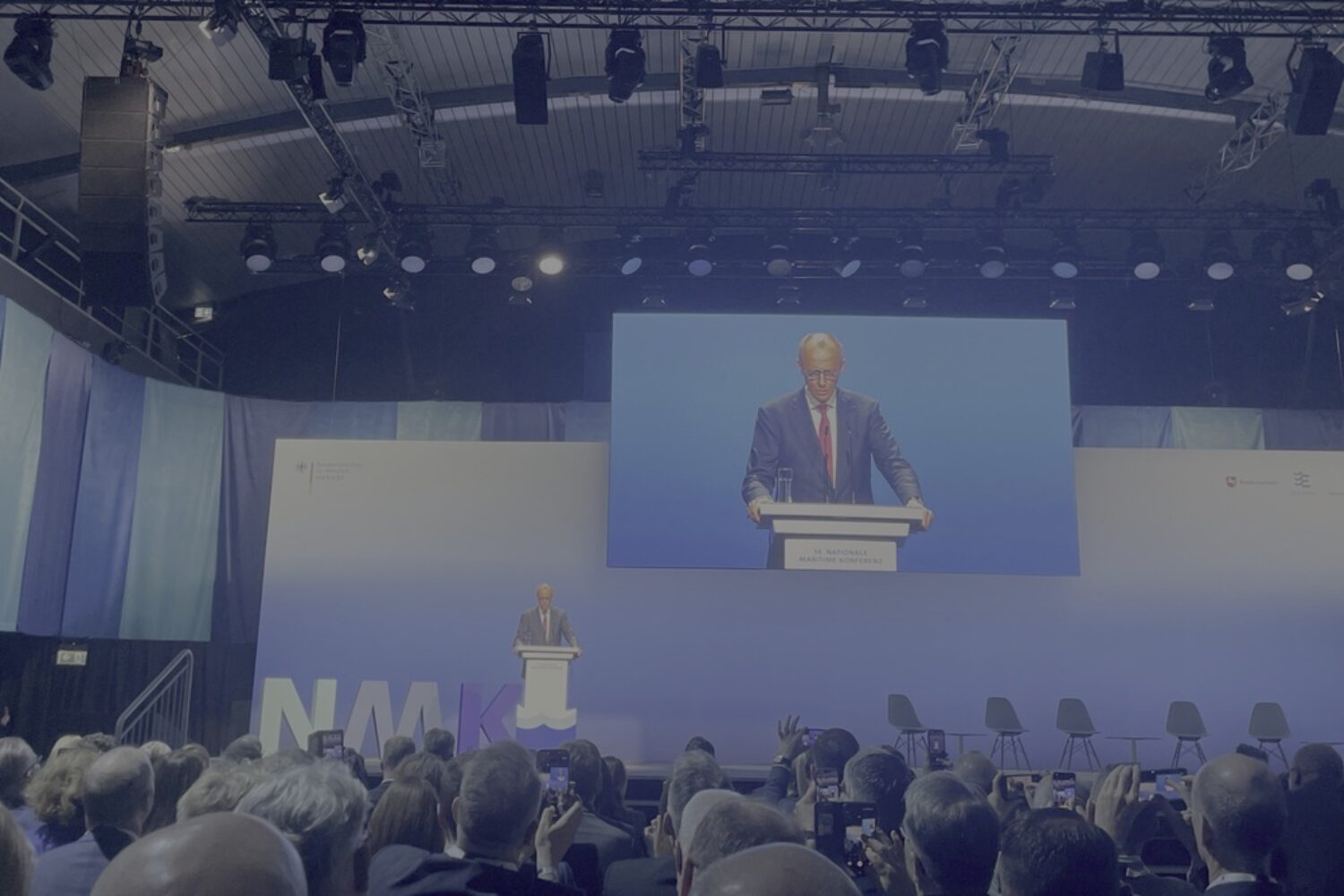
Federal Chancellor Friedrich Merz opened the 14th National Maritime Conference (Nationale Maritime Konferenz, NMK) in Emden as patron together with Federal Minister of Economics Katherina Reiche. Around 800 participants from business, politics and associations have been invited to the top meeting of the maritime industry in Germany. The conference focuses on securing European competitiveness, strengthening maritime security and targeted investment in future technologies “Made in Germany”. The NMK takes place every two years. The very first NMK was held in 2000 – also in Emden, initiated at the time by Federal Chancellor Gerhard Schröder.
The conference, organized by the Federal Ministry of Economics, is regarded as the central industry meeting of the Federal Government for the maritime industry. The list of participants is correspondingly high-ranking: Federal Chancellor Friedrich Merz, Federal Economics Minister Katherina Reiche, Transport Minister Patrick Schnieder, Defense Minister Boris Pistorius, Maritime Coordinator Christoph Ploß and many other politicians are on site.
Chancellor: “The German seaports and inland ports are the vascular system of the German economy
In his speech, Federal Chancellor Friedrich Merz focused on the maritime future of Germany and Europe. “We will only survive in Germany and Europe if we shape our maritime future,” said Merz. To do this, the industry needs reliable framework conditions – especially for shipyards and shipping companies.
“Our shipyards need good financing models,” he emphasized. At European level, the German government wants to advocate a maritime industrial strategy; work is also underway on a uniform tonnage tax for ocean shipping at European level.
Nationally, shipping has already been included in the large-scale guarantee program. At the same time, Merz made it clear that, in his view, financing was not the only bottleneck: “It is not the lack of money that is our biggest problem, it is the long procedures,” said Merz. Germany therefore needs an investment and future model that brings projects to fruition more quickly.
With regard to artificial intelligence (AI), he warned against excessive regulation: “I would urge you to remove the regulation of mechanical engineering from the regulation of AI.” This is the only way Germany can keep up internationally in an industry that is being discussed on this day.
The ports also have a central role to play here. “The German seaports and inland ports are the vascular system of the German economy,” said Merz. They are not only important for trade, logistics and industry, but also for defense capabilities. That is why they need to be expanded, modernized and digitalized. On the subject of port burden sharing and port financing, however, Merz dampened expectations of higher federal funding: “We cannot increase the contribution.” At the same time, he emphasized: “We can meet our responsibility in a different way.”
Outer Weser and Ems: “Deepening must come – and quickly”
With regard to the infrastructure projects on the Outer Weser and Ems rivers, Merz spoke out in favor of swift implementation of the planned deepenings. “The deepenings must come – and quickly,” he said. The federal government, federal states and municipalities must make it clear “that they are all pulling in the same direction”. Merz linked this to the expectation that planning and approval procedures should be accelerated so that central port and waterway projects are not delayed any further.
Merz also referred to the security policy dimension of the maritime industry. The protection of offshore wind farms has an “urgency that we have never seen before”. Germany has a strong industrial base in the security and defense industry. “Our country has world-leading shipyards,” said Merz. German submarines formed the backbone of NATO. He also addressed the F126 program: “We hope that we can bring the project to a successful conclusion.” Merz described the Maritime Security Center in Cuxhaven as a “best-practice model”.
In conclusion, Merz was already looking ahead to the next National Maritime Conference in two years’ time. “I am very pleased that the venue for the next conference will be Duisburg. An outstanding choice,” he said. Duisburg is a central hub far beyond the borders of Germany and is therefore an example of how the maritime economy should not only be thought of from the coast, but also how its importance for the inland should be made visible.
Maritime coordinator wants to create 100,000 jobs in the sector
Maritime Coordinator Christoph Ploß announced on Wednesday morning that the next NMK will be held in Duisburg (North Rhine-Westfalia). With the choice of location, the maritime economy is to be carried more strongly inland from the coastal perspective. “The National Maritime Conference makes it clear how important the maritime economy is for Germany’s sovereignty, security and resilience,” he also said at today’s opening. “With the expansion of maritime research programs and the inclusion of shipbuilding in the federal government’s major guarantee program, we are creating the basis for over 100,000 additional jobs to be created in the maritime industry over the next few years.”
Reiche: “Maritime economy is central to our industrial location”
Katherina Reiche, Federal Minister for Economic Affairs and Energy: “The maritime industry is central to our industrial location, our exports and our security. Our economy cannot function without stable supply chains and secure sea routes. That is why we need a strong maritime infrastructure and state-of-the-art technologies. The National Maritime Conference brings together the right players to work on precisely this. Our goal is clear: to remain competitive, promote innovation and secure Germany’s role as a maritime nation.”
Topics of the NMK 2026
The maritime industry is diverse. In addition to ports, shipyards and suppliers, it also includes offshore wind energy and marine technology. Due to the current geopolitical tensions, the topic of maritime security has also become significantly more important in recent years. The panels at the National Maritime Conference are as diverse as the spectrum of the maritime industry.
Among other things, the competitive conditions for the maritime industry – especially for shipbuilding and the supply industry – will be discussed, particularly against the backdrop of geopolitical tensions. Maritime defense and infrastructure issues will also be discussed, as well as the importance of naval shipbuilding as a key industry. Last but not least, offshore wind energy, which is also considered a key technology, plays a major role. Ports, which are essential for supplying the population with goods and energy as well as for defense, will also have their own discussion forum.
Shipping and national security
The security policy note is flanked by the associations. The German Shipowners’ Association declared before the conference that maritime shipping is central to national security. The VSM, on the other hand, is pushing for industrial policy decisions with strategic reach. Emden will thus become a signaling location for a maritime policy that no longer considers security of supply, industrial performance and protection interests separately.
“The conference in Emden should therefore be more than just an industry meeting, but rather a test case for whether Germany will think strategically about maritime security in the future,” commented Hans-Uwe Mergener, editor of our sister publication ES&T. “However, as Hormus shows with the vulnerability of sea lanes, insurability and the gray areas in the legal spaces of the maritime order, maritime security must be broadly defined. Maritime security is grand strategy because it is not just about observing and protecting a sea area, but also about the ability to secure or influence global flows – to protect or disrupt them. Without a formal declaration of war and faster than classic military logic alone would work. Is Germany ready for this?”