



A “significant milestone” for a Caribbean shipyard project with “German roots”: The first successful docking has taken place at Grand Bahama Shipyard (GBSL) in the new East End floating docks.
The 600 million dollar refurbishment program is intended to mark the beginning of a new era of expanded business activities. The shipyard already refurbishes over 100 ships a year. To this end, the 262-metre-long cruise ship “Carnival Elation” was the first ship to be dry-docked in the “East End” floating dock, marking the official start of regular operations at the facility. GBSL is now equipped with two docks. There are plans to expand to three docks, with the Lucayan floating dock due to go into operation by the end of 2026.
The Grand Bahama Shipyard is operated as a joint venture between Carnival Corporation, the Royal Caribbean Group and, more recently, MSC Cruises , making it a central point of contact for the global maintenance of cruise ships. Lloyd Werft from Bremerhaven was also involved in the founding of the project (see below)
The “East End” floating dock built by CSSC Qingdao Beihai Shipbuilding in China is around 357 m long and around 70 m wide and is designed to lift ships weighing up to 93,500 tons. Equipped with four cranes and modern control systems, the floating facility significantly improves the technical capacities and operational flexibility of the shipyard. To support the integration of the dock into daily operations, the landside infrastructure works, including the quay extension, have also been completed.
Chris Earl, CEO of Grand Bahama Shipyard, described the occasion as a watershed moment for the company. “The first docking after a significant investment in a new facility is testament to the efforts, years of hard work and determination of the entire team. The on-time delivery of the Carnival Elation reflects this commitment and underlines Grand Bahama Shipyard’s potential to become the world’s leading cruise ship repair yard in the coming years.”
The shipyard aims to become the leading cruise ship repair yard in the region. The new floating dock on the east bank restores and significantly expands the shipyard’s necessary capacity after a floating dock broke down seven years ago. With the new dock, the shipyard can now handle several cruise ships at the same time again.
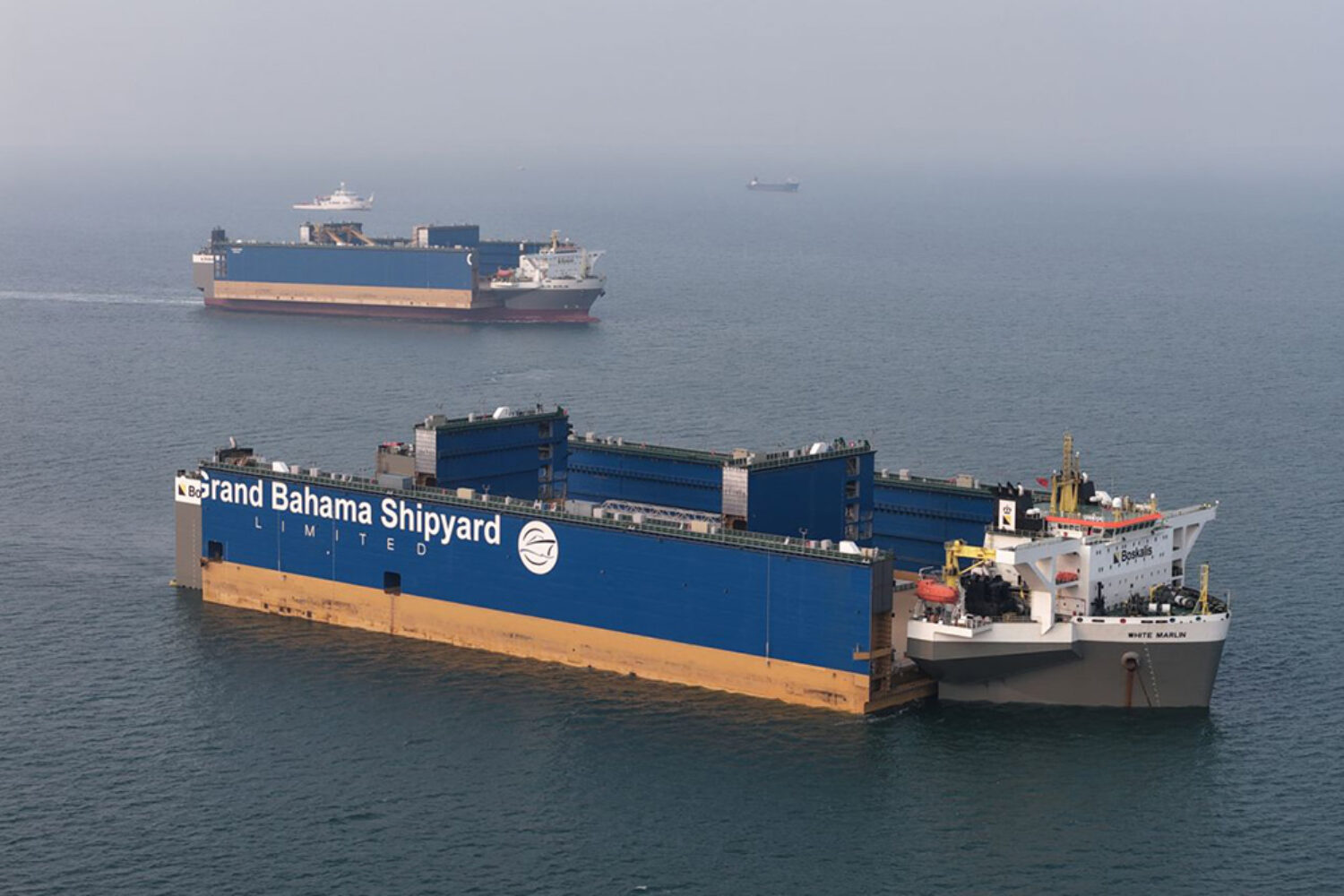
In the meantime, the second floating dock ordered has also been loaded in China for transportation to Grand Bahama Shipyard in Freeport. The Dutch company Boskalis was commissioned with the transport and has now taken over the floating dock “Lucayan” in Qingdao, one of the largest floating docks in the world with a lifting capacity of 130,000 tons, on the two semi-submersible heavy-lift vessels “Blue Marlin” and “White Marlin”. The dock, with a length of 413 m and a width of 85 m, was divided into four sections for transportation.
Loading took four days, with each ship transporting a floating dock section of over 156 m, in each of which there is another, shorter floating dock section. Upon arrival in Freeport, Bahamas, the four sections will be unloaded and welded back together to form a single floating drydock. Both ships are currently at the southern tip of Africa, at the Cape of Good Hope, and are scheduled to arrive in Freeport around May 19.
The current transport of the Lucayan floating dock is the second major order that Boskalis is carrying out for Grand Bahama Shipyard. Last year, the “Boka Vanguard” successfully transported the 357 m long East End floating dock to the Caribbean.
The two new floating docks will enable the shipyard to serve the entire range of cruise ships underway and under construction, as well as a large proportion of the global merchant ship fleet, which in the past usually had to travel to Europe for maintenance work. This will strengthen the company’s position as a leading cruise ship repair facility and also boost the region’s economy through direct and indirect employment opportunities.
The shipyard, located about 100 nm from Miami, was established 25 years ago as part of a larger plan to develop a maritime center in the Bahamas. The aim was to provide cruise ships sailing from base ports in Florida on Caribbean cruises with a local maintenance base off the US East Coast during the off-season.
One of the initiators of this shipyard location was Lloyd Werft Bremerhaven, which founded Lloyd Werft Grand Bahama Ltd. together with Carnival Corp. and Royal Caribbean in September 2000, as Werner Lüken, Managing Director of Lloyd Werft at the time, still recalls today: “The plan was to invest over 70 million euros and create 400 jobs. “We built a new shipyard in the middle of a greenfield site”. At the time, the British financial investor Bridgepoint Capital had a 70% stake in Lloyd Werft, which had just survived insolvency with the Bremen Vulkan.
The project in the Bahamas got off to a very good start in September 2000. However, the financial investor Bridgepoint Capital then objected when it came to contributing one million dollars to increase the capital of the new shipyard. “Bridgepoint didn’t think we could do it,” Lüken sums up today. After just one year, Lloyd Werft withdrew from the shipyard project with a heavy heart and the Grand Bahama Port Authority took over the majority shareholding of Lloyd Werft.