




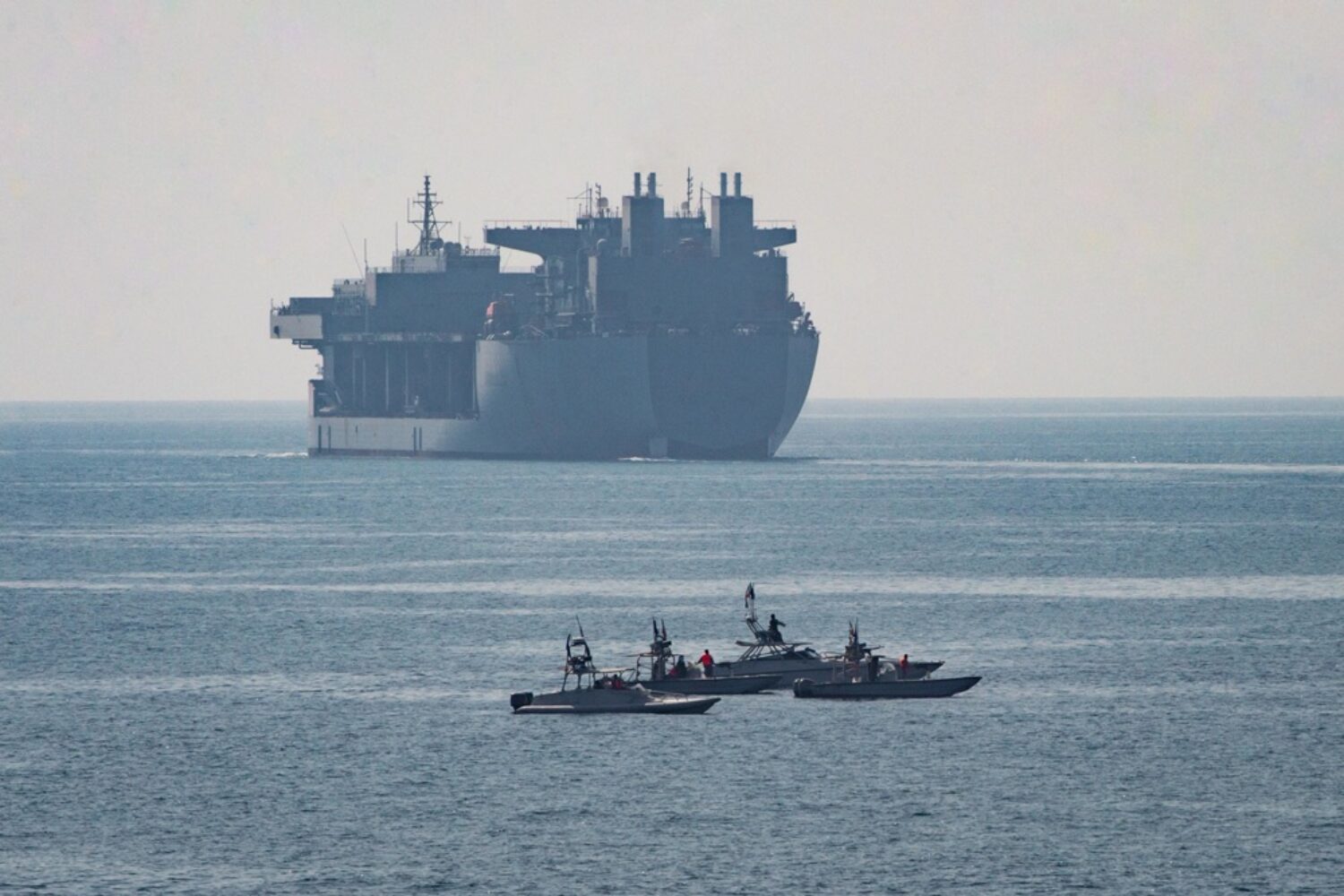
The war in the Middle East has been raging for almost a month. The Strait of Hormuz is effectively impassable and the price of oil is exploding. There are only exceptions for a few ships.
The Strait of Hormuz, which connects the Persian Gulf with the Indian Ocean, may only be around 50 km wide, but it is one of the most important lifelines for the global oil trade. 20% of global demand passes through the strait between Iran and Oman – but it is currently virtually impassable. Since the start of Operation Epic Fury and the US and Israeli war against Iran, the Strait of Hormuz has been closed and the Iranian Revolutionary Guard has been consistently attacking “enemy” ships.
US President Donald Trump recently threatened Iran with an ultimatum, after the expiry of which the US would begin comprehensive attacks on Iran’s energy infrastructure if the Strait was not reopened. Iran, in turn, held out the prospect of retaliation with counter-attacks and an indefinite closure of the Strait of Hormuz. The ultimatum was originally due to expire on Monday, but has recently been extended by five days.
While around 125 ships crossed the Strait every day before the crisis began, the number of passages has fallen by 95% – most recently around four ships a day. Three of these four voyages lead out of the Gulf, meaning that hardly any new ships are calling at the region. According to data from the shipping agency Clarksons Research, only ten oil tankers carrying an estimated 12 million barrels of crude oil passed through the strait last week. In a “normal” week, however, there are around 250 ships with over 300 million barrels on board.
Not all ships are targeted by Iran: the Indian government has sent several LPG tankers through the Strait of Hormuz following agreements with the Mullah regime (two ships on two consecutive days; but still 80% below the normal figure for a week).
Over 1,000 ships in the Persian Gulf
“Excluding vessels operating locally, there are currently around 1,100 vessels (37 million GT worth $30 billion) in the Gulf,” said Steve Gordon, Global Head of Clarksons Research. This total comprises around 300 oil tankers, including 6% of crude tankers (8% of VLCCs) and 4% of product tanker tonnage, as well as 4% of VLGCs and 1% of container and bulk carrier tonnage.
“Charter rates for tankers and gas carriers remain high despite the decline in freight volumes, with various factors currently providing support,” says Gordon. Accordingly, the energy shipping markets remain at a high level (VLCC revenues at $227,000/day, MR revenues at $52,000/day, LNG revenues increased to $150,000/day compared to the previous week, VLGC revenues up to $74,000/day). Bulker revenues are currently stable ($15,000/day), while container freight rates have risen slightly – according to Clarksons, the knock-on effects in logistics have so far been less than originally expected, with rates remaining “well below pre-Covid-19 levels”.
High costs for oil transportation
The transportation costs for a barrel of crude oil have doubled compared to the beginning of the year: a trip from the Gulf of Mexico to Asia currently costs $10/barrel compared to $5/barrel in January. “High bunker prices (e.g. VLSFO in Singapore at c.$1,000/t, up over 100% from early 2026) due to oil supply constraints – our data suggests that the average speed of container ships has fallen by 2% so far in March,” Gordon said.
The Clarksons data clearly demonstrates the importance of the Strait of Hormuz to the global energy industry. Before the conflict, the Strait carried not only the aforementioned 20% of the world’s oil supply, including 37% and 19% of seaborne trade in crude oil and oil products respectively. It also carried 19% of the global LNG trade (3% of global natural gas supply), as well as 28% of global LPG volumes (approximately 10% of supply), 13% of chemicals transported by sea, 9% of passenger cars, 4% of bulk cargo and 3% of containerized cargo.