


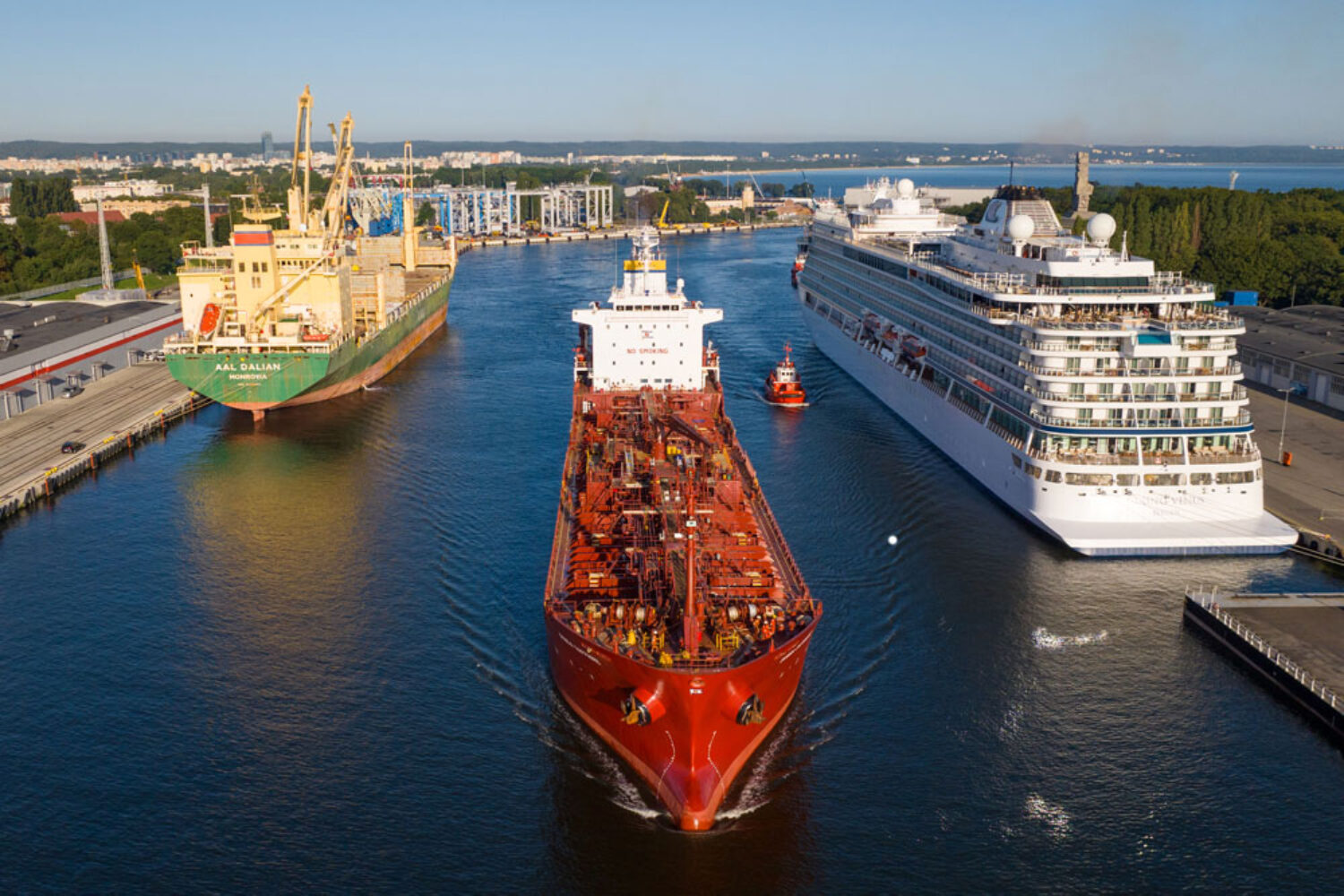
The port of Gdańsk reports an increase in throughput of 4% for 2025. Container handling recorded strong growth. There were declines in coal and timber. Of the total of around 80.4 million tons of goods handled, liquid fuels accounted for almost half.
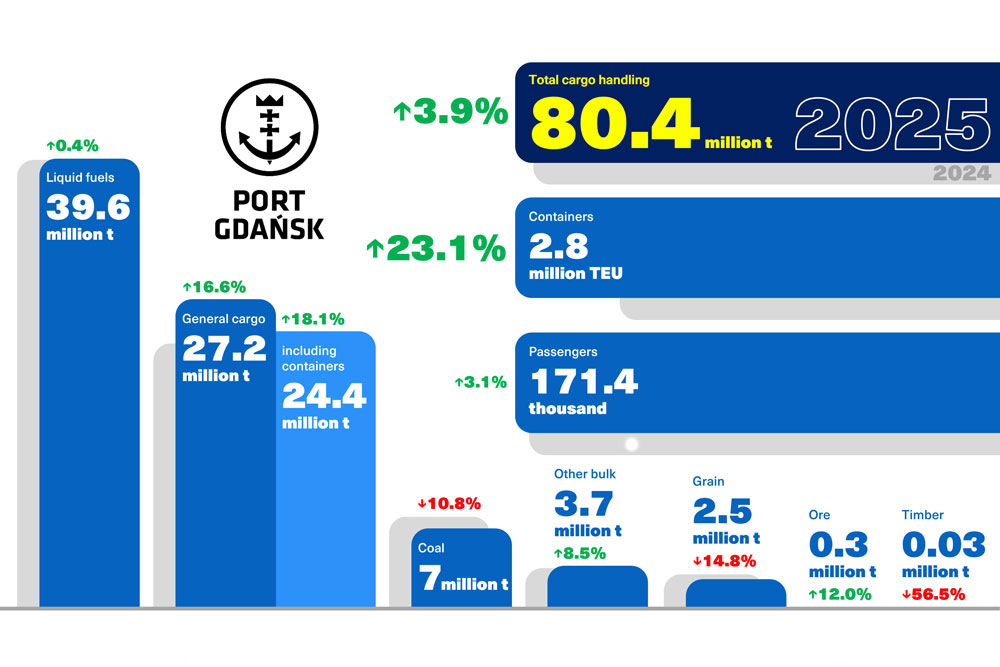
In 2025, a total of 80.4 million tons of goods were handled in Poland’s largest seaport, which corresponds to an increase of almost 4% compared to 2024, when the handling volume was 77.4 million tons.
A total of 4,394 ships called at the port of Gdańsk, 4.2% more than in the previous year. The number of merchant ships amounted to 3,650 units, 2.5 % higher than in 2024. At the same time, the average GT of merchant ships increased by 3.8 %, which, according to the port operators, indicates that the port of Gdańsk is further increasing the use of its deep-water infrastructure by handling ever larger units.
Liquid fuels dominate
Liquid fuels continue to be the largest cargo group in the port of Gdańsk. In 2025, their throughput reached 39.6 million tons (an increase of 0.4 % compared to the previous year) and accounted for 49.3 % of total throughput.
The throughput of crude oil alone, handled via Naftoport, amounted to 37.4 million tonnes compared to 36.6 million tonnes in the previous year, the best result in the history of this terminal. Naftoport handled 379 tankers with crude oil and 84 ships with petroleum products.
Containers drive growth
The second most important cargo group in 2025 was general cargo, which recorded one of the highest increases. The volume rose from 23.3 million tons in 2024 to 27.2 million tons in 2025, which corresponds to an increase of 16.6%. The share of general cargo in total throughput was 33.8 %.
The port of Gdańsk achieved particularly strong growth in the container segment. Almost 2.8 million TEU were handled at the container terminals in 2025, an increase of 23 % compared to the previous year; the Baltic Hub Container Terminal alone handled 2,766,475 TEU. At the same time, the volume of container cargo handled rose by 18% to 24 million tons.
Significant fall in coal handling
There were clear differences in the dry bulk sector. Coal handling fell once again – by 10.8% compared to 2024 to just under 7 million tons. This corresponds to half the volume handled in 2022. The share of this commodity in the port’s freight structure was 8.7%, confirming the steadily declining role of coal in the country’s energy mix.
The handling of ore developed differently, increasing by 12% to 326,700 tons. An increase of 8.5% to 3.7 million tons was also recorded for other dry bulk goods.
In contrast, there were significant declines for timber, which fell by 56.5% to 31,200 tons, and for grain, whose volume fell by 14.8% to around 2.5 million tons.
A decline was also recorded in the Ro-Ro segment in 2025. The number of vehicles handled fell by 15% to 118,000 units.
In contrast, results in the passenger segment developed positively. Last year, the port of Gdańsk handled 171,400 passengers, an increase of 3.1% compared to 2024. This data confirms a stable interest in ferry connections and tourist traffic (266 ferry calls, 57 cruise ships).
Investments in 2025
The year 2025 also brought important investment impetus. In Naftoport, construction began on a sixth transshipment point for liquid fuels, which will be the second facility designed to handle the world’s largest tankers with a length of over 300 m and a draught of up to 15 m.
In the port of Gdańsk, the construction of an installation terminal for offshore wind farms, a floating gas terminal of the FSRU type and the expansion of quay facilities in the inner harbor are also underway. In 2025, several key investments for the port’s development were also completed, including the construction of Terminal T3 in the Baltic Hub and the expansion of the Bytomskie quay.