




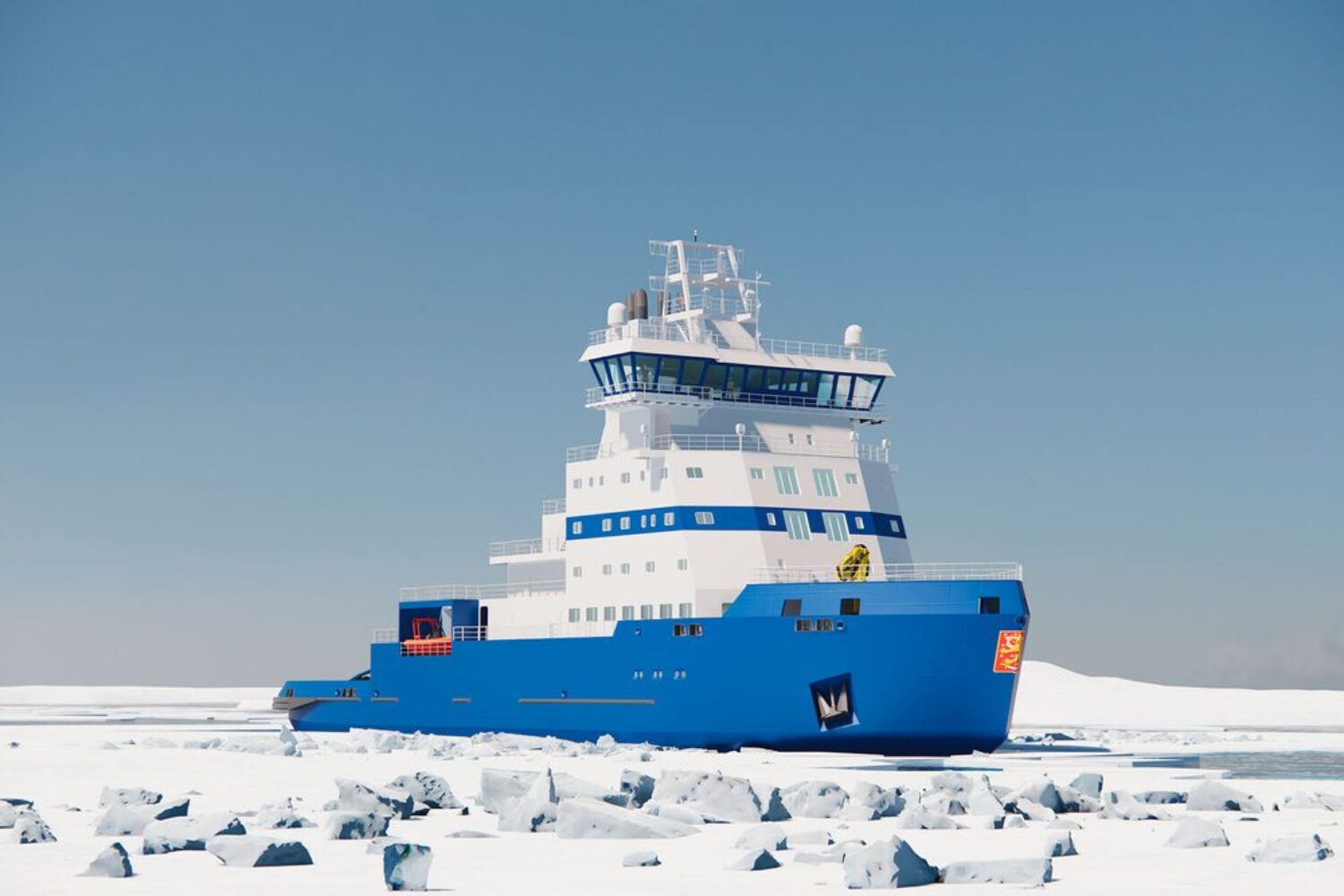
A new icebreaker concept design for the Finnish Transport Infrastructure Agency (FTIA) has now been completed. In the final phase, the focus was on the choice of propulsion system.
The solution was evaluated as an overall system with a view to reliable performance, cost-effectiveness and use in ice and open water conditions in the Bothnian Sea and the Gulf of Finland.
According to the agency, the decision was based on ice model tests carried out last fall. These tests are considered a tried and tested procedure in icebreaker design in order to realistically ensure the iceability and maneuverability before construction begins. The results formed the central starting point for further detailed planning and construction.
Propulsion solution supports the icebreaker’s core tasks
According to the client, a new type of propulsion configuration was selected: classic straight shaft systems with rudders, supplemented by a reversible rudder propeller installed in the bow. Compared to pure rudder arrangements, this combination significantly improves maneuverability and ice management, while remaining technically clear and easy to control over the life cycle.
“This combination increases the agility of the ship, while operation and maintenance remain simple and predictable. This is crucial for operating and life cycle costs,” explained Helena Orädd, Head of the Maritime Transport Department at the FTIA.
Although alternative concepts with multiple rotating propulsion units had been tested, the added value for the main tasks of a class B+ icebreaker was not commensurate with the higher technical complexity and costs. “The chosen solution ensures sufficient performance for ice and open water operations. It is agile and reliable without being technically oversized,” says shipping expert Lauri Kuuliala.
New construction should be able to keep a 25-meter channel clear
The Class B+ icebreaker is designed, once commissioned, to keep a fairway of around 25 metres in width open — comparable to today’s Class A icebreakers — and is therefore intended for assisted traffic.
Key to the vessel’s efficiency are the quality and continuity of the channel, as well as its operational flexibility, including in open water. The latter is particularly important, as the B+ icebreaker is expected to be among the first units to enter service in the Bothnian Bay and, during severe winters, redeploy to the Bothnian Sea and the Gulf of Finland.
The newbuild will replace the approximately 70-year-old icebreaker “Voima”. With a length of around 96 m and an engine output of 10.5 MW, the new ship will achieve the same performance as its predecessor, but will be significantly wider at 24 m (“Voima”: 19 m). The greater width and modern hull and propulsion design should noticeably improve the open-water properties and performance in ice.
The next step is to invite shipyards to submit bids. Construction is scheduled to begin in 2027. The project is part of WINMOS IV and is being funded with €42 million from the CEF program. Delivery is scheduled for September 2029.