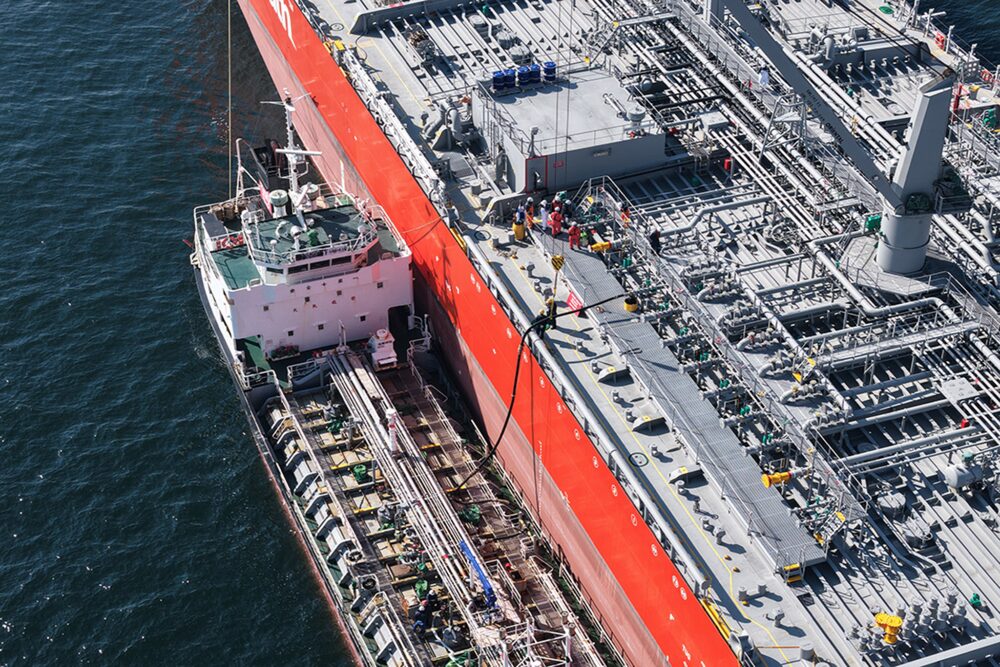


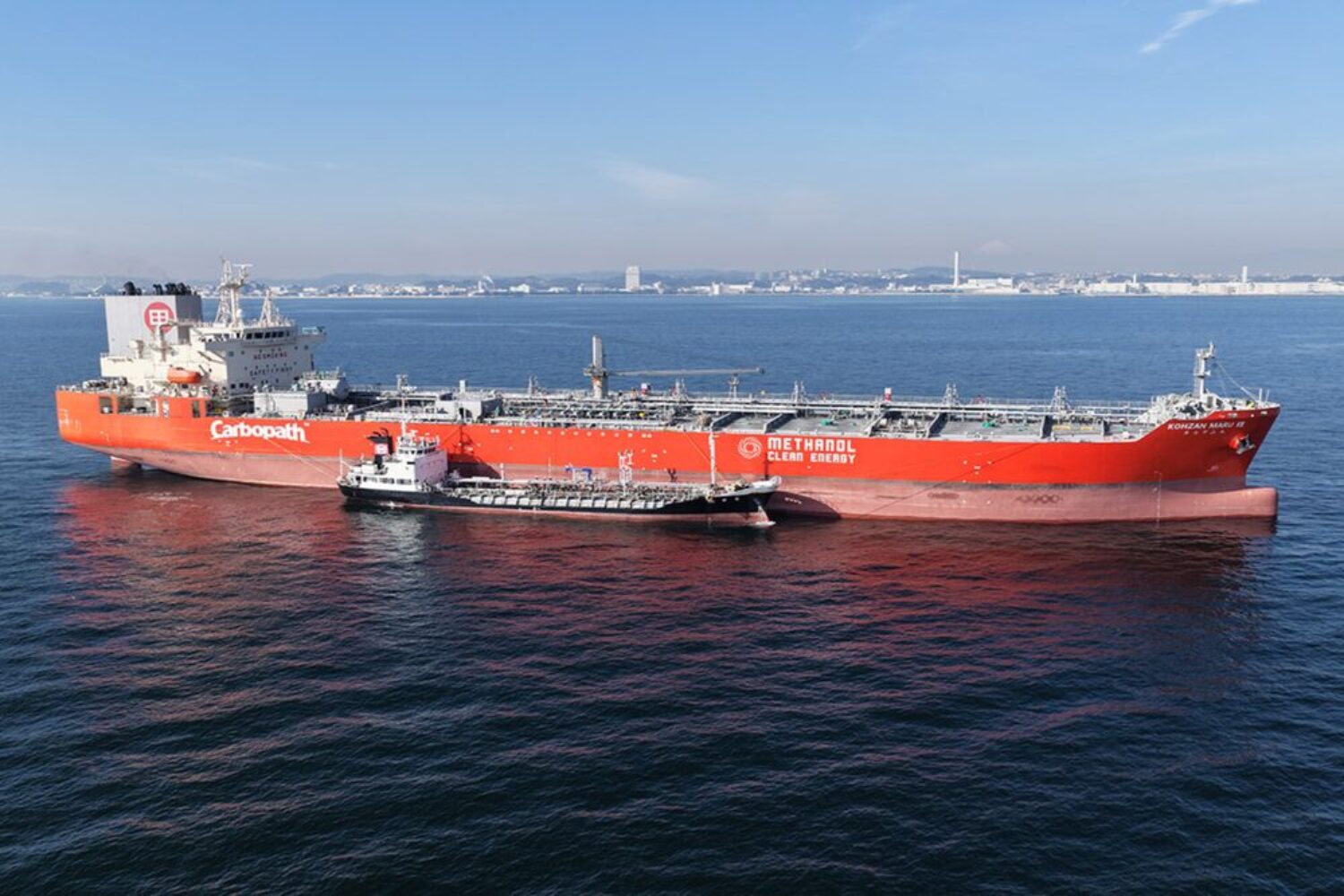
The Japanese shipping company Mitsui O.S.K. Lines (MOL), together with four partners, has carried out the first ship-to-ship bunkering (STS) with methanol in Japan.
The operation took place off the Japanese city of Yokohama in the Keihin harbor and is considered a milestone in Japan for the development of a national methanol bunkering infrastructure.
In addition to the shipping company MOL, the city of Yokohama, Kokuka Sangyo, Idemitsu Kosan and the Mitsubishi Gas Chemical Company (MGC) were also involved in the public-private joint project. The five partners acted as so-called “five parties” in the project.
Methanol bunkering at anchor
During bunkering, methanol was transferred from the coastal bunker tanker “Eika Maru” to the 2025-built chemical and oil product tanker “Kohzan Maru VII”. The “Eika Maru” is operated by Kokuka Sangyo, while the dual-fuel capable “Kohzan Maru VII” is under the management of MOL. Both vessels are chartered by MGC.
Bunkering took place at anchor and not at the pier, an established procedure in conventional fuel supply that has now been implemented for methanol for the first time in Japan.
Biomethanol produced in Japan at MGC’s Niigata plant was used. The fuel, which is based on biogenic raw materials, is intended for the future regular operation of the “Kohzan Maru VII”. Methanol from non-fossil sources, such as CO₂, waste or biomass, enables climate-neutral use in maritime shipping over the entire life cycle.
Several years of preparation beforehand
The premiere was preceded by several years of regulatory and technical preparation: between 2024 and 2025, the Japanese Ministry of Transport MLIT developed standards for procedures and safety measures for methanol bunkering as part of a study group. The basis for this included simulations in the port of Yokohama in September 2024 and experience from domestic chemical transportation. Operators, authorities and the Japanese Coast Guard jointly coordinated processes and safety concepts.
The successful operation is Japan’s first methanol STS bunkering at an anchorage for a ship in active service. The project partners expect the knowledge gained to be transferable to other ship types and regions in the future. The aim is to establish methanol as a viable alternative marine fuel throughout the country.
MOL wants to become “green” by 2050
MOL put the world’s first methanol-powered dual-fuel ship into service back in 2016 and now operates eight such units – one of the largest specialized methanol fleets in the world. As part of the “MOL Group Environmental Vision 2.2”, the shipping company plans to deploy 90 LNG and methanol-powered ships by 2030. The long-term goal is net-zero greenhouse gas emissions by 2050.