




Oceanscore, a company specializing in maritime compliance, has expanded its “FuelEU Pooling Marketplace”. The reason for this is falling costs and a growing supply.
As the Hamburg-based pooling specialist announced, the expansion is taking place against the backdrop of a significant decline in the “OceanScore Pool Price Index” (OPX). In the industry, it is regarded as an important reference value for pooling costs in contracts and commercial planning. The index fell to €190 per tonne of CO2e (CO2 equivalent) by mid-April, before rising again to over €225 in May – “a level that is well below the values of over €230 recorded just six months ago”, Oceanscore announced. Pooling allows ship operators to combine their fleets and thus offset emissions caused by conventional fuels with environmentally friendly ships, for example.
At the same time as prices have fallen, the number of active offers for excess emissions on the FuelEU Pooling Marketplace has grown “significantly”. “In recent market rounds, more than a dozen active offers were available, offering options in terms of different volumes, counterparties and price levels,” Oceanscore said.
The fact that the OPX skyrocketed to almost €300 in the last week of trading for 2025 compliance balances – at the end of April – puts latecomers at a significant disadvantage. From the pooling expert’s perspective, this once again underlines the importance of solid planning and rapid implementation for a successful compliance strategy.
“Not a static process”
“The first few months of FuelEU implementation show that pooling is not a static or purely technical process,” says Oceanscore. Price levels shifted rapidly, the availability of surplus emissions changed within short periods of time, and some pools opened and closed after just a few weeks. At the same time, a growing oversupply of surplus issues is making it more difficult for sellers to find buyers. At the same time, buyers are benefiting from a wide range of alternatives.
“Pooling is not just about having a surplus or deficit position,” said Albrecht Grell, Managing Director of Oceanscore. “It’s more about having access to the market at the right time – with the right contractual partners and sufficient price transparency.”
In response, OceanScore has optimized the FuelEU Pooling Marketplace – which is available as a standalone solution for shipping companies seeking access to pooling opportunities and market data – in several areas:
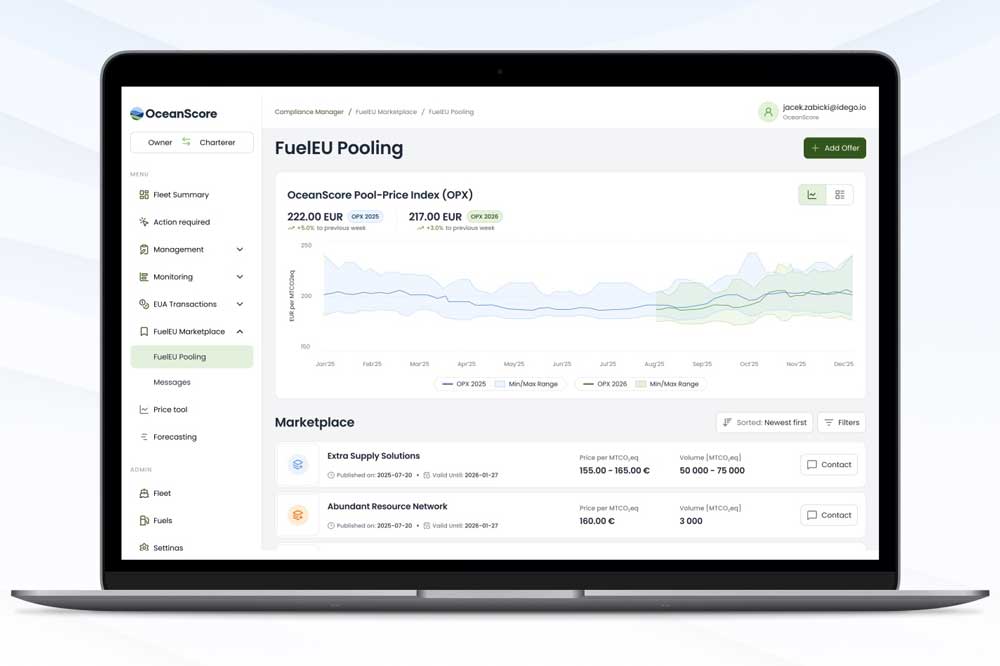
- OPX is now published weekly, reflecting short-term price movements and providing more granular data for assessing timing and negotiation terms
- Higher number of offers and counterparties improves market access across volumes and positions
- Enhanced pricing transparency provides clearer visibility across transaction types and counterparties
As the market is constantly changing, the need for support also varies depending on the company, region and business model. Oceanscore has therefore expanded both areas:
- Self-service capabilities, allowing faster and more independent interaction with the market
- Managed services, including counterparty matching, transaction and KYC support as well as process execution
This enables market participants to choose the level of involvement that best suits their internal capabilities and business strategy. For customers using Oceanscore’s Compliance Manager, the marketplace is already integrated into existing workflows, enabling direct alignment between exposure management, pooling decisions and settlement processes.
More and more shipping companies are using pooling
OceanScore currently serves more than 100 customers and over 2,500 ships worldwide. The FuelEU Pooling Marketplace is actively used by a growing number of shipping companies to gain access to surplus contingents, identify buyers, gain greater market transparency for business decisions and define effective pooling strategies.
“With increasing volatility and the growing availability of surplus contingent, access to market data and potential business partners is becoming a critical factor,” said Grell. “The enhancements made reflect exactly what we are seeing in practice: Companies need both transparency and broad market access to effectively manage FuelEU compliance.”
FuelEU is a regulation of the European Commission and part of the “Fit-for-55” package. It lays down uniform rules for limiting the greenhouse gas intensity that ships are allowed to cause, which primarily relates to the fuels used. FuelEU has been in force since the beginning of 2025 and will be gradually tightened: the reduction targets are currently 2%, but will be increased to 6% from 2030. In the following years, the targets will increase further: 14.5% from 2035, followed by 31% from 2040, then 62% from 2045 and finally 80% from 2050.