


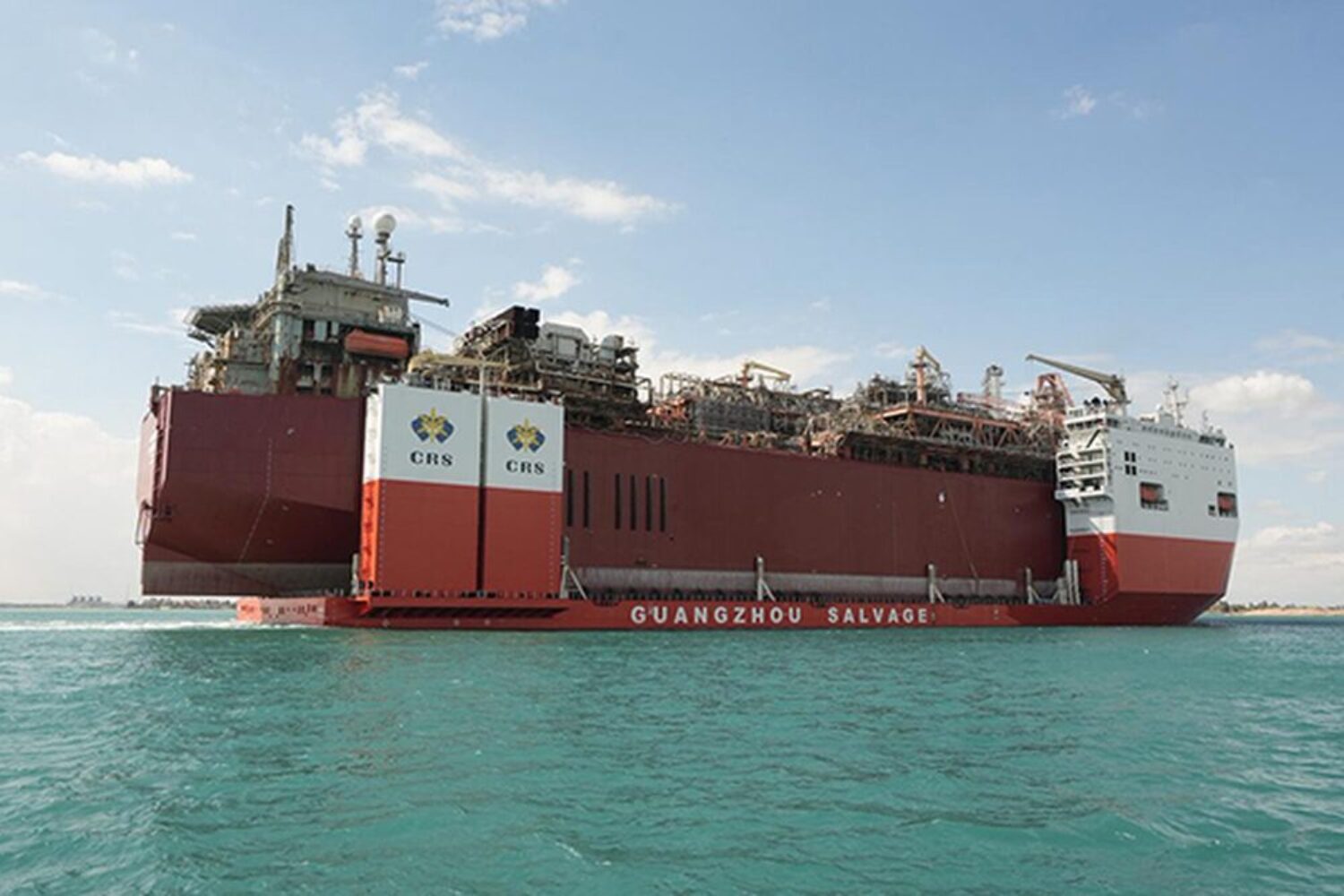
The Suez Canal has once again recorded an elaborate special passage: The semi-submersible heavy-lift vessel “Hua Rui Long” has passed through the canal in a southern convoy.
The unit is one of the largest semi-submersible heavy-lift carriers in the world and was on its way from Singapore to Denmark. The mega semi-submersible had already sailed through the waterway in the fall of 2022, but without cargo at the time.
On board was the “Northern Endeavour”, a 274 m long FPSO (Floating Production, Storage and Offloading) unit, which produced oil in the Timor Sea off Australia from 1999 to 2019. Due to the transit width of 77.7 m caused by the cargo, the passage was classified as a special transit by the Suez Canal Authority (SCA) and required special nautical measures, according to the authorities. Four SCA tugs secured the passage, and six experienced pilots were also deployed. Traffic monitoring centers accompanied the passage in real time. Last year, 27 semi-submersible heavy-lift vessels passed through the 193 km-long canal, and four more have been added since the beginning of the year.
“Hua Rui Long”: a ship with special capabilities
The “Hua Rui Long”, which was commissioned in 2022, sails under the Chinese flag and is operated by the Guangzhou Salvage Bureau. It is used in the project business by Cosco Heavy Transport and the Hamburg-based heavy lift shipping company United Heavy Transport, among others. The special vessel with a carrying capacity of around 80,000 tdw is approximately 252 m long and has a continuous cargo deck measuring around 252 × 60 m.
The lowerable cargo deck is characteristic of the ship type: a powerful ballast system with eight main ballast pumps allows the deck to be lowered up to around 16 m below the water surface so that extremely heavy units such as offshore platforms or ships can be floated up and picked up. The permissible deck load is around 25 t/m², in some places significantly higher. A DP-2 system enables precise positioning during offshore operations.
First return movements in the important waterway
“The choice of passage through the Suez Canal leads to savings in time and costs and at the same time ensures a reduction in harmful CO₂ emissions,” emphasized SCA Chairman Ossama Rabiee, once again promoting the important trade route. The background to this is the significant drop in traffic in the canal as a result of the attacks by the Houthi militia in the Red Sea, which have led to considerable losses in revenue for the canal authority.
In the meantime, however, there are signs of a cautious return: The container shipping companies Hapag-Lloyd and Maersk have announced that they will once again operate the “ME11” service via the Red Sea and the Suez Canal within their “Gemini Cooperation” alliance. According to the companies, the passages will be secured by marine-based safety measures. This means that both shipping companies are gradually returning to the corridor after having routed their ships around the Cape of Good Hope for months. According to Rabiee, the route through the Suez Canal saves around 3,432 nm compared to alternatives, thus significantly reducing transit time, operating costs and emissions.