


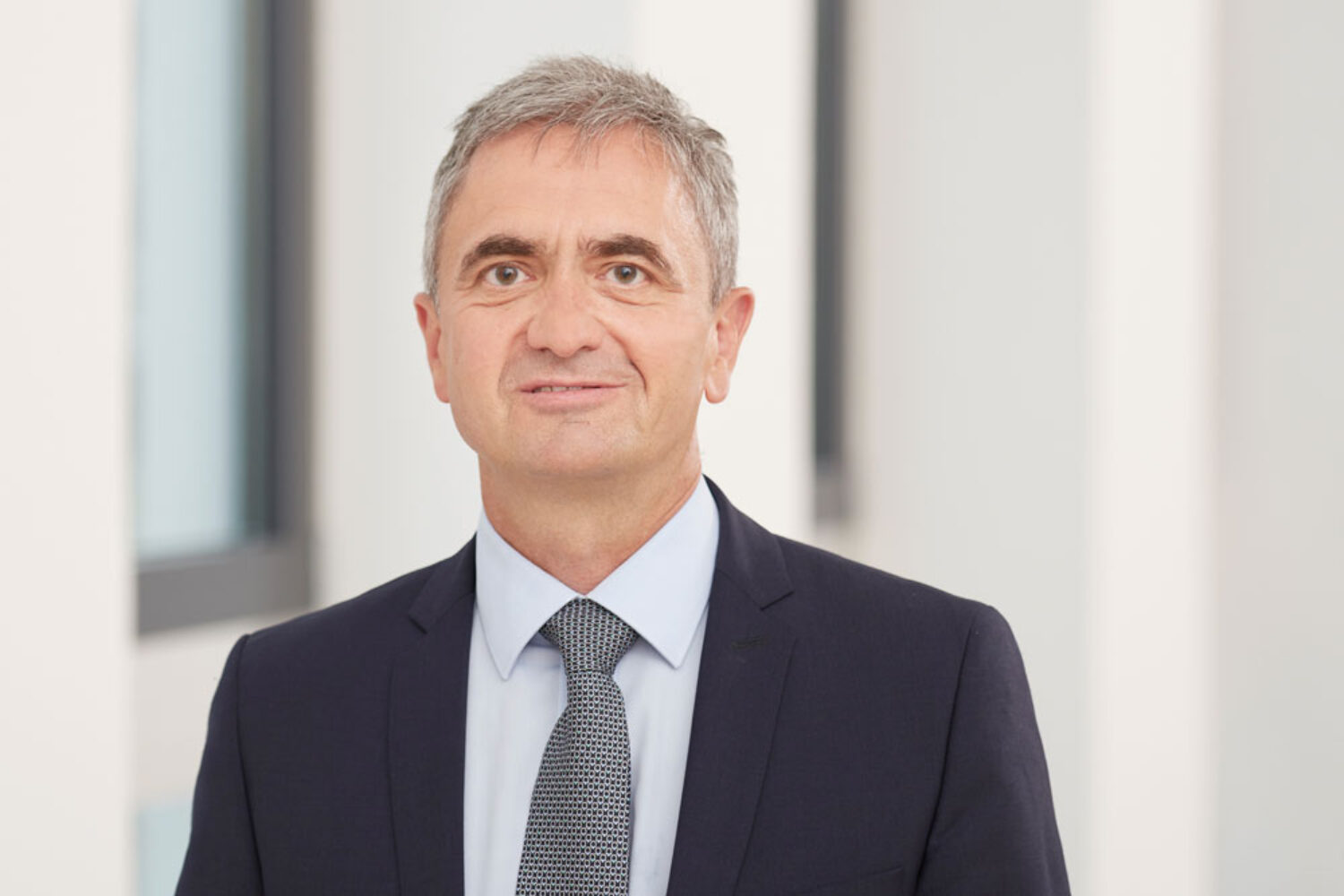
The technologies required for climate-neutral shipping are available, yet their market ramp-up is stalling. Everllence CEO Uwe Lauber speaks about transformation, political hurdles and the need for technology-neutral, reliable framework conditions.
“Those who fail to move with the times will be moved by the times,” as the saying goes. One company that has embedded this maxim in its DNA is Everllence. The roots of the company – which operated under the name MAN Energy Solutions until mid-2025 – date back to the 18th century. For more than 260 years, Everllence has continuously adapted its portfolio to changing market requirements.
In its early days, the company manufactured frying pans and cannonballs. Printing presses and steam engines followed, later diesel engines and turbochargers. Today, Everllence is built on four pillars: two- and four-stroke engines, large-scale industrial heat pumps, carbon capture and storage (CCS) systems, and hydrogen technologies.
Since 2015, Uwe Lauber has overseen the company’s transformation as CEO. On the sidelines of the presentation of a new ammonia-fuelled two-stroke engine in Copenhagen, we spoke with the Everllence chief executive about decarbonisation, current projects and the so-called “show-stoppers” facing not only his company but the maritime industry as a whole.
When we last spoke at the end of 2021, you said your company – then still MAN Energy Solutions – was undergoing a transformation from a supplier of diesel engines to a provider of CO₂-neutral solutions. What share of your portfolio do sustainable energy solutions account for today?
Uwe Lauber: We have recently reviewed the figures. These new solutions now account for around 33% of our portfolio. This includes our methanol- and ammonia-ready dual-fuel engines in both the two-stroke and four-stroke segments, as well as auxiliary engines. It also includes heat pumps. We recently completed a project in Cologne-Niehl in Germany, where we installed a 150 MW heat pump. It can supply heat to around 200,000 households. I believe this is a flagship project in Germany.
Carbon capture and storage is also part of our CO₂-neutral portfolio. Thankfully, the government has now authorised CCS. The previous coalition intended to approve CCS before leaving office, but that did not happen. As a result, we lost another year.
Four years ago, we also discussed the “ElbBlue” project – a container feeder vessel converted from conventional LNG to synthetic LNG. What became of that project?
Lauber: The “ElbBlue” currently operates on fossil methane. With that project, we demonstrated that heavy fuel oil engines can be retrofitted to dual-fuel operation using natural gas – and that fossil natural gas can later be replaced by synthetic gas. For the engine itself, there is essentially no difference, as the chemical formula of methane and e-methane is identical. The concept was to move from heavy fuel oil to natural gas, achieving an immediate CO₂ reduction of around 20%, and then, in a second step, to gradually blend in synthetic gas – 10%, 20% or 50%, depending on availability – to move significantly closer to climate neutrality.
At the time, you described green hydrogen – as the basis for climate-neutral fuels – as “without alternative”, albeit requiring economies of scale. What is your assessment of the hydrogen ramp-up?
Lauber: It has simply not happened – neither globally nor in Europe. One reason is the complexity of approval procedures. Excessive bureaucracy is a deterrent. After the “ElbBlue” project, we even set up an internal team of four people whose sole task is to handle permitting procedures for our customers.
Another issue is the political approach of distributing subsidies too broadly. Instead of investing billions into numerous small electrolyser projects, we should have built large-scale plants in the triple-digit megawatt range – at least 100 MW, 500 MW or even up to one gigawatt. That would have enabled large-scale industrial production and driven down the price per kilogram of hydrogen. Instead, funds were diluted across many small projects, and the ramp-up failed to materialise.
In 2021, you advocated the use of conventional LNG as a bridging fuel until sufficient volumes of synthetic LNG, methanol and ammonia become available. Where do we stand today?
Lauber: What happened was a negative hype. LNG was demonised. In my view, the industry focused too much on its disadvantages instead of accepting it as a transition fuel and working to address its shortcomings.
Since the IMO postponed its Net Zero framework a few weeks ago, we have seen a reversal. Within just two or three weeks, many of our customers shifted back towards LNG. Previously, the focus was entirely on methanol. The cruise sector is the most striking example. Ships that were planned a year ago for methanol propulsion are now reverting to LNG. The world is changing rapidly, and we do not know where the journey will ultimately lead.
What would you advise shipowners planning vessels with an operational lifespan of 20 to 25 years?
Lauber: Always opt for dual-fuel capability. Flexibility is essential. You may know today’s trading route, but if you sell the vessel to an owner operating in a different region where a certain fuel is unavailable, you risk creating a stranded asset.
It also depends on the application. We are here today presenting our first ammonia-fuelled two-stroke engine. I do not see ammonia propulsion in the passenger shipping segment. But dual-fuel ammonia for large oceangoing vessels is certainly an option.
However, beyond the engine itself, infrastructure still needs to be developed – including bunkering and onboard handling procedures. LNG therefore remains an important bridging solution. LNG and ammonia tanks share similarities, meaning components can potentially be reused in a future retrofit. That provides flexibility. A vessel does not need to operate on ammonia from day one. But if owners intend to operate ships for 20, 25 or 30 years, they should already consider retrofit options in today’s design phase.
Another pathway towards decarbonisation is onboard carbon capture. What is your view?
Lauber: In our technology matrix, onboard CCS is in the “watch” category. I strongly advocate technological openness.
At present, capturing CO₂ from the exhaust stream of heavy fuel oil engines is not yet sufficiently mature. Research is ongoing, and we are involved as a partner in one project. So far, only 35–40% of CO₂ can be captured. The remaining 60% is still emitted. The efficiency does not yet justify the investment. Space requirements onboard and the question of CO₂ storage and discharge infrastructure in ports are additional challenges. We may see progress within the next decade. Until then, we are monitoring developments closely.
There is also increasing discussion about nuclear propulsion. Is that relevant for you?
Lauber: We are observing the field. At present, we see applications primarily in segments where commercial viability is not the main driver, such as naval vessels. While capital expenditure for nuclear propulsion is high, fuel costs are negligible and emissions are zero. I would not rule out that small modular reactors under development today could eventually find application in commercial shipping. But again, we are looking at a time horizon of at least a decade.
If we speak again in four or five years, where would you like to see Everllence and the maritime sector?
Lauber: I would like to open a newspaper and read a headline stating that the maritime industry has been a frontrunner in decarbonisation.
Deep-sea shipping consumes around 300 million tonnes of fuel annually. If 80% were replaced by green fuels, shipping would make a substantial contribution and significantly support the ramp-up of sustainable fuel production. Other industries, such as aviation, would also benefit.
I am convinced that synthetic climate-neutral fuels can become economically viable in both sectors once production is scaled up. The increased fuel costs per transported product – whether a car or a pair of sneakers – would be minimal. The same applies to aviation: a ticket price increase of, for example, €10 is manageable.
However, scaling requires secure demand at large volumes to justify investment in large-scale hydrogen and e-fuel production facilities.
But probably not in Germany?
Lauber: Perhaps not primarily in Germany, but within Europe there are suitable regions – Sardinia, Spain, Portugal with abundant solar energy, or northern regions with strong wind resources.
Here in Denmark, in Esbjerg, we installed the world’s largest seawater-based heat pump in 2024 after a coal-fired power plant was decommissioned. It uses electricity from a nearby offshore wind farm to supply renewable district heating.
When the wind farm generates surplus power, the heat pump stores it as heat in large-scale storage tanks, heating water to 100°C. The system functions like an oversized thermos flask, storing heat for up to a week. It acts as a regulatory instrument, balancing fluctuating renewable energy supply and supporting the energy transition.
In summary: the technologies and business cases exist. Why are we not moving faster?
Lauber: The interaction between technology, industry and policy must be better understood – and it is the industry’s task to communicate this. We engage regularly with policymakers and place high hopes in the current government.
But change requires persistence.
Lauber: What is the alternative – to do nothing? Instead of sitting around and complaining, I prefer to travel to Berlin regularly to make our case. I am confident that things will change. We stay on the ball and do not give up.
Interview by Anna Wroblewski