


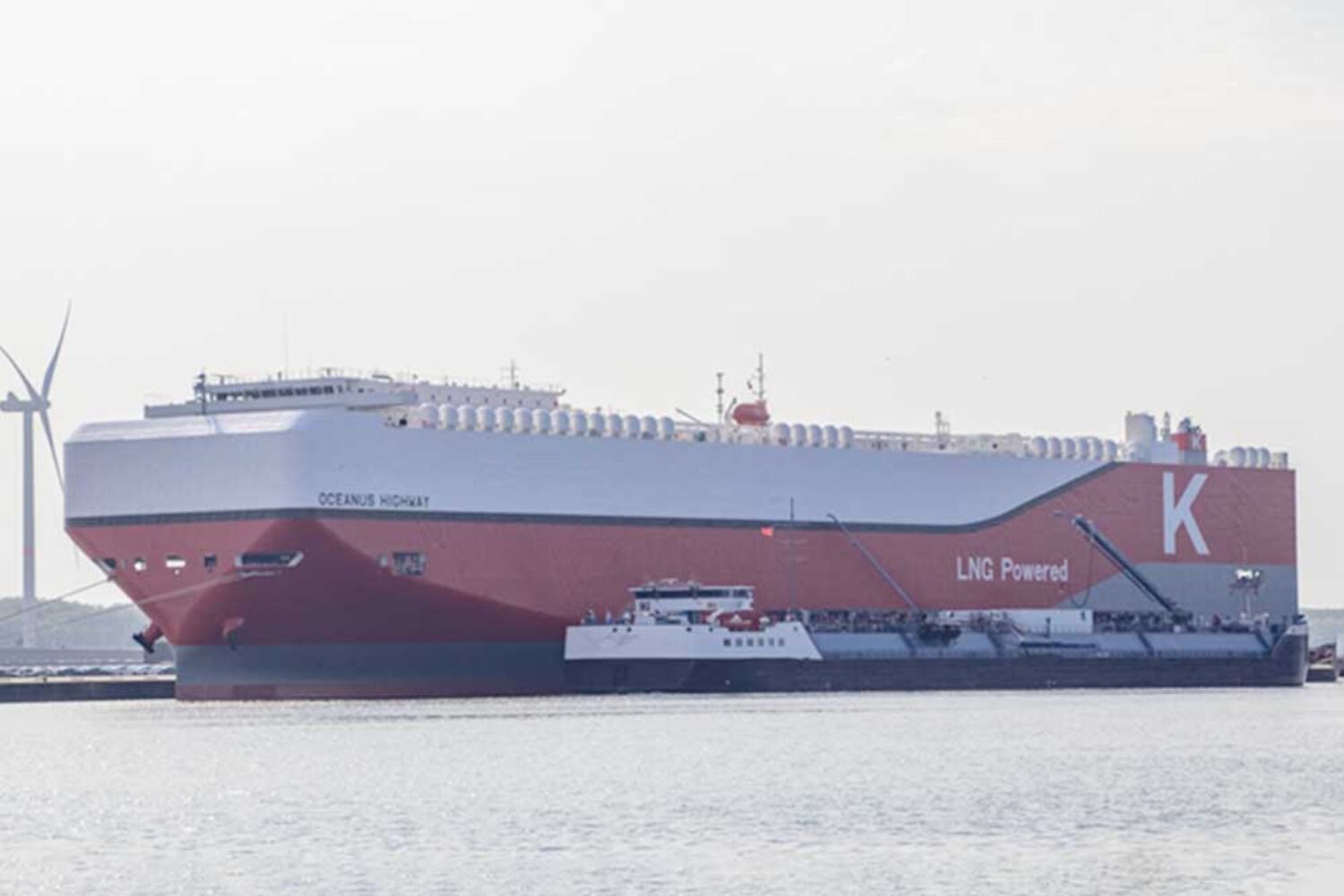
The Japanese shipping company K Line is pushing ahead with the decarbonization of its fleet. In order to operate its car carriers with as few emissions as possible, it is now relying on CO₂-neutral bio-LNG fuel.
Kawasaki Kisen Kaisha (K Line) has now signed an agreement for the long-term procurement of CO₂-neutral bio-LNG fuel (liquefied biomethane, LBM). The fuel is intended for car transporters already powered by LNG. The agreement is expected to reduce greenhouse gas (GHG) emissions by around 60,800 tons annually.
Bio-LNG is produced from animal excrement, food waste and other organic waste. Over its entire life cycle – from production to use – the fuel demonstrably causes lower emissions than conventional energy sources, according to K Line. In addition, bio-LNG can be used in existing LNG-powered ships without any modifications. The shipping company is therefore planning to use the fuel in its existing LNG fleet of car carriers.
The bio-LNG currently used is ISCC-EU certified and therefore meets the sustainability requirements of the EU Renewable Energy Directive (RED). By using internationally certified fuels, K Line wants to contribute to the decarbonization of the entire supply chain together with cargo owners and other partners.
As part of its “K Line Environmental Vision 2050 – Blue Seas for the Future”, the company has set itself the goal of achieving net-zero emissions by 2050. In this context, the shipping company is driving forward the introduction and operation of LNG-powered ships. The continuous use of bio-LNG is a key measure here.