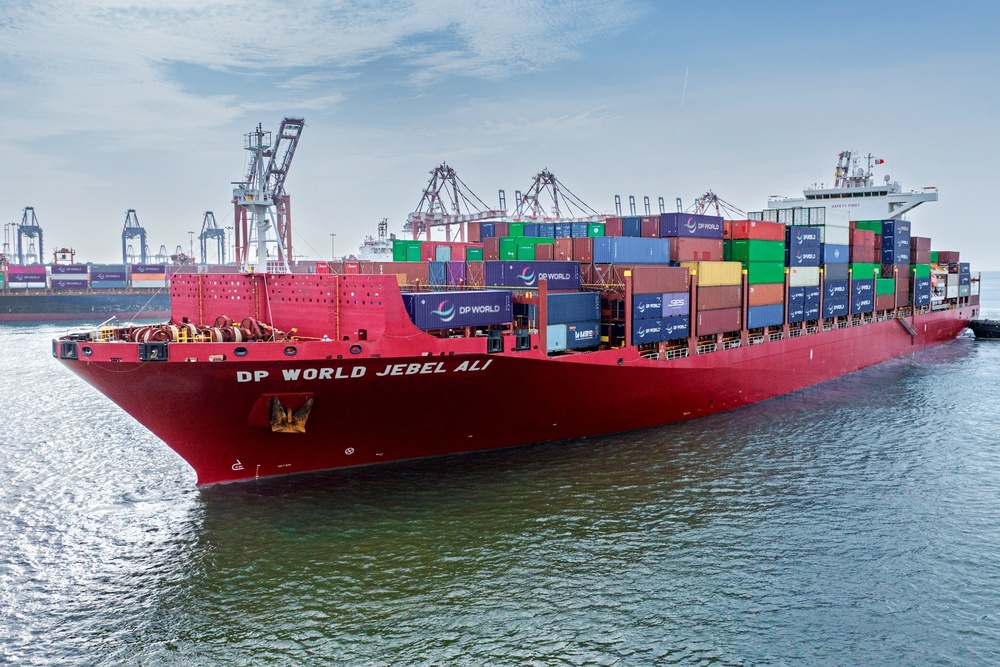




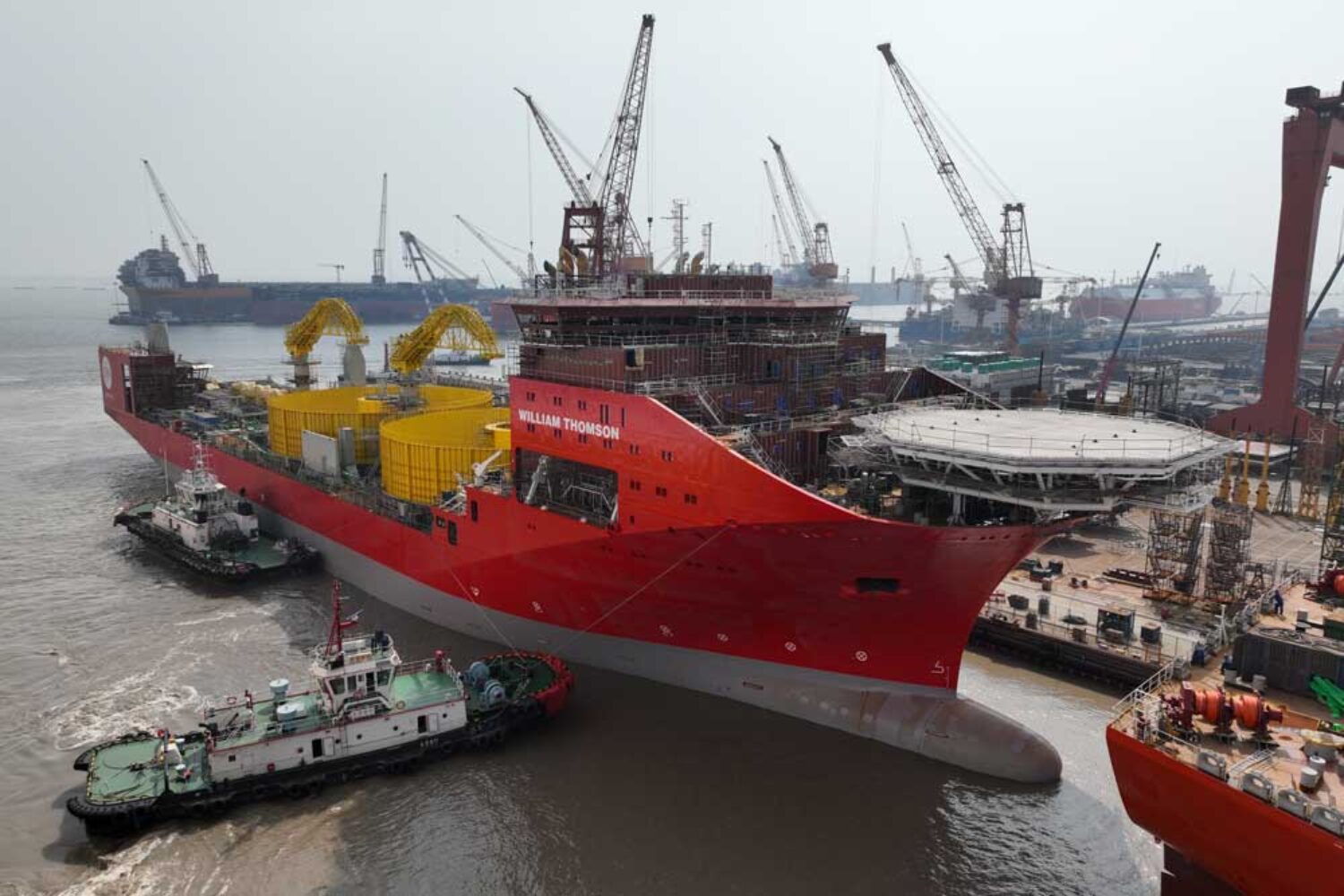
A new cable-laying vessel for Jan De Nul has been launched at the Chinese shipyard CMHI Haimen. The “William Thomson” is one of two identical ships currently under construction.
Like the “Fleeming Jenkin”, the “William Thomson” also has a length of 215 m and a loading capacity of 28,000 tons. Both ships were specially built to lay cables in both shallow and ultra-deep waters of up to 4,000 m.
Thanks to their large loading capacity, they can take longer cables on board in one piece and bridge greater distances with as few underwater connections as possible. Compared to other cable-laying vessels on the market, they therefore also have to return less frequently to reload, says Jan De Nul. This lowers costs, reduces the ecological footprint and also improves cable quality.
Developed entirely in-house
The sister ship “Fleeming Jenkin” was launched in October 2025 and is scheduled for delivery in the fourth quarter of 2026. The “William Thomson” will follow shortly after and is scheduled to go into operation in the first half of 2027. Both vessels and the technologies on board have been developed by Jan De Nul’s in-house experts.
As soon as they are operational, the “Fleeming Jenkin” and the “William Thomson” will be able to start their first projects immediately.
Their first order is the 2 GW program from TenneT, the grid operator for the Netherlands and large parts of Germany. This program introduces a new generation of grid connections for offshore wind farms, each of which can transmit up to two gigawatts. This is more than double the current standard capacity of 700 to 900 MW, according to the offshore company, drawing a comparison with an average nuclear power plant, which usually generates between 1 and 1.6 gigawatts.
As part of this program, the “Fleeming Jenkin” and the “William Thomson” will lay more than 2,800 km of 525 kV DC cables for four different grid connections.
Three cables for the “Princess Elisabeth Island”
In 2028, Jan De Nul will also use one of these new cable-laying vessels to lay three 220 kV DC cables connecting Princess Elisabeth Island to the mainland. This energy island, which Jan De Nul is building in a joint venture for grid operator Elia, bundles the cables from Belgium’s second offshore wind zone (Princess Elisabeth Zone) and enables the North Sea coastal states to be more closely networked.
Five more ships in the pipeline
According to Jan De Nul, it is investing heavily in expanding its submarine cable capacities. In addition to the two cable-laying vessels, three more ships will be added to protect the cables: two trenching support vessels to bury the cables in the seabed and a rockfill vessel to secure the cables with a protective layer of rock.
This brings the total number of vessels under construction for the installation and protection of submarine cables to five.