



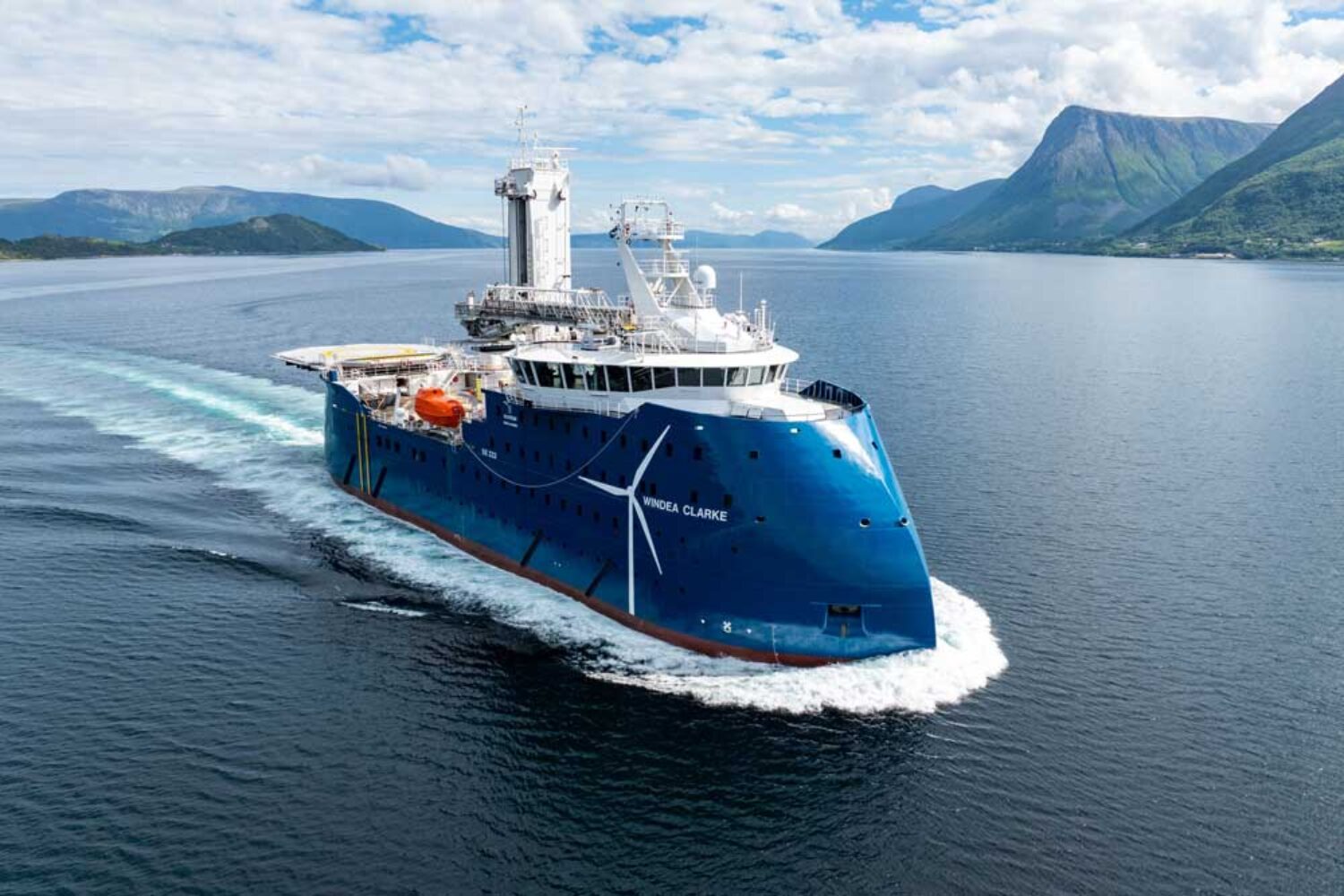
The quartet is complete: with the delivery of the “Windea Clarke”, Bernhard Schulte Offshore (BSO) has taken delivery of the final vessel in its series of newly built CSOVs. The vessel will initially be deployed in the British North Sea.
With the fourth and final Commissioning Service Operation Vessel (CSOV) built at the Ulstein shipyard in Norway, BSO says it has reached an “important milestone” in the expansion of its fleet. The vessel will now be deployed seasonally for an offshore wind project off the coast of Great Britain.
With these four new vessels, BSO’s existing offshore fleet now comprises seven modern vessels. The “Windea Carnot” was most recently delivered in March 2026; other sister vessels include the “Windea Curie” and the “Windea Clausius”.
“With the ‘Windea Clarke’, we are completing a strategically important series of vessels,” said BSO Managing Director Matthias Müller. “It strengthens our ability to support offshore projects with reliable tonnage whilst significantly reducing our environmental footprint. It enables us to offer the global offshore energy sector efficient and scalable services for the construction, commissioning and maintenance phases.”
In Norway, too, the delivery is regarded as a “milestone”. “The continued trust in Ulstein reflects our shared commitment to tackling the challenges of the seas and pushing the boundaries of offshore vessel design,” said Gunvor Ulstein, CEO of the Ulstein Group.
Adapted for use in wind farms
Like its sister vessels, the “Windea Clarke” was specifically designed to meet the evolving requirements of the offshore energy sector. Based on Ulstein’s advanced ship design, the vessel combines high operational performance, energy efficiency and “outstanding” seakeeping characteristics.
Ulstein has incorporated its tried-and-tested “Twin X-Stern” solution, which is designed to improve manoeuvrability, reduce ship motion and enhance fuel efficiency – “all of which are crucial factors for safe and sustainable offshore operations”, BSO stated. Combined with a hybrid battery propulsion system and a design tailored for the future use of methanol, the vessel series is optimised for low-emission operation.
According to BSO and Ulstein, a distinctive feature of the “Windea Clarke” is the DNV classification note “Silent-E”. This confirms that the vessel complies with defined limits for underwater noise emissions in order to protect marine life. Through noise-reduction measures – such as an optimised propeller design, vibration control and a holistic ship design focused on noise reduction – the “Windea Clarke” has been engineered to minimise its “acoustic footprint”.
The “Windea Clarke” offers offshore personnel comfortable accommodation in single cabins and is equipped with a centrally located, height-adjustable “walk-to-work” gangway and a lift tower to ensure the safe transfer of personnel and materials. A 3D motion-compensated crane supports cargo handling operations at sea, whilst generous storage areas and barrier-free workflows enhance operational efficiency. The vessel features a height-adjustable mooring system that facilitates easy transfer between the CSOV and smaller crew transfer vessels (CTVs) – a key safety consideration when operating in offshore wind farms. It is also equipped with a helicopter deck, which allows for flexible deployment of technicians and crew changes.
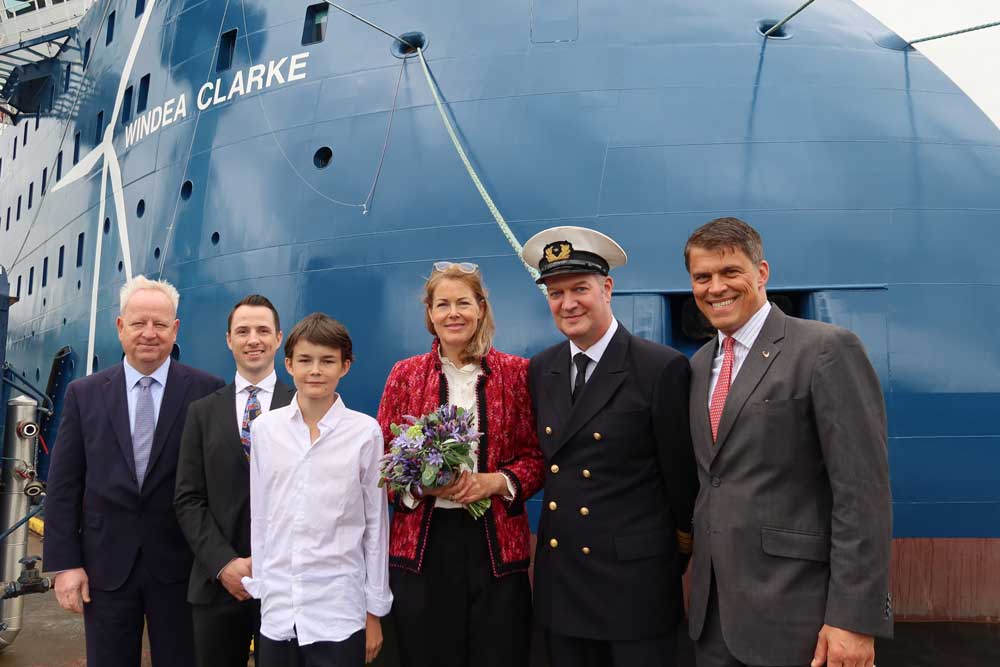
The new vessel continues the naming tradition of the new-build series, which honours pioneering scientists. The “Windea Clarke” is named after Edith Clarke, a trailblazing electrical engineer whose work has made a lasting contribution to modern energy technology.
“With the completion of this series of four vessels, BSO is consolidating its role as a reliable partner to the offshore energy sector and offering modern, versatile vessels that meet the growing scale and increasing complexity of offshore projects,” the shipping company concluded.