


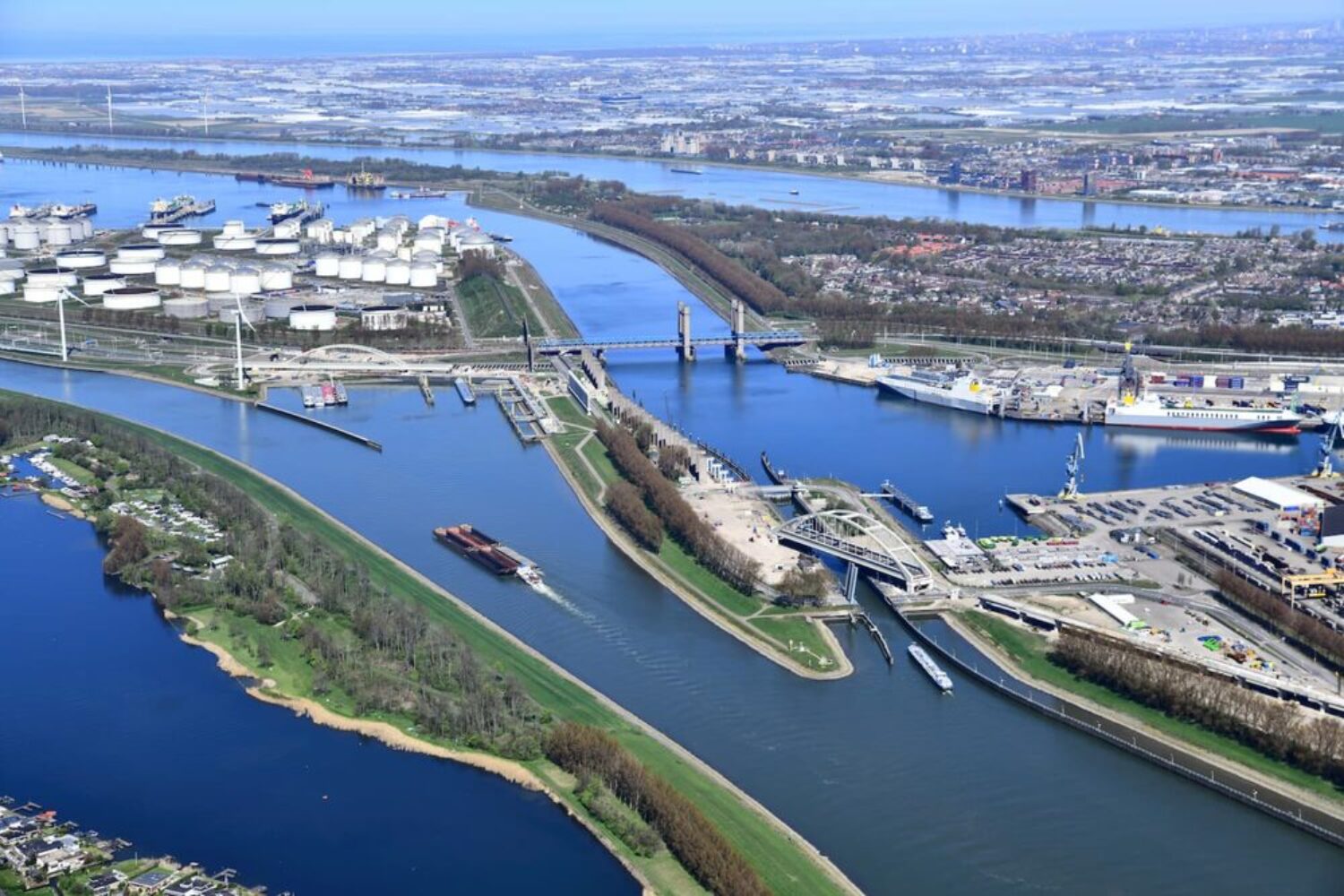
The Port of Rotterdam Authority has published a new climate transition plan. In it, the port authority describes its integrated concept for reducing greenhouse gas emissions in the entire port area.
The plan relates to the port authority’s own organization as well as to the companies based in the port area and shipping, although their emissions are only partially within the port authority’s direct sphere of influence.
In the foreword, CEO Boudewijn Siemons makes it clear that the Port Authority considers climate protection to be an imperative social task. The Port of Rotterdam Authority believes it has a responsibility to actively contribute to reducing emissions. At the same time, the Dutch port manager openly identifies the existing challenges: According to the environmental planning office, it is very unlikely that the Netherlands will achieve its climate target of reducing emissions by 55% by 2030 compared to 1990. The plan cites high grid costs, grid bottlenecks, the nitrogen problem, long approval procedures and political uncertainties as obstacles. At the same time, the port authority points to positive developments, including new hydrogen projects on the Maasvlakte and the planned expansion of shore-side power supply for seagoing vessels.
Meanwhile, the port authority is strategically pursuing the goal of developing the port area into a climate-neutral port by 2050. The transformation process is also intended to support the shift towards a circular industrial and energy economy. According to the position paper, the guiding principle is to connect global trade and at the same time shape the sustainable port of the future.
Four central fields of action
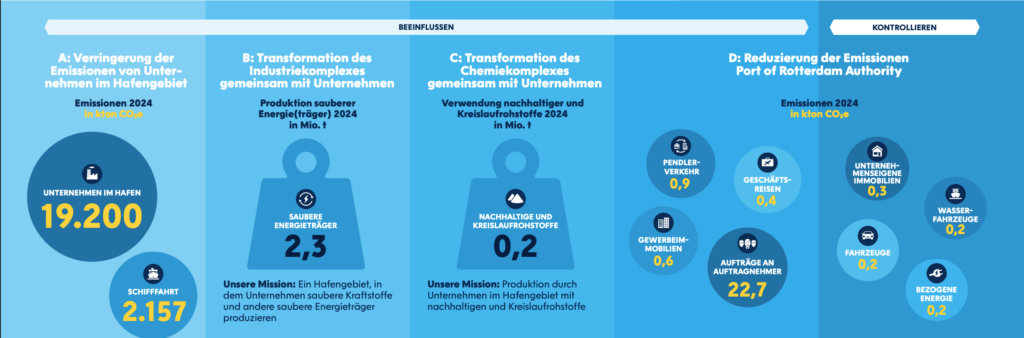
The climate transition plan is divided into four central fields of action. The focus is firstly on reducing the emissions of companies in the port area, secondly on transforming the industrial cluster towards the production of clean energy sources such as hydrogen and alternative fuels, thirdly on transforming the chemical complex with a greater use of sustainable and circular raw materials and fourthly on reducing the emissions of the Port of Rotterdam Authority itself.
In its role, the Port Authority sees itself as an enabler of transformation. Its tasks include safe and efficient port operations, expanding and maintaining infrastructure, setting framework conditions and incentives, promoting cooperation along the value chains and investing in selected transformation projects.
Shipping to reduce emissions by 20% between 2019 and 2030
The plan defines specific targets for the year 2030. Emissions from companies in the port are to be reduced by 55% compared to 1990, while a reduction of 20% compared to 2019 is planned for shipping. In addition, the production of clean energy sources is to reach more than 20 % of fossil fuel production in 2019, as is the share of sustainable and circular raw materials in fossil fuel use to date. For its own organization, the port authority plans to significantly reduce emissions from commuter traffic, business travel, its own fleet and from construction and service contracts, among other things.
Overall, the climate transition plan is intended as a strategic orientation framework that bundles existing targets and measures up to 2030 and provides an outlook up to 2050. At the same time, the document makes transparent in which areas the Port of Rotterdam Authority can directly control emission reductions and where it is dependent on cooperation and external framework conditions.
The Port of Rotterdam Authority’s detailed climate transition plan is available here.
(© Port of Rotterdam Authority)