

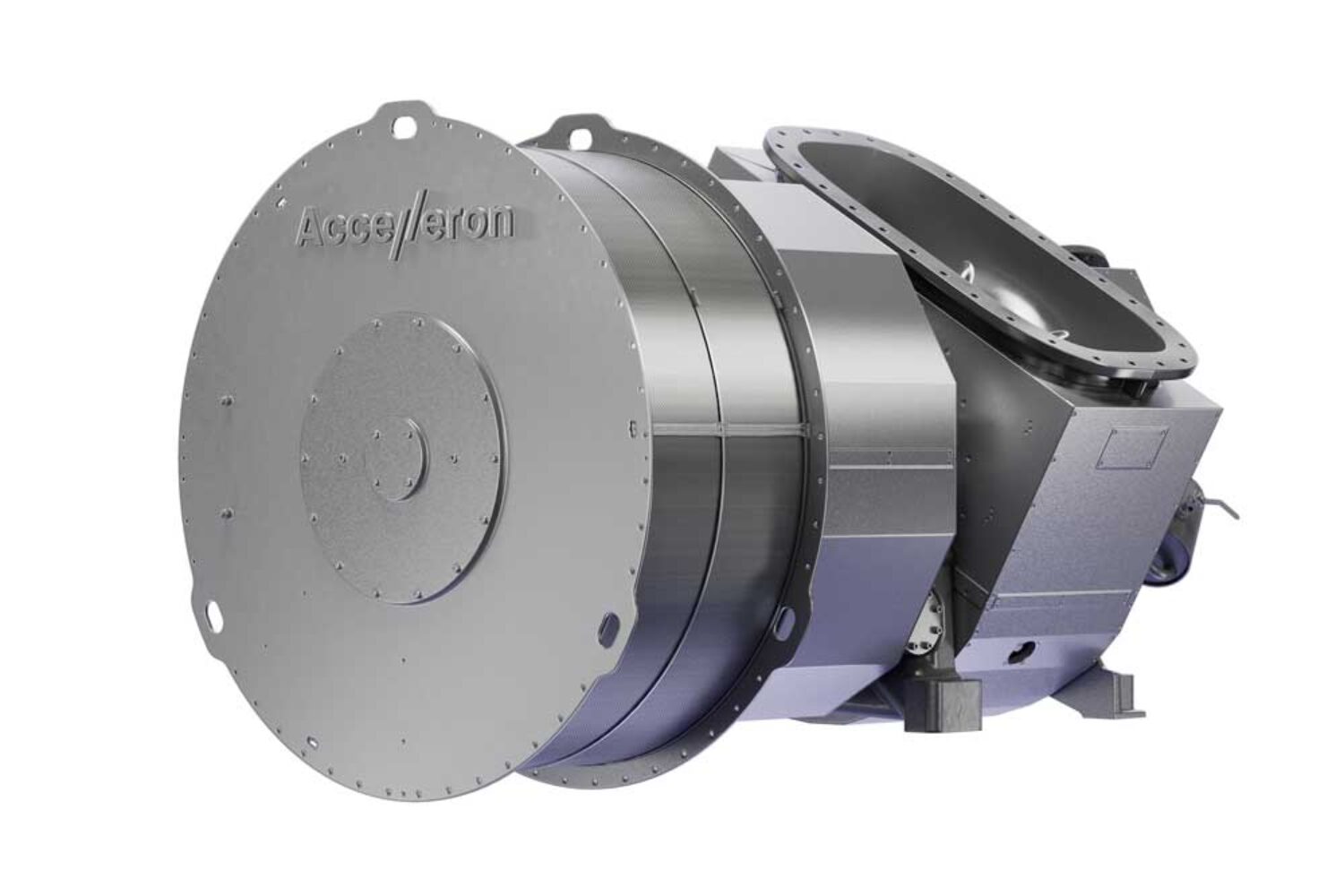
The Swiss manufacturer Accelleron has launched the ACCX300-L, a new turbocharger for low-speed two-stroke engines.
The system is designed to help shipping companies adapt to changing operating profiles, new fuels and stricter emission requirements. With a new maintenance-friendly cartridge concept, a simplified platform architecture and integrated digital functions, the ACCX300-L is no longer dependent on a visit to the shipyard for maintenance work. This makes the turbocharger flexible to handle.
Unpredictable operating environment
According to Accelleron, the ACCX300-L was developed in response to an increasingly unpredictable operating environment in which mission profiles, emissions targets, fuel paths and trade routes are constantly changing.
Rather than focusing purely on incremental performance improvements, Accelleron takes a more holistic approach and sees turbocharging as a durable platform that combines new technologies with a modified service model, simplified design and integrated data functions. The aim is to enable operators to adapt to changing conditions without compromising efficiency, reliability or service continuity.
New cartridge concept
A central element of the ACCX300-L is a newly developed cartridge concept that is intended to fundamentally change the maintenance of turbochargers. By replacing the entire rotating assembly during a stay in port, major maintenance events no longer have to be linked to shipyard visits.
This means that maintenance can be more closely aligned with actual operating conditions instead of fixed overhaul intervals. This reduces dependence on off-hire times and gives operators more control over planning, costs and availability.
Over a typical ship lifetime of 25 years, this approach reduces the number of planned service visits from four to three and at the same time enables the full utilization of the component service life. This should enable more predictable maintenance, lower lifecycle costs and fewer operational disruptions.
Simplified platform architecture
This service-oriented design is supported by a simplified platform architecture, including a reduction in sizes from five to two. This standardization simplifies spare parts logistics and reduces storage requirements in mixed fleets.
At the same time, it allows flexible configurations across different performance ranges, including single and twin versions with combinations of the two sizes. This means that the same platform can be used for different ship and engine requirements and also offers upgrade options over the life cycle of a ship.
Optimized efficiency

According to Accelleron, the twin configuration with automatic switch-on and switch-off function for turbochargers improves efficiency, particularly during slow steaming. If the engine load falls below a defined threshold value, one turbocharger is deactivated so that the remaining unit can operate closer to its optimum efficiency range. This avoids an increase in specific fuel consumption at low loads, which should reduce both costs and emissions over the annual operating hours, while maximizing the service life per unit.
Connectivity is an integral part of the ACCX300-L and is designed to enable the transition from periodic, manual reporting to continuous data-based decision making. Using signals already available on-board, such as RPM, temperature and speed, Accelleron’s Turbo Insights feature provides insights into turbocharger health and performance.
This should enable more accurate diagnostics, more informed maintenance decisions and optimal use of component life. In combination with service contracts such as “Turbo MarineCare”, maintenance planning and cost control should also become easier to calculate.
Christoph Rofka, President of Accelleron’s Medium and Low Speed Division, says: “The ACCX300-L is far more than an evolutionary development – it is a rethought turbocharging concept that is geared to the operational realities of shipping companies and operators. By combining next-generation turbocharger technology, improved maintainability, data connectivity and simplified platform design, we give our customers more control over how they configure, maintain and optimize their assets over the long term. This enables more flexible and efficient operations. In a volatile market environment, this adaptability is becoming as important as pure performance.”
According to Accelleron, the ACCX300-L has successfully passed all qualification tests since its initial launch in 2023 and is now commercially available.
If you would like to learn more about Accelleron and the company’s latest developments, tune in to the HANSA.newscast:
#69 Accelleron CEO Daniel Bischofberger on Turbochargers, Flexibility and the Fuel Bottleneck