


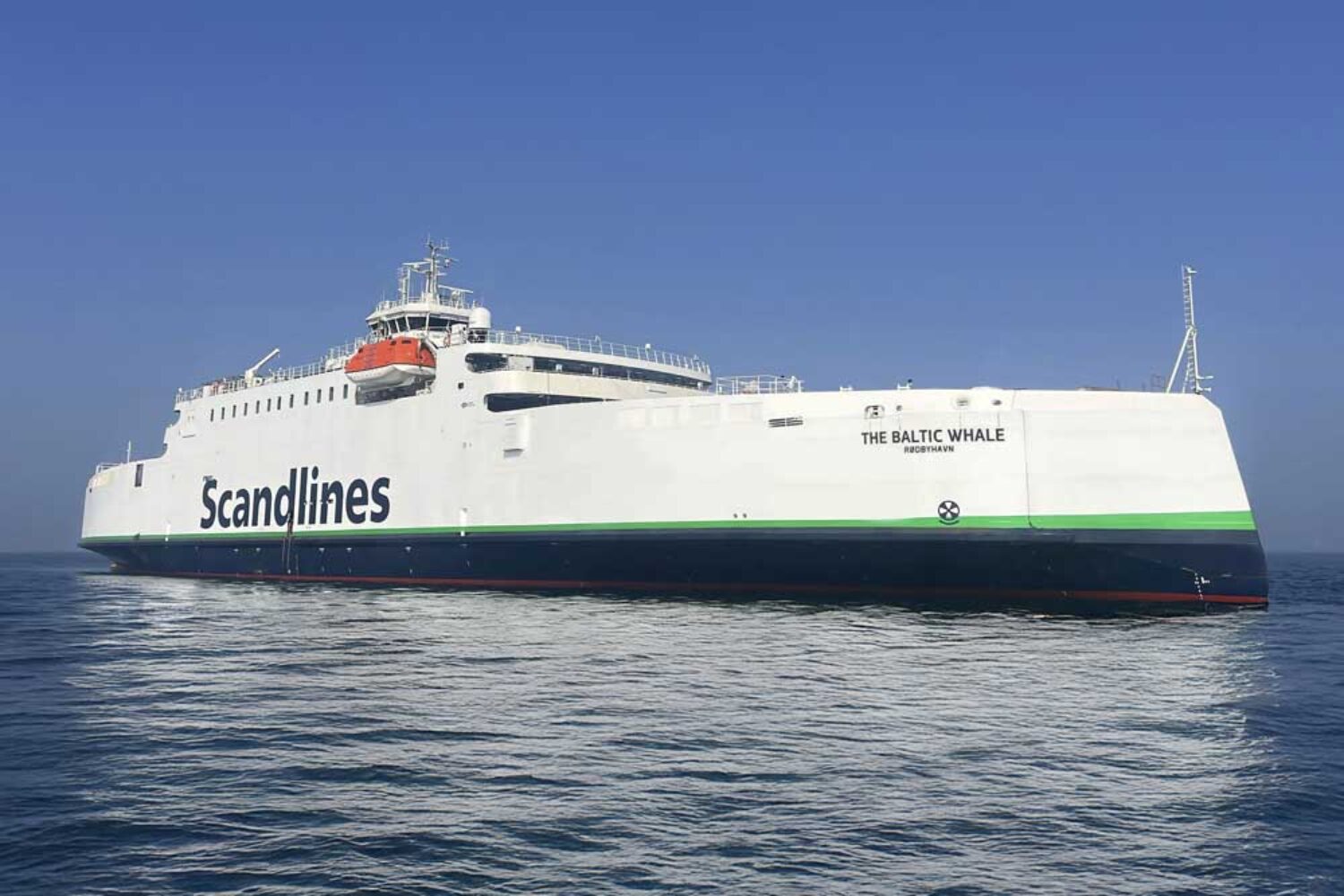
The Scandlines shipping company is deploying the new ferry “The Baltic Whale” between Germany and Denmark from today. It is one of the largest ferries in the world that can run entirely on shore-power.
“The Baltic Whale” is used on the Rødby-Puttgarden route. The freight ferry has space for a total of 66 trucks and 140 passengers. Today’s maiden voyage from Denmark to Germany, with Scandlines representatives and freight customers on board, was preceded by a visit to the shipyard, sea trials and the christening of the ship.
The ferry is one of the largest in the world that can be operated exclusively with charging current from land. “It marks an important milestone in the shipping company’s long-term vision of ensuring ferry operations with zero direct emissions by 2040, while at the same time increasing capacity for freight customers,” Scandlines announced.
The ship is equipped with battery systems that can be recharged within a few minutes. “The Baltic Whale” can cover the route in regular operation without direct emissions. In addition, the ship’s noise emissions are also lower than those of comparable ferries, which protects the marine environment – including the porpoise living in the Baltic Sea, after which the ferry is named.
“The commissioning of “The Baltic Whale” on the Fehmarnbelt is a milestone for Scandlines – a day we have been waiting many years for,” said Michael Guldmann Petersen, COO of Scandlines. “We had the idea of a battery-powered ferry back in 2018, and now it’s here. This is a great success and something we have been looking forward to.”
“The Baltic Whale” was designed as a pure cargo ferry. The capacity of 1,200 loading meters is spread over two decks. Dangerous goods – including industrial products, batteries, cosmetics and car parts – can be transported efficiently and predictably. This should allow more freight to be shifted to this ferry, creating additional capacity for cars and passengers on the other Scandlines ferries, especially during the peak season.
Charging time of 12 minutes
“The new ferry is an important component of Scandlines’ green ambition to ensure ferry operations without direct emissions by 2040,” says Petersen. “At the same time, it is designed to deliver what our customers expect from us every day: stability and operational safety.”
According to Scandlines, the commissioning of the new ferry will increase the transport capacity for freight units on the Rødby-Puttgarden route by 27%. At the same time, freight customers will enjoy even better conditions on board, as several types of cargo can be handled on the same crossing. The frequency is to be “significantly” increased, especially for hazardous goods. “This makes our route even more attractive as a freight connection between Northern Europe and the rest of Europe,” Petersen concluded.
“The Baltic Whale” completes the 18.5 km crossing in around 45 minutes. Scandlines has invested in modern charging infrastructure in the ports so that the charging time for a crossing should be just 12 minutes. An intelligent charging station ensures that the ferry is automatically switched on in less than 15 seconds, regardless of water levels and movements. The ship also has the option of hybrid operation and is equipped with diesel generators that can be used if necessary.
“Other shipping companies must follow suit”
The German Nature and Biodiversity Conservation Union (NABU), with which Scandlines has been working for several years, has accompanied the company on its way to emission-free ferry operations. “The maiden voyage of ‘The Baltic Whale’ is an important milestone for climate protection in shipping,” said NABU President Jörg-Andreas Krüger. “It shows that emission-free propulsion systems are already feasible on demanding ferry routes. This project is a strong example of how entrepreneurial courage, technological innovation and climate protection can go hand in hand. It proves that electrification at sea is no longer a promise for the future, but a reality. Lighthouse projects like this are crucial for creating trust in new technologies and getting entire industries moving.”
The battery-powered ferry also sends a signal to politicians. “Other shipping companies must follow this example,” said NABU shipping expert Sönke Diesener. “In the long term, every ferry in Germany should be electrically powered. Most ferry routes in this country are significantly shorter than the Puttgarden-Rødby route. Technically, there are hardly any excuses. Apart from a few connections as far as Finland or the Baltic States, all connections can be battery-electric.”
Electrification offers great potential on inland waterways or short sea routes such as between Puttgarden and Rødby. The solution combines rapid climate protection with clean air and less noise. According to NABU, a “targeted electric offensive” for ferries in Germany could have a rapid impact – provided that policy and funding instruments follow suit.
“The Baltic Whale”
- Length: 147.4 m
- Width: 25.4 m
- Construction draught: 5.30 m
- Loading capacity: 66 cargo units (1,200 loading meters)
- Maximum number of passengers: 140
- Service speed: 16/10 knots
- Crossing time: 45 minutes
- Battery system: 10 MWh
- Charging in port: 12 to 18 minutes
- Project investment: € 84 million