



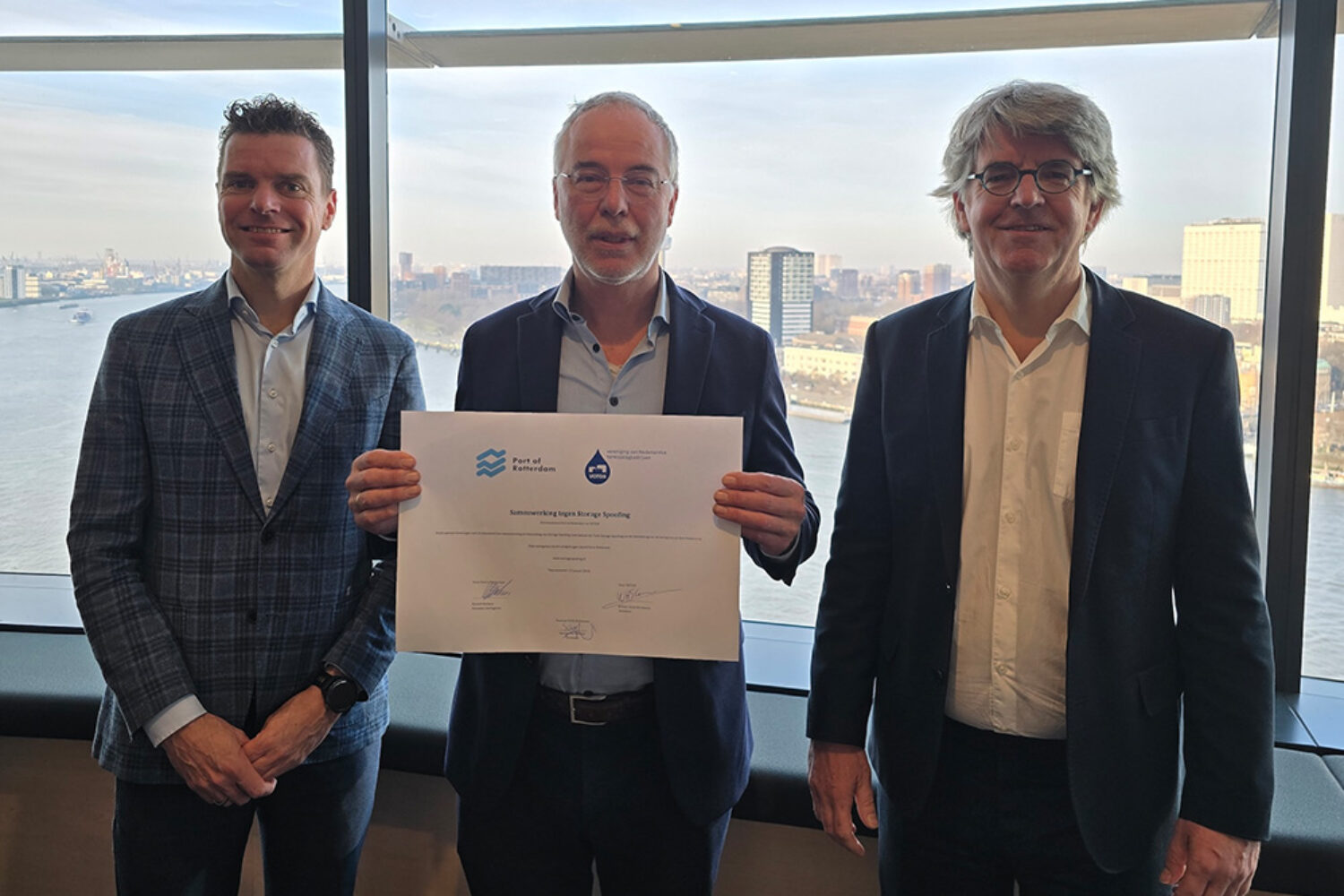
Together against spoofing: Europe’s largest seaport, Rotterdam, wants to take stronger action against internet fraud involving tank storage infrastructure and is joining forces with an industry association to do so. The police are also on board.
The port authority and Votob, the association of Dutch tank storage companies, have signed a cooperation agreement to this end. The initial aim is to set up a working group to continue and expand the fight against storage spoofing fraud. With this step, the two parties want to “send a clear signal to international fraudsters who target the port of Rotterdam and other seaports with this persistent form of fraud”. The organization TCT (The Commodity Traders) and the Port Police are also part of the working group.
Storage spoofing or tank storage spoofing is the collective term coined in Rotterdam for all forms of selling non-existent storage capacity and stocks of raw materials and materials in terminals – especially in the Rotterdam port area. In this form of internet fraud, criminals offer their business via fake websites that imitate well-known tank storage companies. Victims include international traders, who are deceived and lose considerable sums of money to non-existent businesses, and legitimate companies in the port area, whose names and data are misused. In some cases, tanker trucks even appear on site to pick up products that do not exist.
The annual loss for traders is estimated to be at least €10 million, as a lower limit based on the known amounts actually paid. In 2025, offers with a total volume of € 2.5 billion were reported to the working group. In addition, there is considerable damage for companies whose names and data are misused, as well as damage to the image of ports as a whole.
“Several of our members have been affected by this for years,” said Votob Director Willem-Henk Streekstra. “It is good to actively tackle this issue together with the Port Authority and other partners. Together we can achieve more than individually. It remains extremely annoying when your own company name is misused and people lose a lot of money.”
The first examples of this type of fraud date back around 15 years. Around ten years ago, the number of incidents began to increase, which is why a working group was set up in 2017 under the umbrella of the then Ferm Rotterdam. Among other things, an awareness campaign was launched, which laid the foundation for the current working group. The blacklist of fraudulent websites now includes more than 1,250 domains and is constantly being expanded.
The working group – consisting of Ferm, the Port of Rotterdam Authority, the Seaport Police and several VOTOB members – entered into a collaboration with the Foundation Internet Domain Registration Netherlands (SIDN) in 2020 and with The Commodity Traders in 2024. SIDN assists in taking fraudulent websites offline with a .nl domain. TCT supports the working group in due diligence to check the reliability of transactions and documents offered and to determine which websites belong on the blacklist. Fraud cases are prevented on a daily basis.
The working group was previously accessible under the Ferm Foundation at the domain ferm-rotterdam.nl/storage-spoofing and has now moved with immediate effect to www.storagespoofing.nl – a platform of the Port of Rotterdam Authority of VOTOB, TCT and the Seaport Police. On the part of VOTOB, several terminals in the port of Rotterdam are also participating in the working group.
“Ferm Zeehavens is a nationwide platform for the cyber resilience and resilience of seaports of national importance,” says Marijn van Schoote, Director of Ferm Zeehavens. “Storage spoofing is a form of digitized crime that affects the economy and the integrity of ports as much as the people who work there. That is why it is important that this new collaboration ensures lasting attention in the fight against this form of fraud. We are very pleased that the Port of Rotterdam Authority and VOTOB recognize this urgency.”
The main means used by fraudsters are fake websites, emails and other forms of digital contact based on trust, as well as manipulated documents. A lot of information about (spoofed) companies is freely available via websites, trade registers, Google Maps, etc. and can be easily copied. This has resulted in an unmanageable number of dubious websites that are increasingly difficult to distinguish from genuine ones. The working group is actively committed to tracking down these websites, blacklisting them and taking them offline.