



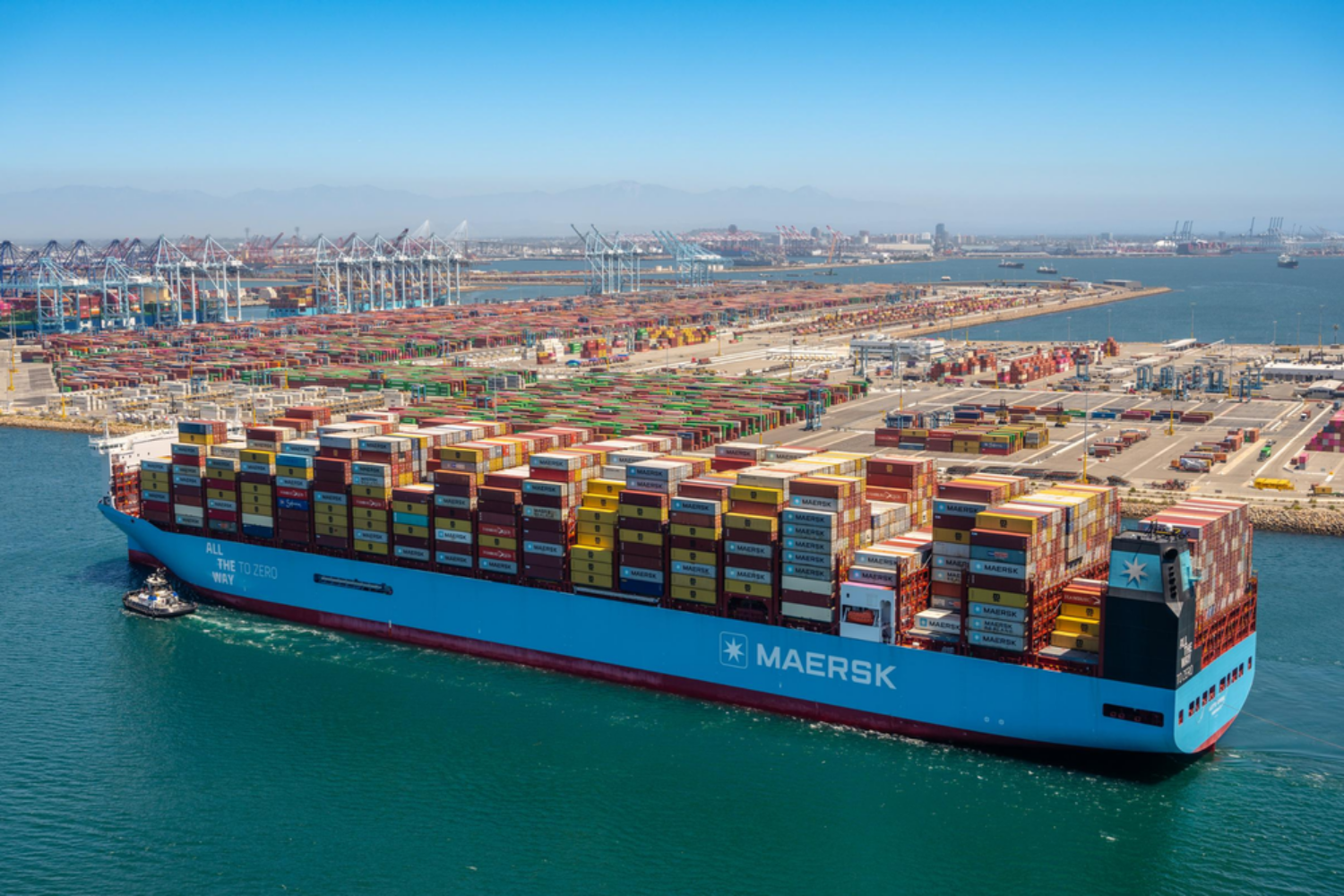
The Danish logistics giant Maersk has closed the third quarter with strong growth, largely driven by maritime trade. The group now expects significantly higher profits for the year than previously forecast.
The A.P. Møller-Maersk Group increased its turnover in the last quarter. The company stated that, despite tense geopolitical conditions and the resulting disruptions to supply chains, trade flows had remained robust. Market conditions were favourable: Maersk recorded a 27 per cent year-on-year increase in revenue to a total of $18.1 billion. EBITDA rose from $2.7 billion to $4.7 billion, whilst EBIT increased from $1.3 billion to $3.3 billion. The EBIT margin thus reached 18.1 per cent.
Accordingly, the company has raised its full-year forecast: expected EBITDA is now between $14bn and $14.5bn (previously $10.5bn to $12.5bn). Maersk expects EBIT to be between $8bn and $8.5bn (previously $4.5bn to $6.5bn).
The Ocean business segment, which covers maritime trade, benefited particularly. Here, EBIT rose almost fivefold from $567 million to $2.6 billion. Although adverse weather conditions in Asia restricted capacity and shipments, Maersk reported that transport volumes remained high; vessel utilisation remained at 96 per cent. The ongoing closure of the Strait of Hormuz and widespread congestion across the network increased costs for bunkering, network operations and container handling, and affected schedule reliability.
The Logistics & Services business segment also increased its revenue by 13% and improved its EBIT margin to 5.8%. In the Terminals business segment, the company even achieved record revenue: volumes rose by 2.6 per cent, supported by growth in Africa and Europe of 14 per cent and 6.7 per cent respectively. Capacity utilisation stood at 85% (previous year: 90%). Adjusted for an impairment charge recognised in 2025 in connection with a concession extension, the EBIT margin rose by 0.5 percentage points from 32 to 32.5%.
“Our fleet was operating at full capacity”
“We delivered a strong quarter across all business segments,” said CEO Vincent Clerk. “Despite ongoing geopolitical uncertainty and disruptions, global trade has proved remarkably resilient. Demand is driven not only by private consumption, but increasingly also by major investments in electrification, energy generation and the rapid expansion of AI infrastructure, which are generating significant volumes of industrial goods worldwide. We are well positioned to meet this demand: our fleet was operating at full capacity, and on some routes demand exceeded the available cargo space. This demonstrates the strength of global trade as well as the outstanding work our colleagues do for our customers every day.”
In the third quarter, the global economy grew not only robustly but also across a broad base. Demand for containers rose by 2–4 per cent year-on-year. Among other factors, the weather had a negative impact: As Maersk reported, Asian exports slowed in July and August as a result of weather-related disruptions. On the import side, subdued demand in Europe and for imports into the Middle East was partly offset by solid growth in Africa, Latin America and North America.
“The third quarter was characterised by a severe typhoon season in Asia, which led to significant congestion in ports and tied up a considerable proportion of shipping capacity in queues off the ports,” the statement said. “At their peak, average waiting times at ports worldwide reached 16.6 hours – the highest figure since January 2023. As a result, average spot freight rates, as measured by the Shanghai Containerised Freight Index, were 46 per cent higher in the third quarter than in the previous quarter.”
The group remains on a growth trajectory, as evidenced, amongst other things, by its investments and projects. At the end of August, the ground-breaking ceremony took place for APM Terminals’ new Laldia terminal in Chittagong (Chattogram), Bangladesh. The project will increase the port’s annual capacity by 900,000 TEU. In September, APM Terminals Suape in Pernambuco, Brazil, commenced operations with the arrival of its first cargo vessel. The new terminal increases the capacity of the Suape port complex by 55 per cent and will initially provide up to 400,000 TEU of additional annual handling capacity. As part of its fleet renewal programme, Maersk has ordered 26 dual-fuel container ships, each with a capacity of 18,600 TEU. Delivery is scheduled for 2029 and 2030.