


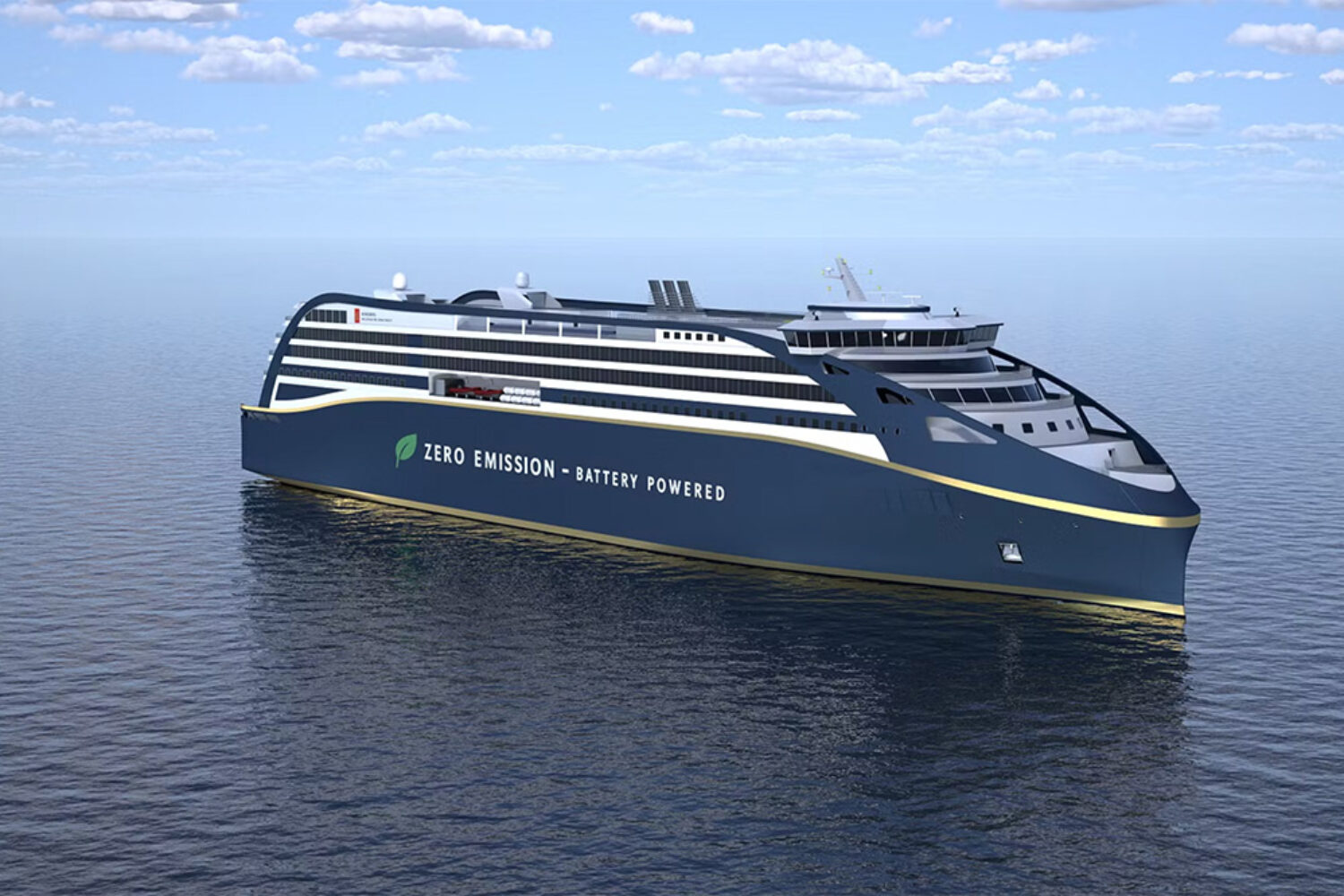
The Norwegian Kongsberg Group has identified a number of European passenger and freight routes that could have “strong potential for the introduction of all-electric RoPax ships”. Germany is also mentioned.
According to a report published today, all-electric drive technology could be particularly suitable for heavily frequented short-haul corridors in Northern Europe. According to the report, the routes that stand out among the European connections examined are those that are characterized by a combination of short distances, high capacity utilization and favourable port conditions. Corridors such as Dover-Calais, Tallinn-Helsinki and various connections between Scandinavian, German and Baltic regions are mentioned.
Both the availability of the necessary infrastructure and traffic density play a decisive role in the assessment.
The study was prompted by the “rapid development of battery technology”, falling costs for energy storage systems and the increasing impact of EU regulations within the framework of the Emissions Trading System (EU ETS) and the “FuelEU Maritime” initiative. Taken together, these factors would now shift the economic framework conditions in favor of zero-emission ships on high-frequency short-haul routes.
According to the data, all-electric RoPax vessels entering service between 2030 and 2040 could have a total lifetime cost that is 8 to 15% lower than diesel-powered alternatives – despite higher initial investments. Lower energy costs and the elimination of emissions-related expenses will also result in operating cost savings of 20 to 27%.
Oskar Levander, Vice President Business Development – Emerging Solutions at Kongsberg Maritime, explained that the industry has reached a decisive turning point: “Just a few years ago, diesel-powered RoPax vessels had a clear economic advantage. This no longer applies today. Battery-electric ships are now not only technically feasible, but also extremely attractive economically on a growing number of highly frequented routes.”
Of course, Kongsberg also has its own portfolio in mind when carrying out the analysis: “To support operators in their long-term investment decisions, Kongsberg Maritime has developed two concept designs for all-electric RoPax vessels,” it says. These are a cargo-oriented vessel, optimized for efficient operation at lower speeds, and a passenger-oriented, faster design that is ideal for routes with strong demand in public transport and tourism.
Both RoPax designs have a length of over 200 m and feature modular battery compartments, smart energy management systems and functions for automatic docking (“Auto Docking”) and automatic routing (“Auto Crossing”). Drive concepts with electric pod drives are integrated with the aim of reducing system complexity and increasing overall energy efficiency.
While the study acknowledges that charging infrastructure on land remains a challenge, it also highlights the growing momentum along the entire maritime value chain. Progress would require close cooperation between shipowners, ports, network operators and players in the freight industry. “For many operators, the question has changed – no longer ‘if’ electrification will take place, but ‘when’,” adds Levander. “A number of major European routes are now approaching the point where full electrification is both technically and economically feasible.”