




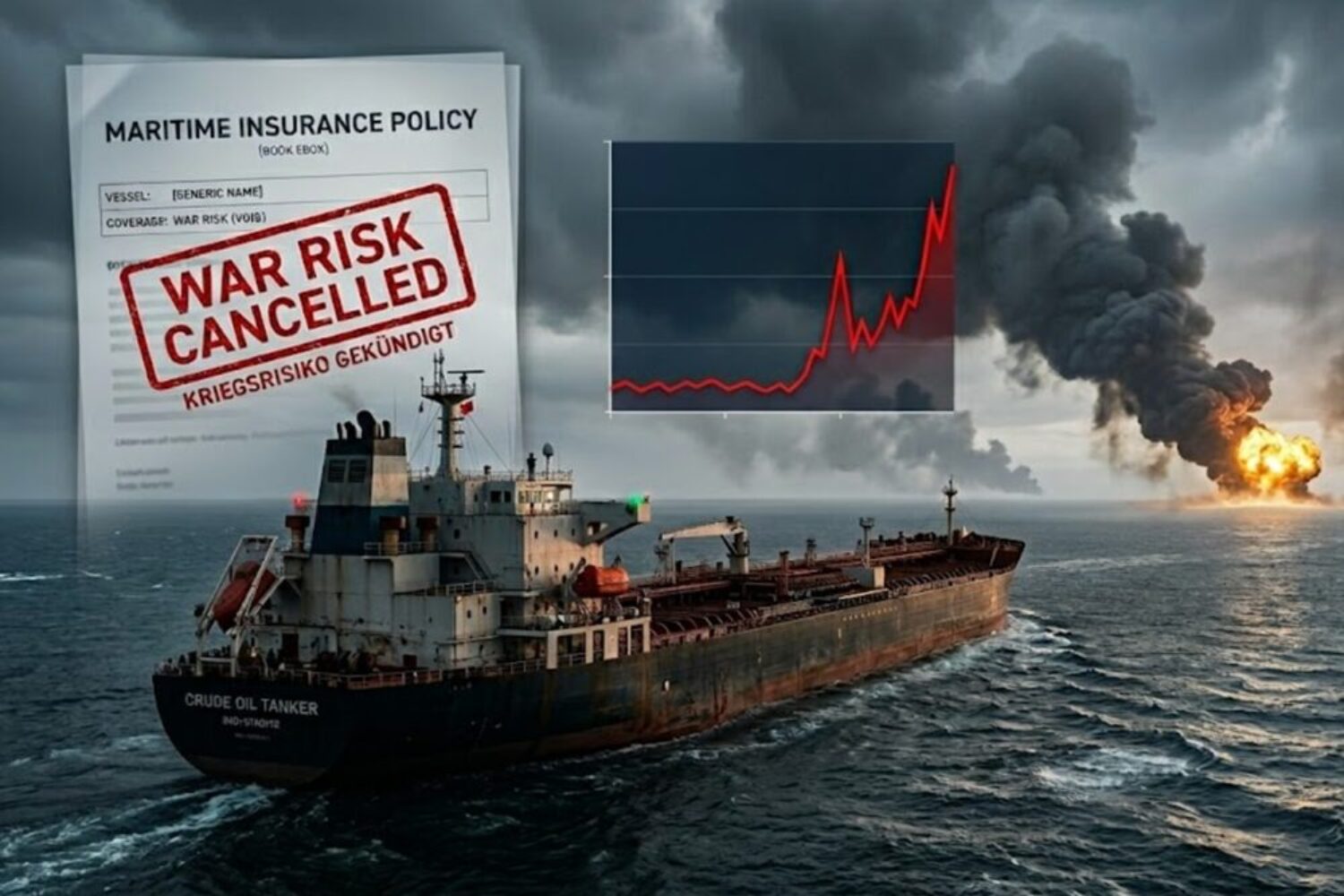
The escalation in the Strait of Hormuz has direct consequences for the marine insurance market.
Several leading P&I and marine insurers are canceling their war risk cover for ships in the region. According to the companies, the corresponding notices will come into force on March 5. The insurers include Gard, Skuld, NorthStandard, the London P&I Club and the American Club. The background to this is several attacks on tankers in the Persian Gulf and around the Strait of Hormuz, in which ships were damaged and there were fatalities.
In light of the escalation, the Norwegian insurer Skuld has announced the termination of its war risk cover for fixed premium policies with a corresponding war risk extension. The reason given for the move is the significant increase in geopolitical uncertainty and the withdrawal of reinsurance capacity, which means that it is no longer possible to provide viable cover for war risks in the short term.
The termination affects ships sailing in or present in Iranian waters and the Persian/Arabian Gulf, including the Gulf of Oman and defined adjacent sea areas. Other elements of cover remain unchanged; in particular the reciprocal P&I cover and Freight Demurrage & Defense insurance (FD&D) are not affected. According to Skuld, it is examining a chargeable “buy-back” option to reinstate the war risk cover. For shipowners, the termination means that existing war risk policies for the affected trade will lose their validity unless new conditions are agreed.
At the same time, premiums have risen sharply: Market sources report an increase within a few days from around 0.2% to up to 1% of the ship’s value per voyage. For a tanker with a value of $ 100 million, the additional premium would thus rise from around $ 200,000 to around $ 1 million.
Insurance brokers point out that individual underwriters are currently either only underwriting at greatly increased conditions or temporarily offering no cover at all for transits through the Strait of Hormuz. In effect, this is tantamount to an insurance-driven restriction of traffic.
The development has a direct impact on charter contracts and freight rates. Without adequate war cover, transits are generally not permitted in terms of contracts and financing. (JWY)