




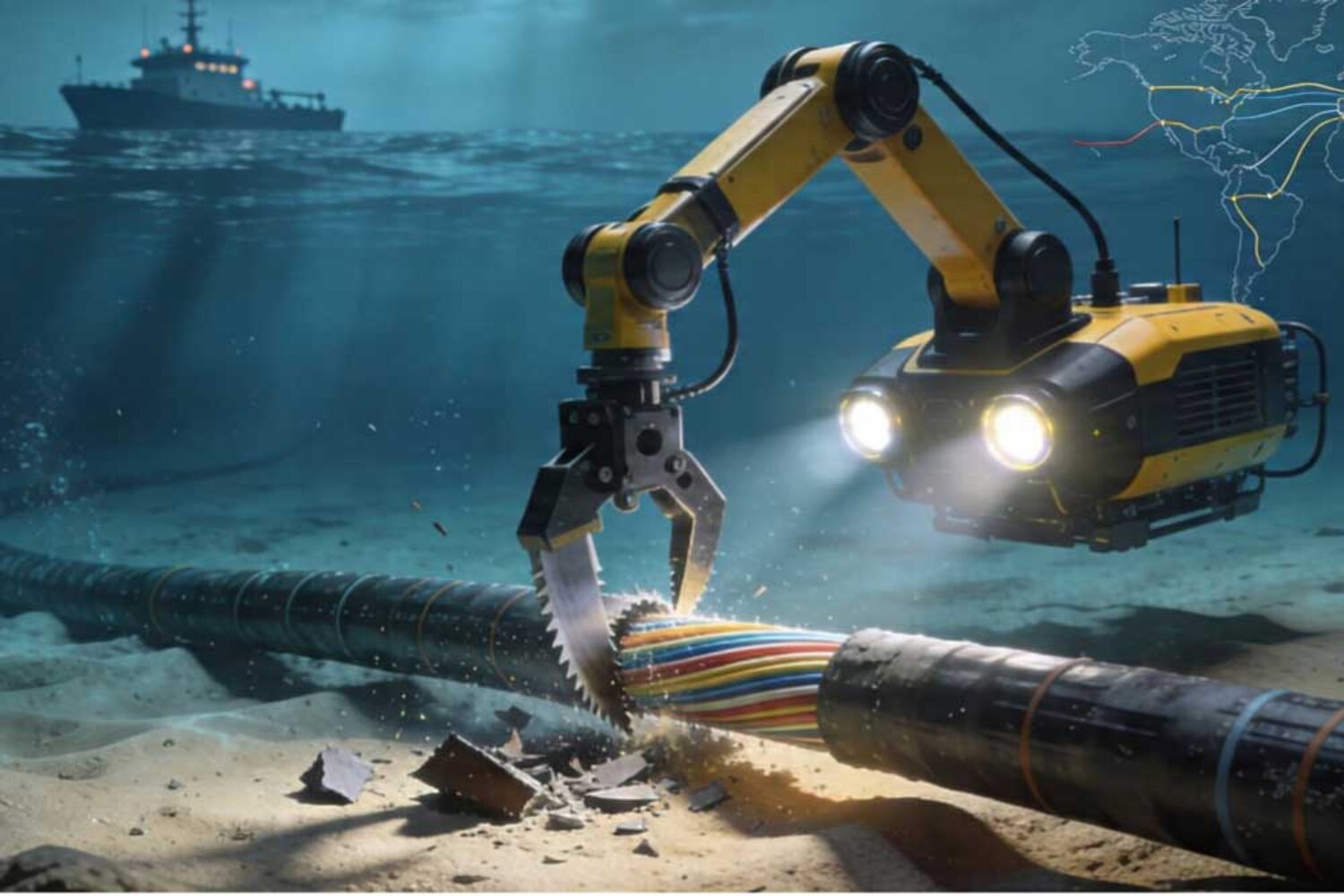
The vulnerability of global data infrastructure is not a new phenomenon. What is new is the dynamism with which the exposure, threat quality and strategic significance of these risks are changing simultaneously.
According to reports from international specialist media, China has tested an underwater device at a depth of around 3,500 m that can be used operationally at sea depths of up to 4,000 m. The system is officially declared as a civilian work and maintenance device. Its strategic relevance lies in its obvious dual-use potential.
Testing on a state research vessel
The test took place on board the Chinese research vessel “Haiyang Dizhi 2”, which is used for government geological exploration programs. Technologically, the system combines a mechanical cutting mechanism with an electro-hydraulic actuator. According to the Chinese, the intended fields of application are in pipeline maintenance, in the raw materials sector and in scientific and technical deep-sea operations.
The fact that the same technology would also enable the targeted cutting of cables is a result of its design.
Submarine cables in the crosshairs
Submarine cables are the central physical backbone of global digital communication: Around 99% of intercontinental data and voice traffic is handled via them. Cable damage is not an uncommon occurrence. In a report published in August 2025, the European Commission’s Joint Research Center found that around 150 to 200 submarine cables are accidentally and unintentionally damaged worldwide every year. Repairs take an average of 10 to 20 days, and up to eight weeks in deep-sea areas that are difficult to access, and cost an average of USD 1.5 to 2 million per incident.
In most cases, cable damage is caused by human activity, with the most common cause being accidental damage by fishing vessels. While bottom trawling can damage and entangle cables at depths of up to 2000 m, damage caused by anchors is more likely to occur in shallow waters. In this respect, the reported system opens up a new dimension from a security policy perspective: it potentially enables interventions at great depths.
Classification: Keep a sharp lookout!
Russian special submarines and reconnaissance ships declared as research units have shown that interventions against critical underwater infrastructure have long been part of the security policy picture. It is not the possibility itself that is new, but its possible miniaturization: if deep-sea interventions can be carried out with more compact or unmanned systems in the future, the circle of potential actors will grow – and with it the uncertainty in risk assessment.
The Chinese test of a deep-sea cutting tool therefore does not in itself represent a qualitative turning point, but rather perpetuates a trend: technological access to critical maritime infrastructure is increasing, while its protection remains complex and resource-intensive. In addition to accidental damage, targeted interventions that are difficult to attribute and whose systemic impact goes far beyond individual incidents are becoming increasingly important. China’s demonstration intensifies the debate about hybrid warfare, as an act of sabotage would have disproportionate effects.
There is no acute pressure for Western states to act, but there is a need to include undersea cables more consistently as strategic infrastructure in security policy planning. The debate about the resilience, redundancy and protection of these systems is therefore likely to become even more important. Europe and NATO must increase their focus on monitoring and repair capacities.
At the same time, the perspective of the insurance industry is also shifting. With increasing dependency, accumulation risks and potential loss amounts rise, while attribution and risk modeling become more uncertain. (HUM)