




No other liner shipping company is currently growing as fast as CMA CGM. The French plan to overtake Maersk by the end of 2027.
For years, growth in the shipping industry had one name: MSC. The Swiss shipping company has massively expanded its fleet, both through newbuilds and acquisitions on the second-hand market, and has recently surpassed the magic milestone of 1,000 ships. The company operates a capacity of more than 7 million TEU, and for the time being, MSC is likely to remain secure in first place in the market.
In the first half of 2026, however, another company has gained momentum. For the first time, the lion’s share of growth was not accounted for by MSC, but by the French shipping company CMA CGM. Whilst MSC expanded its fleet by approximately 205,000 TEU, CMA CGM grew by 235,000 TEU according to data from Alphaliner – equivalent to an increase of 5.7 per cent. Only the Taiwanese shipping company Yang Ming achieved greater growth relative to its own fleet, with 41,233 TEU and 5.8 per cent. By way of comparison, the global fleet grew by an average of 2 per cent, whilst MSC’s growth of 2.9 per cent was still above this.
1.8 million TEU on order
It is no coincidence that CMA CGM is growing at such a rate: CEO Rodolphe Saadé stated in an interview with the French newspaper Les Echos that he aims to overtake its nearest competitor, Maersk, by 2027 and take second place in the rankings. The figures already point in that direction: the shipping line’s current capacity stands at almost 4.4 million TEU, putting it just a few deliveries away from Maersk (4.7 million TEU). Added to this is the significantly larger order book: CMA CGM is awaiting delivery of approximately 1.8 million TEU, whilst Maersk’s order book stands at ‘only’ 1.2 million TEU. Fleet growth stood at 116,500 TEU, representing 2.5 per cent. The two companies are pursuing different strategies: CMA CGM is massively expanding its fleet, whilst Maersk is focusing on the sustainable modernisation of its existing fleet.
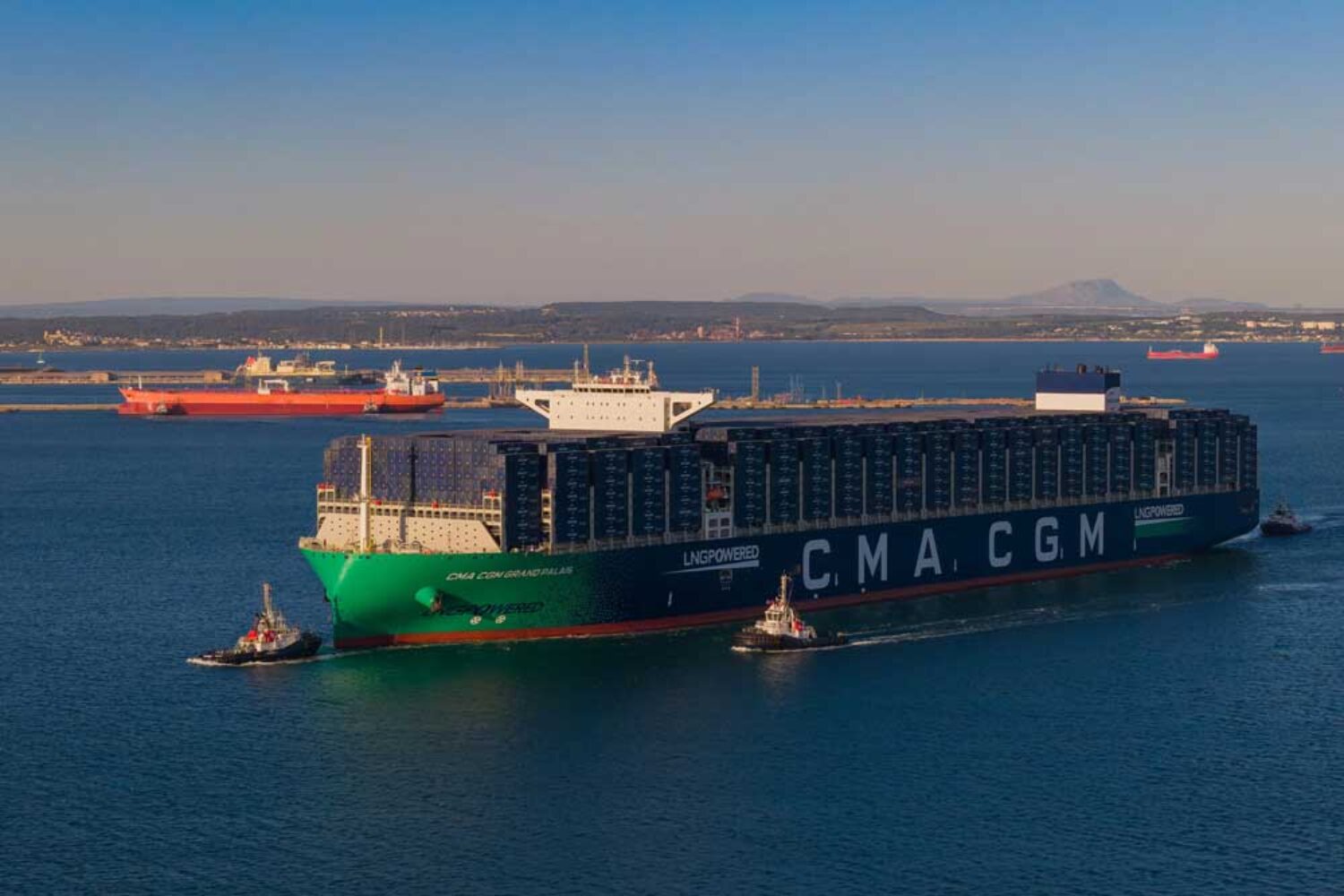
The “CMA CGM Notre Dame”, the French shipping company’s new flagship, is a prime example of this fleet expansion. It has a capacity of 24,212 TEU and is powered by LNG. Other vessels delivered included the “CMA CGM Grand Palais” (23,872 TEU) and ten methanol-powered container ships ranging from approximately 13,000 to 16,000 TEU.
Hapag-Lloyd and Zim shrink slightly
Whilst most shipping lines in the global top 10 expanded, two major companies have recently downsized. Hapag-Lloyd lost a net total of around 5,100 TEU, representing a slight decrease of 0.2 per cent. The Israeli shipping company Zim reduced its fleet by 11,300 TEU (-1.6%). Both companies are set to merge: Hapag-Lloyd plans to acquire Zim for $4.2 billion. Although the agreements have been signed for months, the transaction does not appear to be entirely certain. The Israeli Ministry of Defence recently warned against the takeover, partly due to Hapag-Lloyd’s links to investors in the Middle East. The Israeli government holds a so-called “golden share” in Zim and can therefore intervene in the shipping company’s operations if national interests are at stake.