


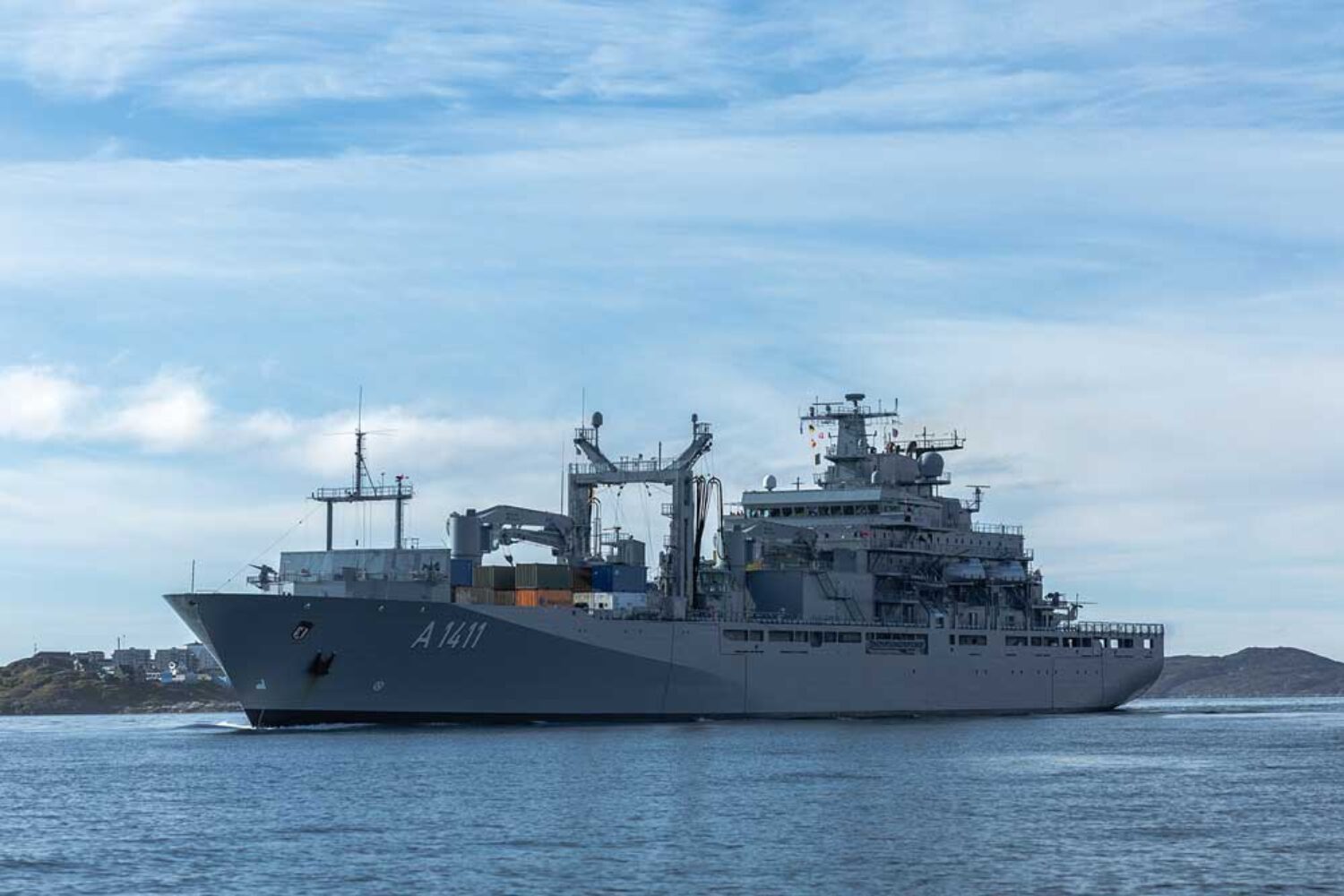
The task group support ship “Berlin” has left its home port of Wilhelmshaven today to join Standing NATO Maritime Group 1 (SNMG 1). It will not return until the end of January 2027.
The Standing NATO Maritime Group 1 (SNMG1) is one of NATO’s standing maritime task forces and is therefore one of the Alliance’s permanently available naval task forces. Depending on the mission or the willingness of the Alliance partners to participate, the force comprises several destroyers and frigates, as well as, as a rule, a supply ship. Its area of operations covers the North Sea and the Baltic Sea, as well as the North Atlantic as far as the Strait of Gibraltar. There, the ships conduct joint exercises to further improve their interoperability and ensure operational readiness. At the same time, however, SNMG1 also carries out operational tasks – in addition to deterrence, these include, for example, embargo enforcement operations, search and rescue operations, and humanitarian aid missions.
The force’s roots date back to 1967. At that time, it was established as the Standing Naval Force Atlantic, before being given its current name in 2005. As part of NATO’s reorganisation, the standing maritime task forces were later integrated into the structures of the Very High Readiness Joint Task Force (VJTF). As a result, SNMG1 is now one of the Alliance’s most rapidly deployable forces and is also regarded as a visible symbol of multinational cooperation within NATO.
German Navy in the NATO force
“Over the past few months, we have completed an enormously challenging operational training programme – operational readiness and combat effectiveness as a matter of course were the be-all and end-all here,” said Martin Kiesewetter, commander of the “Berlin“. “This has had a profound impact on the crew and forged us into a fighting unit. We are therefore ideally equipped to carry out joint exercises and manoeuvres with our task force in the coming weeks and months.”
The German task group support ship will undertake various tasks within the NATO task force. The Berlin will take part in operational manoeuvres and also ensure the supply of the other combat units. For example, it will refuel other units at sea. During such a manoeuvre, up to three warships sail side by side, with the distance between the units often being just 50 metres.
Commenting on the tasks of SNMG1, Commander Kiesewetter said: “The ship and its crew will primarily be deployed to control and protect strategically important sea lanes in the North Atlantic, as well as the North Sea and the Baltic Sea.”
Berlin-class task group support ships
The Navy’s largest ships currently have a displacement of around 20,000 tonnes. The three Berlin-class task group support ships provide all the necessary resources to support task forces at sea: fuel, provisions, supplies and ammunition. As multi-purpose vessels, they also provide specialised medical facilities, as well as satellite-based communications technology for command and control tasks.
They can support all these tasks with air capabilities. For instance, the task group support ships have space in the hangar in front of the flight deck for two Sea Lion naval transport helicopters. With such capabilities, these ships enable naval task forces to operate independently of ports, thereby more than doubling the time the task forces can remain at sea, depending on their size. Furthermore, these capabilities are not restricted to specific maritime areas but are available worldwide – as the German task group support ships have impressively demonstrated on numerous occasions during international operations in recent years. (DF)