





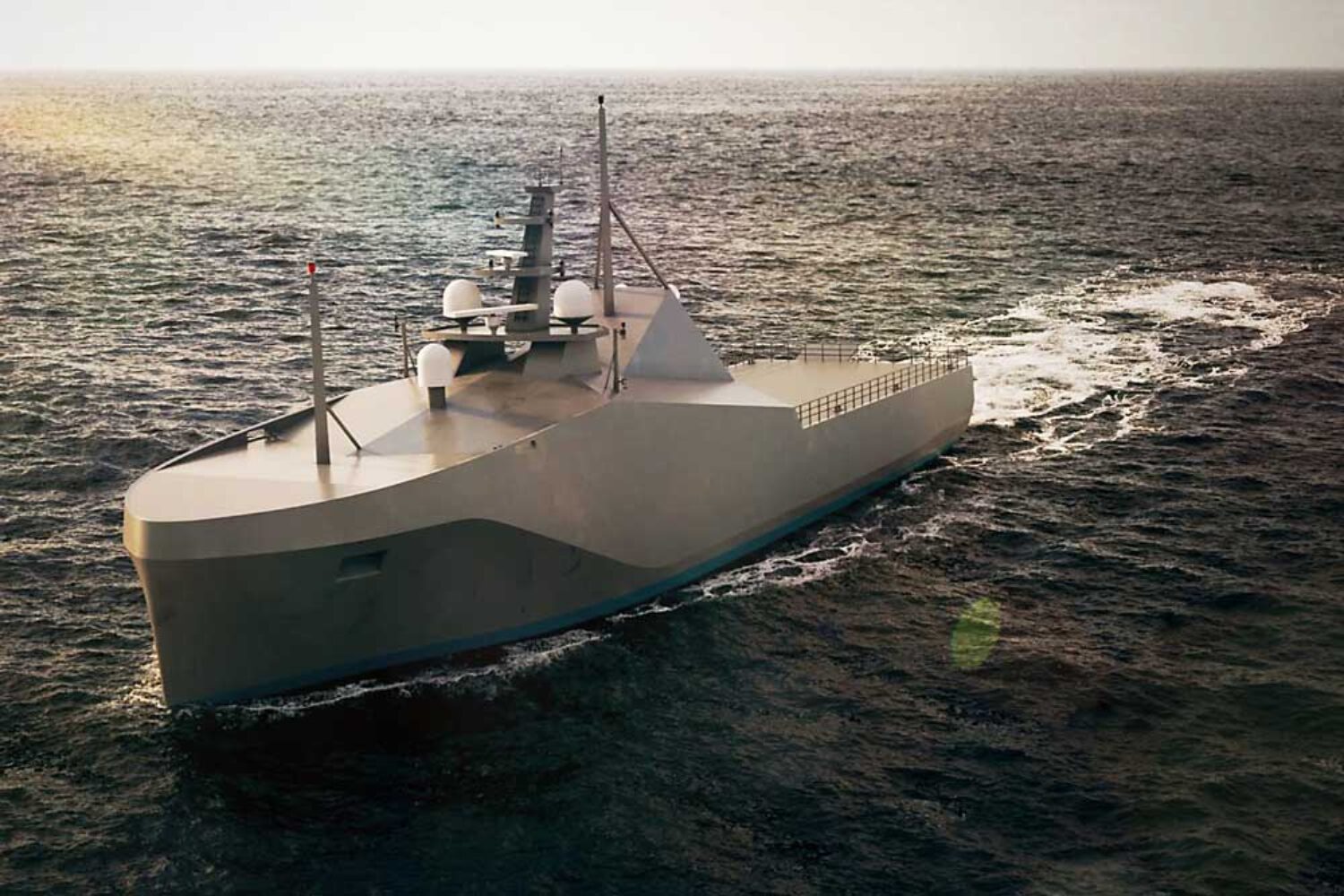
The Norwegian company Kongsberg Maritime has unveiled the “Arctic Hunter”, a new unmanned vessel designed to hunt submarines in the North Atlantic. The British Royal Navy will primarily use it as a sensor platform.
The Royal Navy plans to integrate manned warships and unmanned systems into what is known as a ‘hybrid fleet’ in future, and has already identified four (unmanned) ship types for this purpose.
“Arctic Hunter” was unveiled today in Oslo. The system is intended as a potential contribution to the British Type 92 programme, through which the Royal Navy aims to procure additional unmanned platforms for anti-submarine reconnaissance. Unlike conventional warships, the “Arctic Hunter” is not intended to carry out independent anti-submarine warfare using existing weapon systems, but rather to be deployed primarily as a permanently available sensor platform. To this end, Kongsberg Maritime has adapted one of its existing (civilian) vessel designs for use in Arctic waters. The platform combines expertise from commercial shipbuilding with technologies for remote control and autonomous navigation.
According to the company, the relevant unmanned vessel technologies have already received certification from the classification society DNV and the Norwegian Maritime Authority. In doing so, Kongsberg is specifically highlighting the requirements for the safe operation of larger unmanned vessels.
For the actual submarine reconnaissance mission, the ‘Arctic Hunter’ is to be equipped with sonar technology from Thales UK. In addition, it will feature secure military communication systems through which the vessel can transmit its sensor data to other units. The UUV could then operate from a forward support point within the Arctic Circle. The aim is to ensure the most continuous possible surveillance of the waters in the High North, particularly with regard to Russian and Chinese submarines.
“Arctic Hunter” is not intended to replace manned frigates or maritime long-range reconnaissance vessels, but rather to complement them. The unmanned sensor platforms are designed to monitor larger sea areas and feed their reconnaissance findings into a shared network. This would allow manned units to focus more on identifying, tracking and, if necessary, engaging detected submarines, rather than getting bogged down in routine tasks. This is particularly important given that even the Royal Navy does not have enough manned units to effectively control these maritime areas.
According to Kongsberg, the proposed design has considerable payload reserves and sufficient deck space to accommodate additional or alternative mission systems throughout its service life. A distinctive feature is the planned manufacturing approach. The ships are to be built at civilian shipyards and subsequently fitted with military technology by the defence industry. Kongsberg is collaborating on this with its long-standing shipbuilding partner, Balaena Maritime. Production is scheduled to take place at Balaena Maritime’s shipyard in Birkenhead, UK.
According to current plans, the first ships could be ready for military outfitting and subsequent deployment by the end of this decade.
The Royal Navy and its Hybrid Fleet
The “Arctic Hunter” fits into the fundamental reorientation of the British Navy. In future, the Royal Navy intends to operate manned warships, unmanned surface vessels, underwater drones and autonomous aerial vehicles as part of a joint operational network. This approach was formalised by the British Government in the 2025 Strategic Defence Review. It is based on the realisation that the surveillance and defence of large maritime areas cannot be ensured by a limited number of manned warships alone. Unmanned systems are intended to provide additional sensors and weapons without requiring a correspondingly large number of additional crews. The original operating environment for unmanned systems – ‘dirty, dull and dangerous’ – certainly applies to the remote waters of the Arctic.
In building its Hybrid Fleet, the Royal Navy is pursuing several programmes simultaneously:
- Type 91: unmanned surface platforms armed with missiles, designed to increase the fleet’s firepower.
- Type 92: unmanned sensor platforms for submarine reconnaissance in the North Atlantic. Kongsberg is now offering the ‘Arctic Hunter’ for this programme.
- Type 93: particularly large unmanned underwater vehicles designed to operate alongside manned hunter submarines.
- Type 94: further unmanned sensor platforms to supplement the maritime reconnaissance network.
Future manned warships are also to be designed with a stronger focus on this collaboration. In June 2026, the UK Ministry of Defence announced the procurement of at least six so-called Common Combat Vessels. These are intended to replace the existing Type 45-class destroyers whilst also serving as command platforms for unmanned systems in the air, on the surface and underwater. Delivery is expected from the early 2030s.
In addition, the eight planned Type 26-class frigates and the five Type 31 frigates will remain key components of the future surface fleet. The Royal Navy therefore does not simply intend to procure additional Unmanned Surface Vessels (USVs), but to transform its entire operational command structure: manned ships are to increasingly operate as command and strike platforms within a larger, networked system.
Atlantic Bastion: A sensor network against Russian submarines
The British ‘Atlantic Bastion’ programme plays a central role in this. It is designed to improve surveillance of the North Atlantic and, in particular, to counter the growing threat posed by Russian submarines.
According to the plans of the British Ministry of Defence, a multi-layered reconnaissance network is being developed for this purpose, linking sensors on the water’s surface, underwater and in the air. Artificial intelligence is intended to support the analysis of acoustic data and reduce the time between the detection of a potential target and the transmission of the information. In addition to unmanned surface and underwater vehicles, this network will also include the future Type 26 frigates, maritime aircraft and other reconnaissance systems.
This is not exclusively about military anti-submarine warfare. The UK also aims to better protect its critical underwater infrastructure. After all, submarine cables and pipelines, in particular, are of considerable importance for Europe’s communications and energy supply.
The Ministry of Defence had also already announced in December 2025 that the first new technologies would be tested as part of the Atlantic Bastion programme. Numerous companies from the UK and other European countries are involved in the development. The Royal Navy demonstrated just yesterday, on 5 November 2026, that this development is no longer confined to the drawing board, with the official formation of its first Autonomous Squadron in Portsmouth. The squadron is set to deploy unmanned surface vessels such as the Kraken and Rattler for operational tasks.
“Arctic Hunter” could form a further component of this network in future, albeit with a significantly different role: whilst smaller unmanned surface vessels are also intended for immediate tactical operations, the Norwegian platform is set to operate over longer periods as a sensor platform in the challenging waters of the North Atlantic.
Ukraine is changing naval warfare
The war in the Black Sea illustrates the impact that unmanned systems can have on naval warfare. At the start of the Russian invasion in 2022, Ukraine had a significantly inferior navy. Russia was initially able to control large parts of the Black Sea and blockade Ukrainian ports. Rather than building up a comparable fleet of conventional warships – which it would probably not have managed anyway – Ukraine increasingly relied on anti-ship missiles and unmanned surface vessels. These comparatively cost-effective systems enabled attacks on the much larger and more expensive Russian warships. The Ukrainian UOVs could be deployed with relatively few personnel and were rapidly refined technically. Their loss was less severe, both economically and militarily, than that of a manned warship.
By the summer of 2024, the Russian Black Sea Fleet had already suffered considerable losses. In July 2024, Russia withdrew its remaining larger warships from the ports of the occupied Crimea. Ukraine had thus, despite its inferiority in terms of equipment and personnel, restricted a significant portion of Russia’s freedom of action in the western Black Sea.
Above all, this demonstrates that the size and firepower of individual warships no longer alone determine success at sea. Equally important are the ability to adapt rapidly to technical changes, the integration of different types of weaponry, and the capacity to deploy large numbers of comparatively inexpensive systems. This is precisely where the British concept of the Hybrid Fleet comes into play. However, the Royal Navy is pursuing a broader approach than the Ukrainian attacks using armed UAVs.
British-Norwegian cooperation
The development of ‘Arctic Hunter’ is also part of the closer military cooperation between the UK and Norway. Both countries aim to expand their capabilities for monitoring the North Atlantic and Arctic waters. In this context, Kongsberg refers to the British-Norwegian Lunna House Agreement, which is intended to support the joint introduction of autonomous systems in the High North.
Kongsberg also announced that it would sign technology agreements with Thales UK and Balaena Maritime during the Atlantic Future Forum in Oslo. This is intended to further strengthen cooperation in sonar technology, shipbuilding and autonomous systems, as well as industrial participation by both countries.
“Arctic Hunter” could thus become an example of a new form of maritime defence procurement: a tried-and-tested civilian ship design is combined with military sensors and autonomous control systems to deliver new capabilities more quickly and potentially more cost-effectively than through the complete development of a new warship from scratch.
Whether the Royal Navy will actually procure the “Arctic Hunter” as a Type 92 platform remains to be seen, however. Today’s presentation by Kongsberg marks, for the time being, its proposal for a component of the UK’s future hybrid fleet.
Author: Dorothee Frank, Online Editor-in-Chief, Mittler Report