


The US government also intends to rely on nuclear propulsion for ships as part of its efforts to revitalise the national maritime industry. With a new partner, it is even considering the construction of a specialised shipyard.
Just a few days ago, the British company Core Power announced an agreement with the major US energy hub, Corpus Christi. The aim is to jointly explore the use of nuclear-powered ships. Now Core Power is taking things a step further and joining forces with the US Maritime Administration (MARAD).
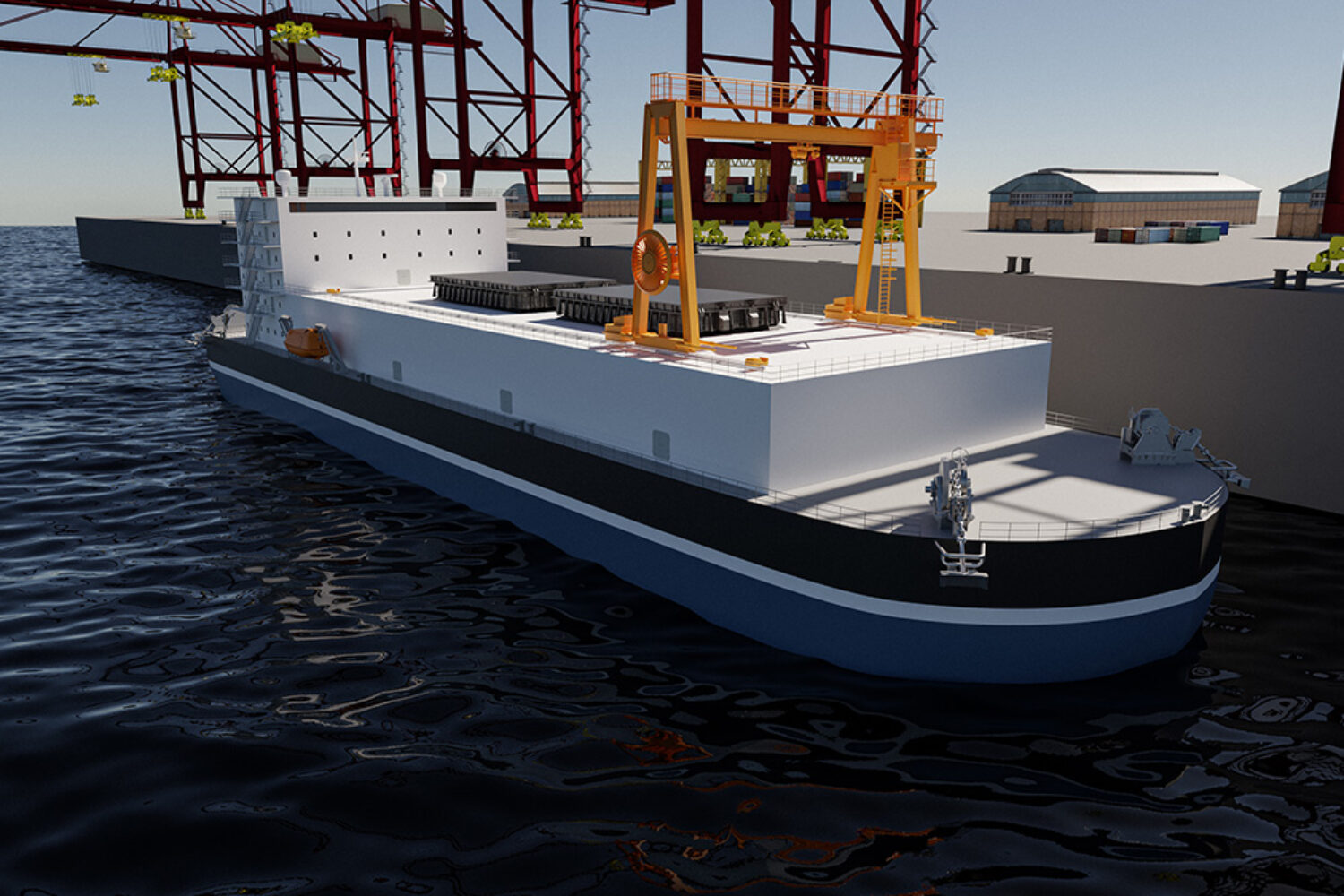
At the heart of the collaboration are the framework conditions for the use of nuclear energy in shipping. For several years now, Core Power has beenchampioning the use of floating nuclear energy storage facilitiesand nuclear propulsion systems in shipping. The aim is to begin construction of the first vessels from 2028 – as part of a concept that ‘combines shipbuilding by allies with specialised US expertise in the integration of nuclear technology’, in line with US President Donald Trump’s ‘Maritime Action Plan’, according to today’s announcement.
The whole initiative is seen as part of a strategy to make nuclear-powered ship propulsion an integral part of the revival of US civilian shipping – despite all the unresolved issues that still await a solution.
The aim is to jointly accelerate the path towards a future fleet of US-flagged, nuclear-powered merchant ships – from commercial, industrial and regulatory perspectives.
Trump views Asian dominance in shipbuilding as a thorn in his side – he has his sights set on China in particular. At the same time, he is looking for ways to strengthen the industry in his own country. His ‘Maritime Action Plan’ aims to halt the decline of the US shipping industry, mobilise private investment and rebuild an industrial base that the government regards as crucial to economic and national security.
Mikal Bøe, founder and CEO of Core Power, said today on the occasion of the cooperation agreement: “China is already moving towards nuclear-powered civilian shipping. That should raise the necessary awareness in Washington. America will not regain its maritime strength simply by building a better version of yesterday’s ships.”
In his view, the conditions are favourable: “The US has the nuclear expertise to lead the way with the next generation. Japan and South Korea can accelerate conventional shipbuilding, whilst America builds up the specialised capabilities at home for the integration of nuclear technology and life-cycle management – skills that can also strengthen the broader maritime industrial base.”
The government could set the direction and coordinate efforts; the private sector must provide the capital and the steel. “This marks the dawn of a new era for American shipping: we are making American shipping great again by shaping the future, rather than merely rebuilding the past,” said Bøe.
According to most experts, the challenge for the use of nuclear technology in the civilian sector lies in creating a comprehensive system that is safe, secure, capable of obtaining regulatory approval, insurable, financeable and operable on a fleet-wide scale – whilst ensuring clearly defined responsibilities for the integration of nuclear technology, fuel supply, port infrastructure, personnel and support throughout the entire life cycle.
Marad Director Stephen M. Carmel has now stated: “President Trump has made it clear that American energy dominance and maritime strength go hand in hand. This framework ensures that the United States takes a leading role worldwide with a safe, US-flagged fleet. Nuclear propulsion offers a significant economic opportunity, but must be viewed as a complete system – safe, secure, licensable and worthy of investment.” The aim of the Memorandum of Cooperation (MOC) is to translate policy objectives into a concrete, economically viable path.
A new US nuclear shipyard?
Reducing uncertainty in these areas is intended to enable the mobilisation of private capital for ships, shipyards and the supporting infrastructure. According to its own statements, Core Power is planning the development of a specialised US shipyard for the integration of nuclear systems and the entire life cycle – including reactor installation, initial fuelling, testing, commissioning, refuelling, fuel unloading and ongoing maintenance – whilst conventional ship hulls and maritime systems are manufactured in commercial shipyards. To this end, the company intends to draw on ‘shipbuilding capacities of allied states’.
However, none of this is set in stone yet. The footnotes to the announcement explicitly emphasise that the Memorandum of Understanding (MOC) does not entail a procurement contract, a grant or a commitment of federal funds. Nor does it oblige Marad to acquire ships, technologies or services.