



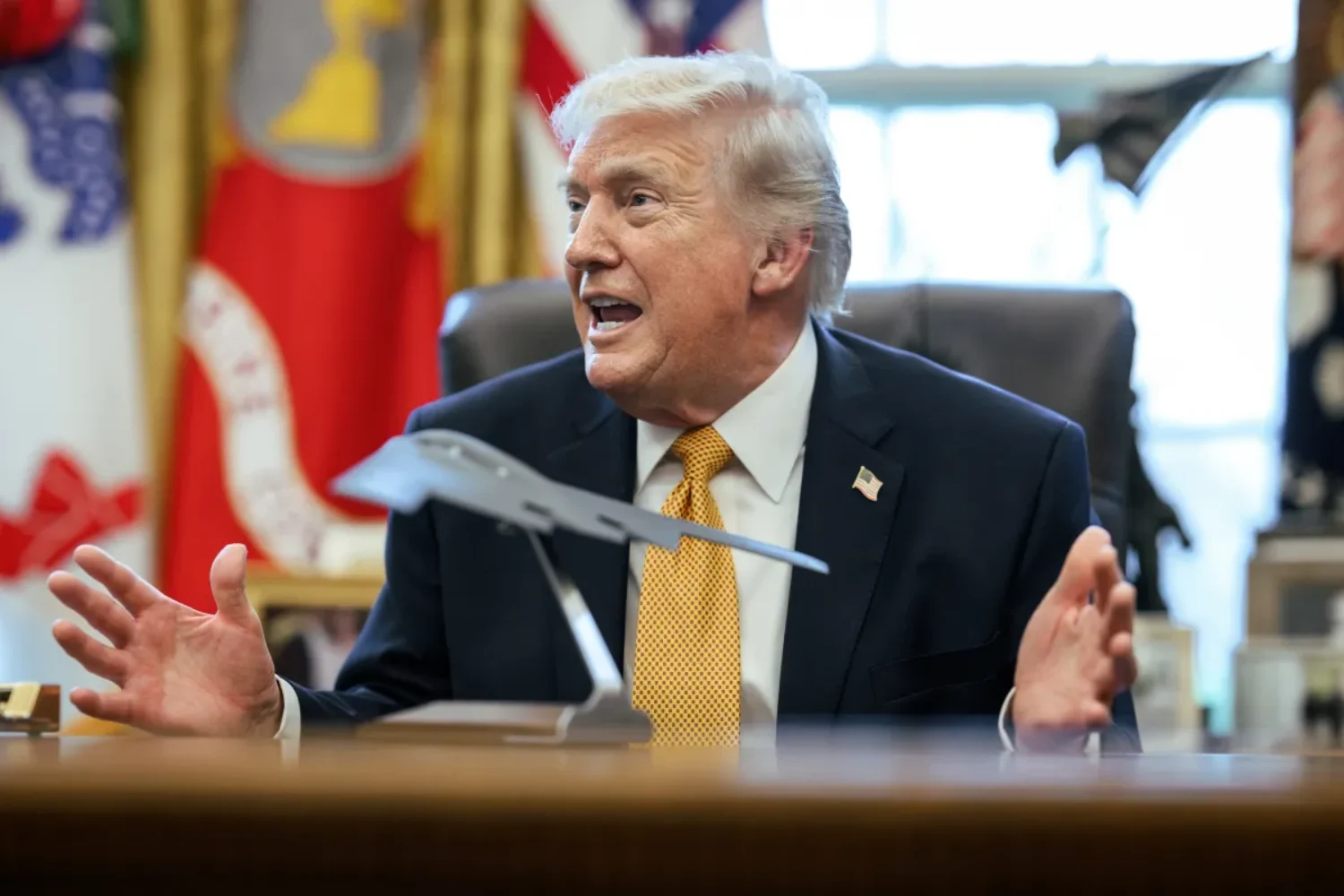
Just at the start of the week, the US President had announced that he would impose a toll on ships passing through the Strait of Hormuz. However, following protests from various quarters, he quickly backed down from the idea.
It is a classic Trump manoeuvre: first comes the grand announcement (albeit without any details), but as soon as there is any pushback, the President changes course and acts as if he had planned it that way from the outset. What is a daily occurrence in US politics has also been affecting the situation in the Persian Gulf.
At the start of the week, Trump had proposed a new solution for protecting the Strait of Hormuz, where the situation had recently escalated again following renewed attacks on ships by Iran. According to this proposal, the strait would be reopened to shipping, although Trump demanded a 20% freight surcharge for ships – as ‘fair’ compensation for the protection provided by the US military. He announced on his Truth Social network, with the Caps Lock key held down, that America would henceforth be the “guardian of the Strait of Hormuz”. However, ships with links to Iran or those bound for Iranian ports would not be permitted to pass through the strait.
US Navy blocks Iranian maritime traffic
The blockade has been back in force since yesterday – so at least this part of the announcement has come to pass. The planned toll, however, met with resistance, and even within his own cabinet, Trump’s course of action sparked debate, particularly as he himself, along with Foreign Secretary Marco Rubio and Finance Secretary Scott Bessent, had previously spoken out against such a charge.
The shipping industry rejected the proposal, with representatives unanimously citing international law, which guarantees freedom of navigation in international waters such as the Strait of Hormuz. In an interview with the US broadcaster CNBC, the European Community Shipowners’ Association (ECSA) emphasised the safety of seafarers. The International Transport Workers’ Federation (ITF) called for an end to attacks on seafarers.
The Hamburg-based shipping company Hapag-Lloyd also publicly described the toll as “fundamentally wrong”. Even Iran, which claims sovereignty over the Strait of Hormuz, used Trump’s proposal as a springboard: 20% was too much, it argued, and Iranian charges would be fairer. The scale of the planned toll is illustrated by a Bimco analysis shared on CNBC: a VLCC-class tanker would have to pay up to $27 million in tolls per voyage, based on the value of its cargo and the price of oil.
Oman, too, which had been in discussions with Iran regarding charges for the Strait of Hormuz, distanced itself from the plan once again. The Sultanate is committed to restoring freedom of navigation in the strait – “in full accordance with international law”.
Gulf states to invest in the US economy
This united front appears to have convinced Trump to abandon the toll. In a post on Truth Social on Tuesday night, he instead announced a new plan centred on investment from the Gulf states.
“Following extremely productive discussions with leaders in the Middle East, I have decided to replace the 20 per cent US reimbursement fee with trade and investment agreements that various Gulf states will conclude with the US,” Trump wrote. “These investments will be massive, but at the same time extremely beneficial for these states and their future.”
The President hopes that the investments will lead to the construction of new factories, industrial facilities and equipment on a “historic scale”, which is expected to create millions of jobs.
However, whilst billions of dollars are now set to flow from the Gulf states to the US, the flow of oil through the Strait of Hormuz has once again dwindled to a trickle in recent days. According to data from the industry service Kpler, only ten ships passed through the strait on Monday, nine of which travelled through Iranian waters.