


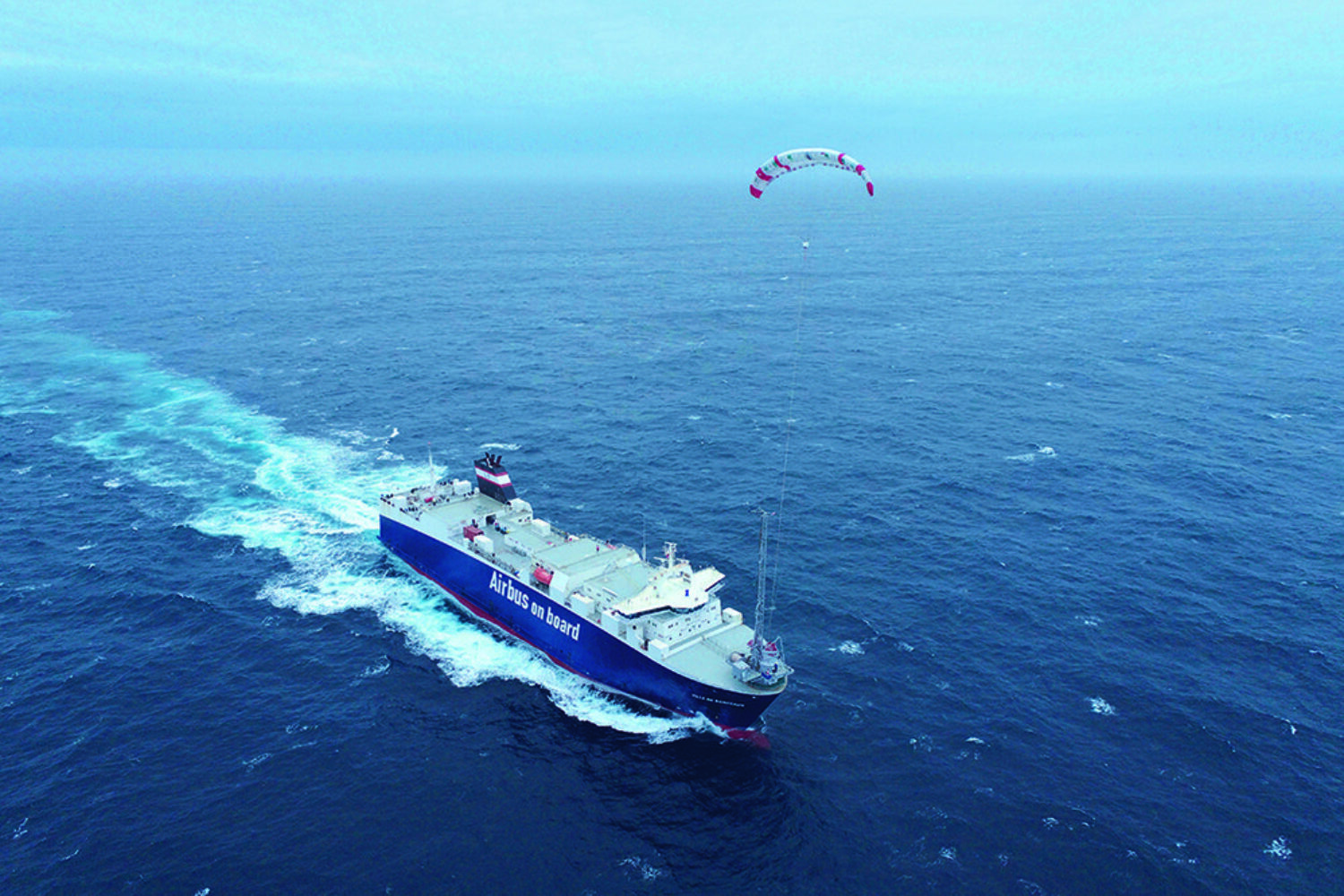
The Japanese shipping group K Line has taken an important step towards the further market integration of its kite sail technology.
An independent audit of the automated kite system “Seawing” developed by the French subsidiary Oceanicwing has been completed by the classification societies Bureau Veritas and ClassNK, K Line has now announced. The system’s tensile performance was analyzed. Oceanwing is continuing to carry out demonstration trials on land and at sea in order to advance the practical application of the “Seawing” systems by around 2027.
Seawing uses wind power and, according to the developers, can be installed “on any type of vessel”, including existing ships. It was added to K Line’s portfolio in 2024 when the Japanese company took over and renamed the product developer Airseas. The company believes it is well positioned in the growing competition for “wind propulsion”: “Several wind-assisted propulsion systems (WAPS) are being developed, but compared to other WAPS, “Seawing” is capable of generating comparatively high thrust with high-altitude wind,” according to the official assessment. Phase one of Seawing’s development was completed in June 2025, and Oceanwing verified the performance with a 300 m² kite at a test site on land.
BV and ClassNK based their assessments on the test results of the first phase of the development project and confirmed the suitability of the validation process used in the demonstration trials. The reports confirmed that the theoretical tensile force of the 300 m² kite used in the first phase of the development project was 25 tons. If the kite size is doubled to 600 m², the theoretical tensile force is expected to double to 50 tons. This is to be confirmed by further tests.
The tractive force generated by “Seawing” is wind-dependent, but it is expected to enable an average annual fuel consumption reduction of over 10% for large bulk carriers. “Actual energy savings will vary depending on ship type, speed, route and time of year. With certain combinations of these factors, fuel consumption can be reduced by significantly more than 10%,” says K Line.
The system is currently in the second development phase. Oceanwing wants to increase the size of the kite and check its functionality and safety at its test site on land in order to prepare it for use on ships. Offshore demonstration trials are also planned with a large bulk carrier of the shipping company “K” Line to test tensile strength and reliability. The aim is to complete the tests by around 2027 and drive forward the practical application of “Seawing”.