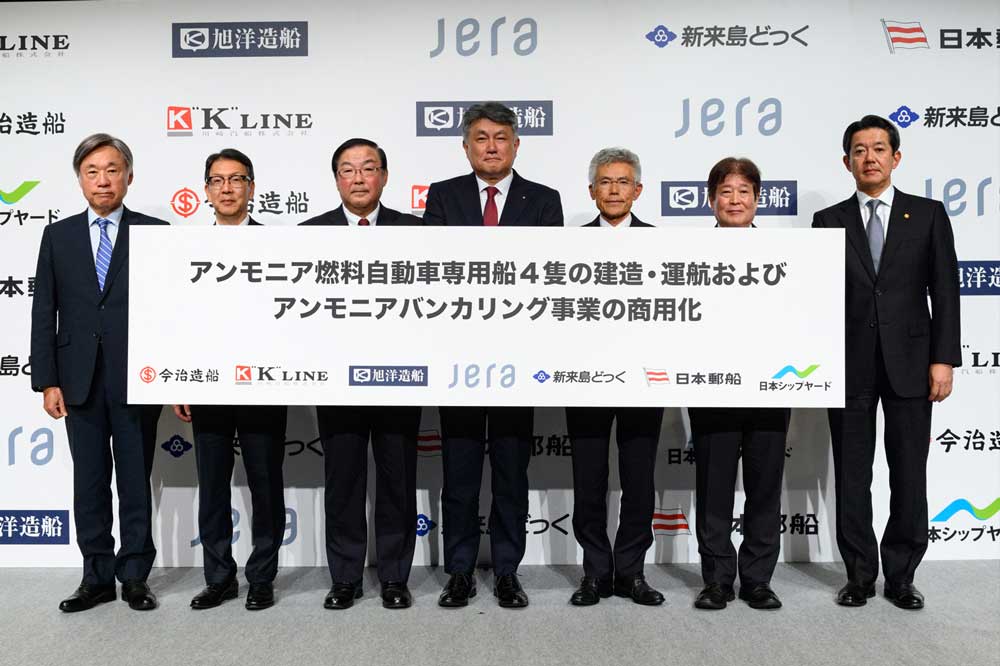



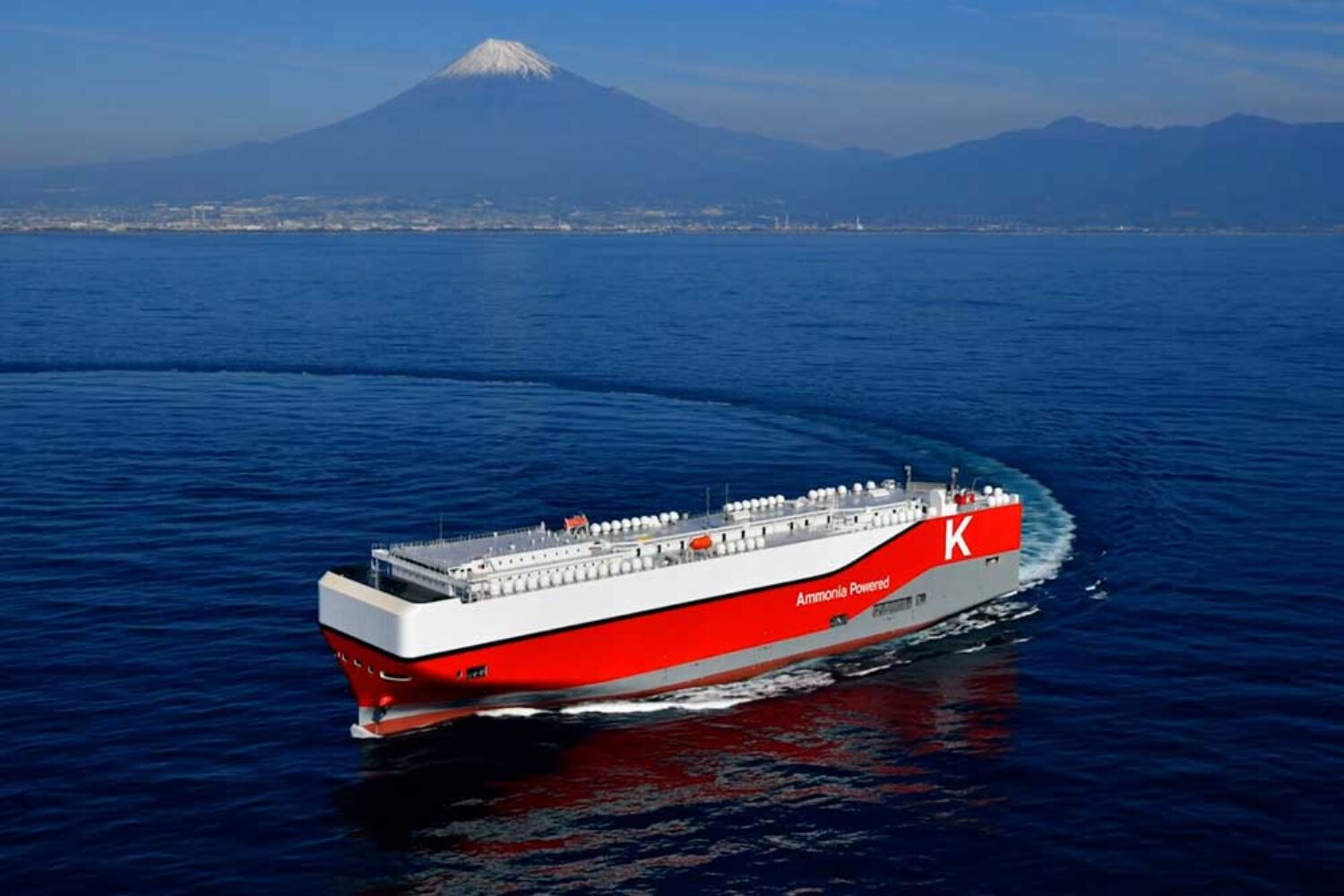
The Japanese shipping companies K Line and NYK have announced an order for four new car carriers and the establishment of an ammonia supply chain. A total of seven partner companies are involved.
Together with their partners, the shipping companies are planning not only the construction of new ‘Pure Car and Truck Carriers’ (PCTCs) to be powered by ammonia, but also the commercialisation of a bunkering service for this alternative fuel. Originating in Japan’s Chubu region, this development project is the first of its kind in the world to encompass both fuel procurement and supply infrastructure. In the long term, it aims to promote the decarbonisation of international shipping. The shipping companies involved are Kawasaki Kisen Kaisha (K Line), Nippon Yusen Kabushiki Kaisha (NYK), the energy supplier Jera, and the four shipbuilders Kyokuyo Shipyard, Shin Kurushima Dockyard, Nihon Shipyard and Imabari Shipbuilding, the world’s fourth-largest shipbuilding group.
The project is a “comprehensive initiative to develop an integrated supply chain for ammonia as a fuel”, K Line announced. This encompasses the procurement of green ammonia, the development of loading facilities for ships and the construction of a specialised bunker vessel (for ‘ship-to-ship’ fuel supply), right through to the operation of ammonia-powered car carriers. The companies are also planning a stable supply system for ammonia.
“Ammonia is regarded as a next-generation fuel: its combustion produces no carbon dioxide (CO₂), and it can be stored and transported in liquid form,” according to a statement from K Line. “Particularly with the use of low-carbon ammonia – which is already produced with reduced CO₂ emissions – significant progress is already being made towards practical application in the field of power generation. In future, its use is expected to extend to the transport sector, including maritime shipping, as well as to other industries.”
Green ammonia from India
The energy company Jera is taking the lead in establishing an ammonia value chain. This is part of its efforts to achieve net-zero CO₂ emissions across its domestic and international operations by 2050, to contribute to global decarbonisation and to address global energy challenges. The initiatives include the use of lower-carbon ammonia at the Hekinan thermal power station – south of Nagoya – as a substitute fuel to decarbonise thermal power generation. In addition, facilities for loading tanker lorries are being built to supply other customers with lower-carbon ammonia.
As part of this project, Jera is sourcing green ammonia produced using renewable energy. Supplies are expected to come from India, amongst other sources. Furthermore, Jera is developing new ship-loading facilities at the ammonia receiving terminal near the Hekinan thermal power station, thereby creating a stable supply system for bunker vessels.
NYK operates a bunker vessel
Kyokuyo Shipyard will build the ammonia bunker vessel. Completion is scheduled for 2030 – coinciding with the entry into service of ammonia-powered car carriers. Upon completion, the vessel will be owned and operated by NYK (or a wholly-owned NYK subsidiary).
K Line and NYK will also establish a joint venture for fuel sales, in which both companies will hold equal stakes, to facilitate the sale and supply of fuel to ships. With the help of the bunker vessel, the joint venture will supply car carriers with ammonia fuel as part of an STS (ship-to-ship) bunkering operation.
Construction of the four car carriers
K Line and NYK will each commission two ammonia-powered car carriers – making a total of four vessels. Following their planned completion in 2030, the vessels are set to transport finished vehicles for customers, including Toyota Motor Corporation.
These newbuilds will be Japan’s first ammonia-powered car carriers. They will be fitted with dual-fuel engines capable of running on ammonia, as well as fuel tanks with sufficient capacity to enable trans-Pacific crossings using ammonia alone as the propulsion source.
As ammonia is toxic and corrosive, the ships feature a multi-layered safety concept. This includes measures to prevent and detect leaks, as well as procedures for neutralising ammonia in the event of a leak.
Shin Kurushima Dockyard, which has the most extensive experience in the construction of car carriers worldwide, is leading the basic design phase. The ships will then be jointly designed and built by Shin Kurushima Dockyard, Imabari Shipbuilding and NSY – “companies which all possess in-depth and proven expertise in the construction of car carriers”, the statement adds.