


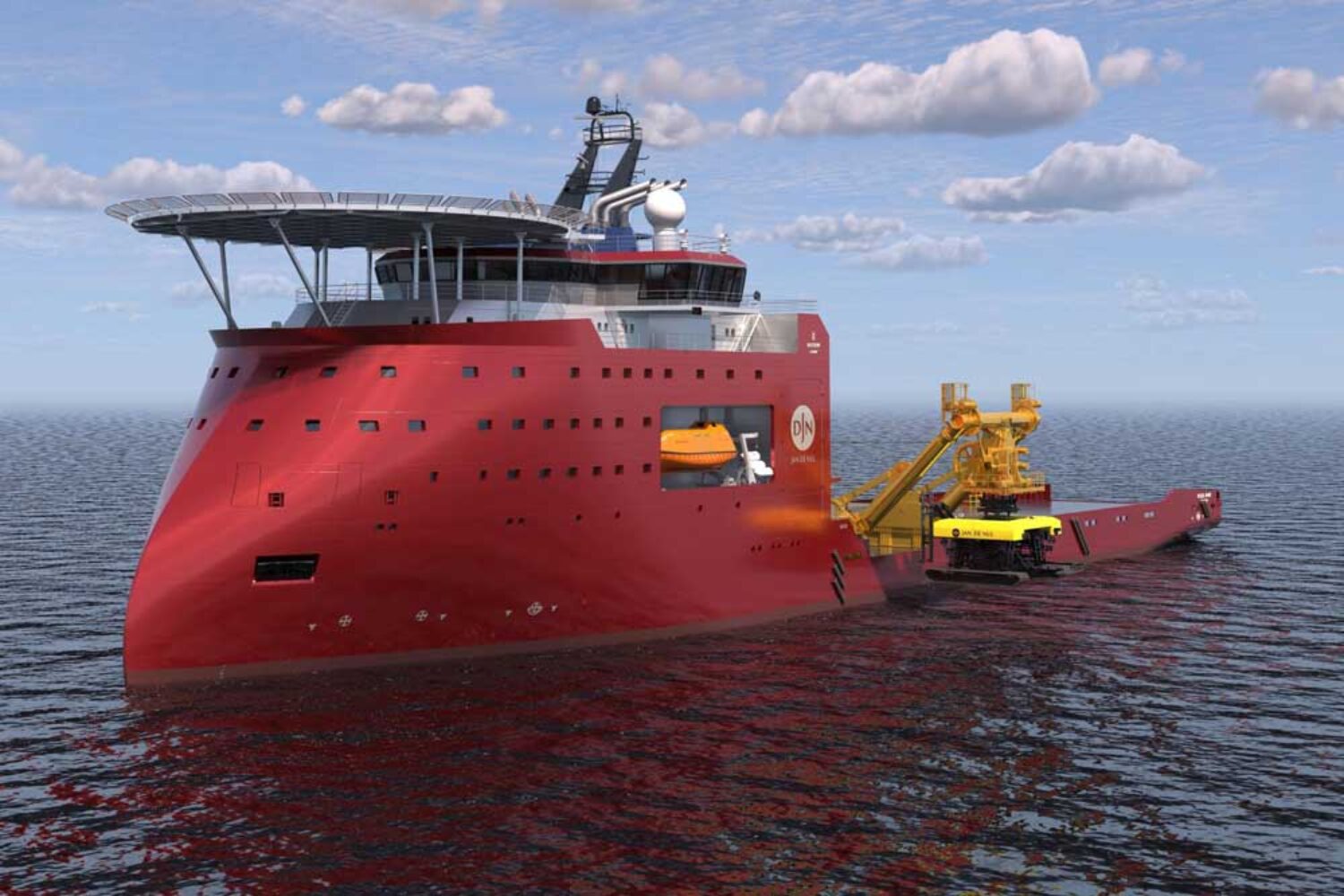
The Belgian company Jan De Nul is continuing to expand its fleet for offshore structures: a new cable laying vessel is being built in China and a second vessel is being converted.
It was only in October that the “Fleeming Jenkin”, the largest cable laying vessel in the world, was launched for Jan De Nul; the identical ship “William Thomson” is still under construction. The company also announced the order of a downpipe vessel to place stones to protect the laid cables. Jan De Nul has now announced the next addition to the fleet: two vessels designed for the safe installation of submarine cables in the seabed.
“With the ‘Fleeming Jenkin’ and the ‘William Thomson’, we will soon be expanding our fleet with two XL vessels for laying subsea cables,” said Wouter Vermeersch, Director Subsea Cables Offshore Energy for Jan De Nul. “Investing in vessels that can protect these cables is a logical next step. Last year we announced the rock installation vessel ‘George W. Goethals’, which protects cables and other energy infrastructure with a protective layer of rock. Now we are expanding our fleet with vessels specifically designed for the safe installation of cables in the seabed.”
The first addition is a new cable laying vessel equipped with a modern underwater robot. This will be controlled from the deck and will be able to lay cables at depths of up to 5 meters.
The ship was designed by Ulstein and is being built at the CMHI shipyard in China. Like all of Jan De Nul’s newer ships, it will be equipped with ULEv (Ultra-Low Emission Vessel) technology. According to Jan De Nul, this technology filters up to 99% of nanoparticles from the exhaust gases and reduces the amount of pollutants. The ship’s engines can run on biofuel, which reduces CO₂ emissions. In addition, the ship and its engines are prepared for future operation with methanol. Delivery is planned for 2028.
In addition, Jan De Nul will convert its ship “Henry Darcy” into a cable-laying vessel equipped with an underwater robot specialized in laying cables in shallow waters. This robot was recently ordered from partner Osbit.
Jan De Nul invests in the expansion of offshore energy
Jan De Nul is currently having four ships built for the laying and protection of submarine cables and is having another ship refitted. “We do not comment on specific figures, but our efforts are enormous,” said Vermeersch. “This also sends a signal to our governments: We are ready to further support the expansion of offshore energy production and contribute to a reliable energy system based on locally generated electricity.”
“We are delighted that Jan De Nul has placed its trust in Ulstein Design & Solutions,” said Sales Director Rolf Petter Almli. “Jan De Nul is a new customer for us and we look forward to contributing with a modern and operationally flexible ship design.”
Ulstein’s vessel design is modular and supports a wide range of offshore sectors, including energy, construction and deepwater operations. This version is specifically designed for subsea trenching and ensures precise performance, the company said. The “Ulstein X-Bow” hull design improves comfort, reduces wave resistance and fuel consumption.