




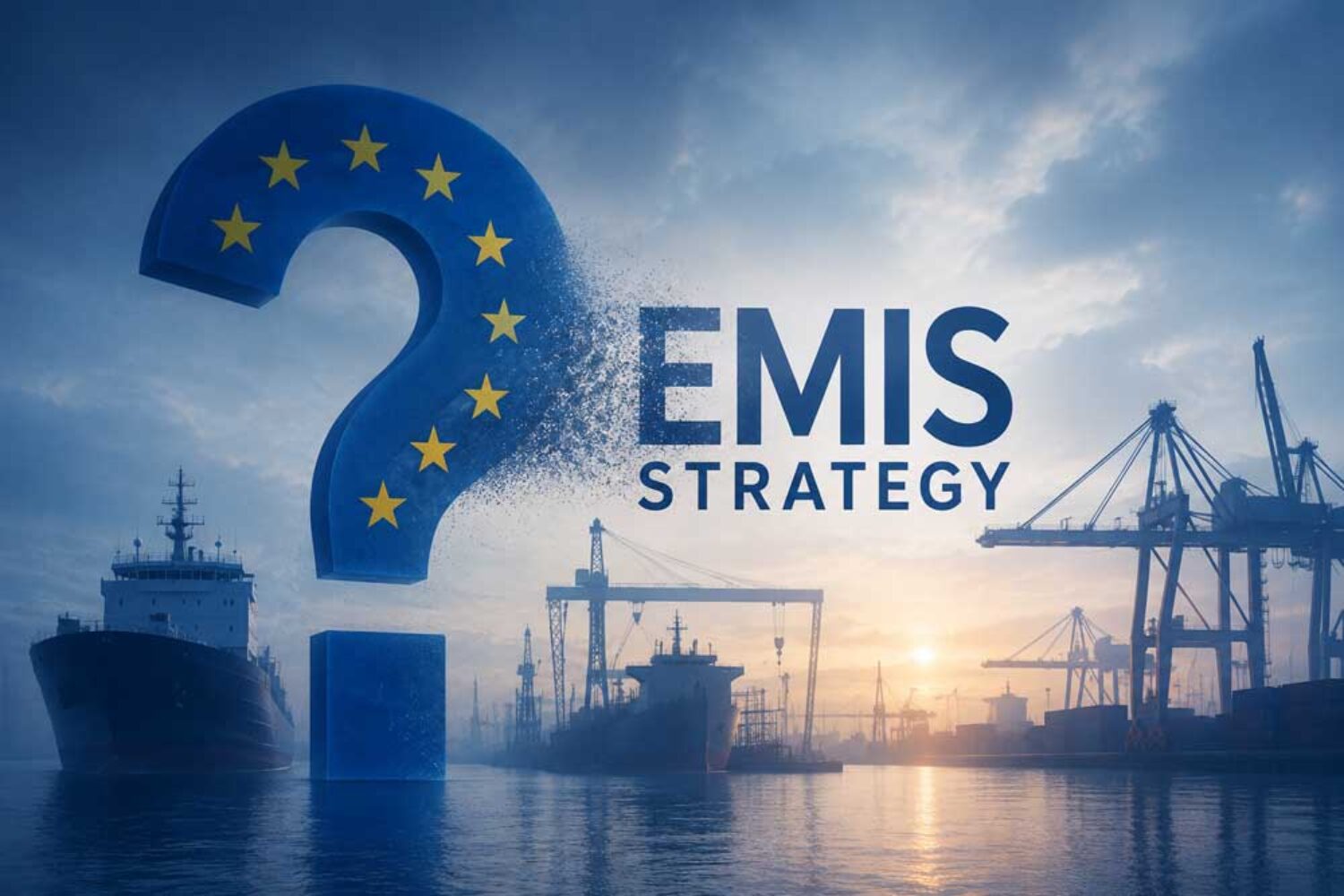
The EU has adopted its first-ever Maritime Industrial Strategy. The document identifies key challenges, but remains vague on financing, governance and implementation. Critics see it as more of a vision than an industrial policy.
Brussels has delivered – at least on paper. On 4 March 2026, the European Commission adopted its first standalone Industrial Maritime Strategy (COM(2026)111 final), and on 8 June, the EU Transport Council approved the associated conclusions. For the German Shipbuilding and Ocean Industries Association (VSM), this is an “important signal”.
Reading through the 29-page document, one encounters a familiar pattern: problems are identified, instruments outlined, funding from the Commission’s own budget programmes pledged – the actual implementation at shipyards, national procurement authorities and in training systems is delegated to Member States, market players and follow-up procedures.
Strong diagnosis, weak remedy
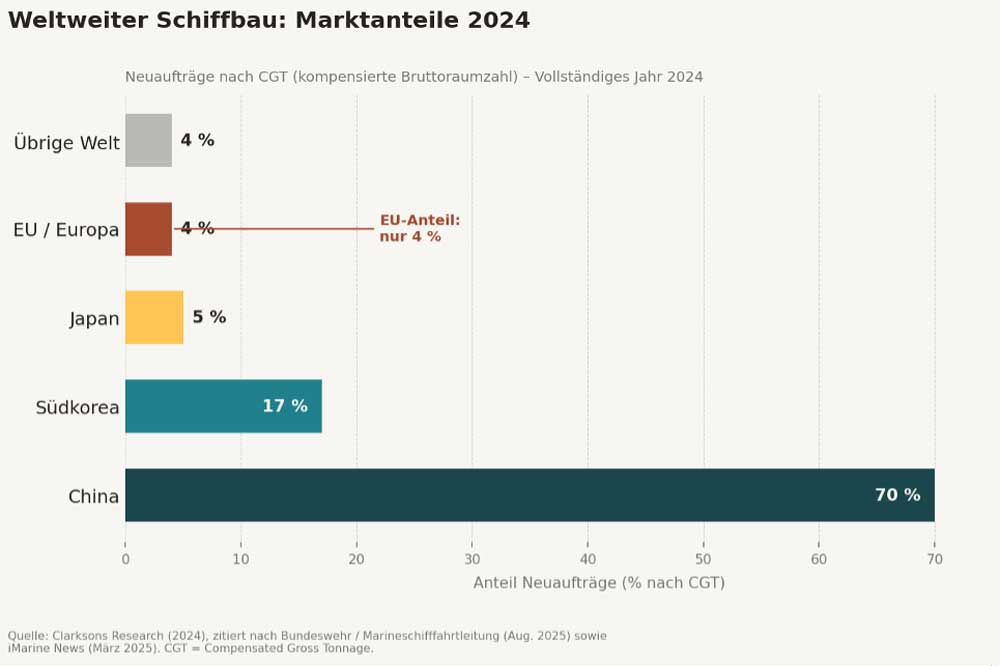
The EU’s Industrial Strategy for the Maritime Economy (EMIS) (COM(2026)111 final) is unsparing in its analysis of the problems. The EU’s market share in global shipbuilding has fallen to around five per cent. China holds almost half of the world market, buoyed by state subsidies running into the hundreds of billions and a vertically integrated value chain stretching from steel to electronics. According to SEA Europe, the association of European shipbuilders and marine technology companies, Europe has fallen below the critical mass: fewer orders force a reduction in capacity, higher prices lead to even fewer orders – a self-reinforcing downward spiral.
The EMIS sets ambitious goals: maintaining technological leadership in specialist segments (including research vessels, cruise ships and ferries) and strengthening the shipbuilding industry. The Commission calls for climate protection, digitalisation and maritime safety, but operates with familiar means: EU funding programmes, research initiatives and state aid (under existing guidelines) are to continue to finance shipbuilding and fleet retrofitting. It aims to connect key sectors (‘Value Chains Alliance’) and modernise innovation pipelines and port infrastructure.
All relevant topics are addressed — supply chains, modular manufacturing, series production, skilled workers, financing, dual-use, digitalisation, safe ports, alternative fuels. The Commission has set itself over sixty individual measures with deadlines.
Yet where the actual implementation must take place, the document remains non-binding: Member States are invited, encouraged and urged. A total funding figure is missing. There is no governance structure in place that extends from the Commission through the Member States to shipyards, suppliers and training providers. EMIS appears less like a strategy and more like a well-formulated wish list.
Looking outwards
An international comparison highlights what EMIS lacks: a state-led steering mechanism that structurally enshrines binding commitments – rather than relying on cooperation from Member States.
The US Maritime Action Plan (MAP) of February 2026 sets out targets and figures: at least 150 billion US dollars in committed investment, a planned Maritime Security Trust Fund with mandatory funding, a universal tonnage tax on foreign-built ships, Vendor Activation Grants to develop second- and third-tier suppliers, and multi-year contracts as a key procurement tool. McKinsey estimates the additional labour requirements of the US shipbuilding industry at up to 250,000 skilled workers; the MAP responds with expansion plans for the Merchant Marine Academy and scholarship programmes.
The UK makes government demand the cornerstone of its industrial policy: the National Shipbuilding Office coordinates a public order pipeline of over 150 ships spanning thirty years — this provides shipyards with investment security, suppliers with predictability and training providers with lead time. France steers the industry through ownership rights: the state holds shares in strategic shipyards and makes industrial policy decisions directly, rather than through grant application procedures.
Connectors
Resilient supply chains are created by mapping critical dependencies in ship engines, propulsion systems, alloys and maritime electronics. EMIS calls for diversification but has yet to produce an action plan with funding figures.
Scalable production requires long-term order pipelines. The EMIS responds with ‘Shipyards of the Future’ under Horizon Europe – an R&I programme that does not build manufacturing capacity. The industrial lever – the integration of other maritime economic components such as cranes, cargo-handling equipment and fleet financing – is not being utilised.
Rapid innovation requires regulatory testing grounds with an accelerated certification pathway. EMIS outlines testbeds – without resources, without governance, without a regulated path from the funding framework to the production line.
Workforce readiness. The EMIS dedicates a separate pillar to skilled workers: university networks, expansion of the Erasmus programme, reskilling. However, the 250,000 retraining needs identified relate to seafarers, not shipyard workers. How many skilled workers the shipbuilding industry will need by 2030 remains unquantified — no budget, no commitment, no timetable.
New industry alliances. The Value Chains Alliance announced for 2026 is conceptually sound, but is described throughout the document merely as a discussion platform — without a mandate, governance or decision-making powers.
Standardisation. A structural shortcoming is not addressed: the fragmentation of national ship specifications. Without standardisation, there can be no series production; without series production, no cost reduction; without cost reduction, no strategic resilience. The EMIS leaves this lever untapped.
System engineering and programme management. FREMM and the Belgian-Dutch collaborations (rMCM, ASWF) demonstrate that cross-border series production can succeed — provided that the platform, specifications and system architecture are jointly defined in advance and a lead nation, with a prime contractor, assumes responsibility. In contrast, the F126 programme demonstrates that even clear contractual structures can fail if contractors introduce immature technologies and clients refuse to adopt digital processes. Such implementation failures cannot be remedied by strategy papers — but a robust EU industrial policy could set minimum standards for digital systems engineering and certification processes in multinational procurement projects.
The EMIS addresses neither the formula for success nor its opposite.
Vision rather than commitment
EMIS marks a political consensus that did not exist five years ago. The recognition of the maritime industry as strategic infrastructure is a real step forward. But consensus alone does not build shipyards – and without shipyards, there are no ships.
European cooperation in shipbuilding needs a different operating model: fewer national special interests, more robust digital toolchains, clearer responsibilities, earlier industrialisation planning and realistic interface management.
This raises the following questions following the implementation of the EMIS, which has so far been rather intent-driven: Will the Value Chains Alliance be given a genuine mandate? Will multi-year contracts be negotiated? Will the OECD Shipbuilding Agreement be revived or an alternative anti-dumping instrument created? Will skilled labour requirements be quantified and training capacities ramped up?
Until these questions are answered, the situation remains as the EU Council of Ministers itself acknowledges in its resolutions (ST-9700-2026): the instruments referenced in the EMIS have so far had “a rather limited impact on the maritime industry”. The diagnosis has been made, and the same prescription has been rewritten. This is not a change of course, but rather continuity rather than strategy. HUM