



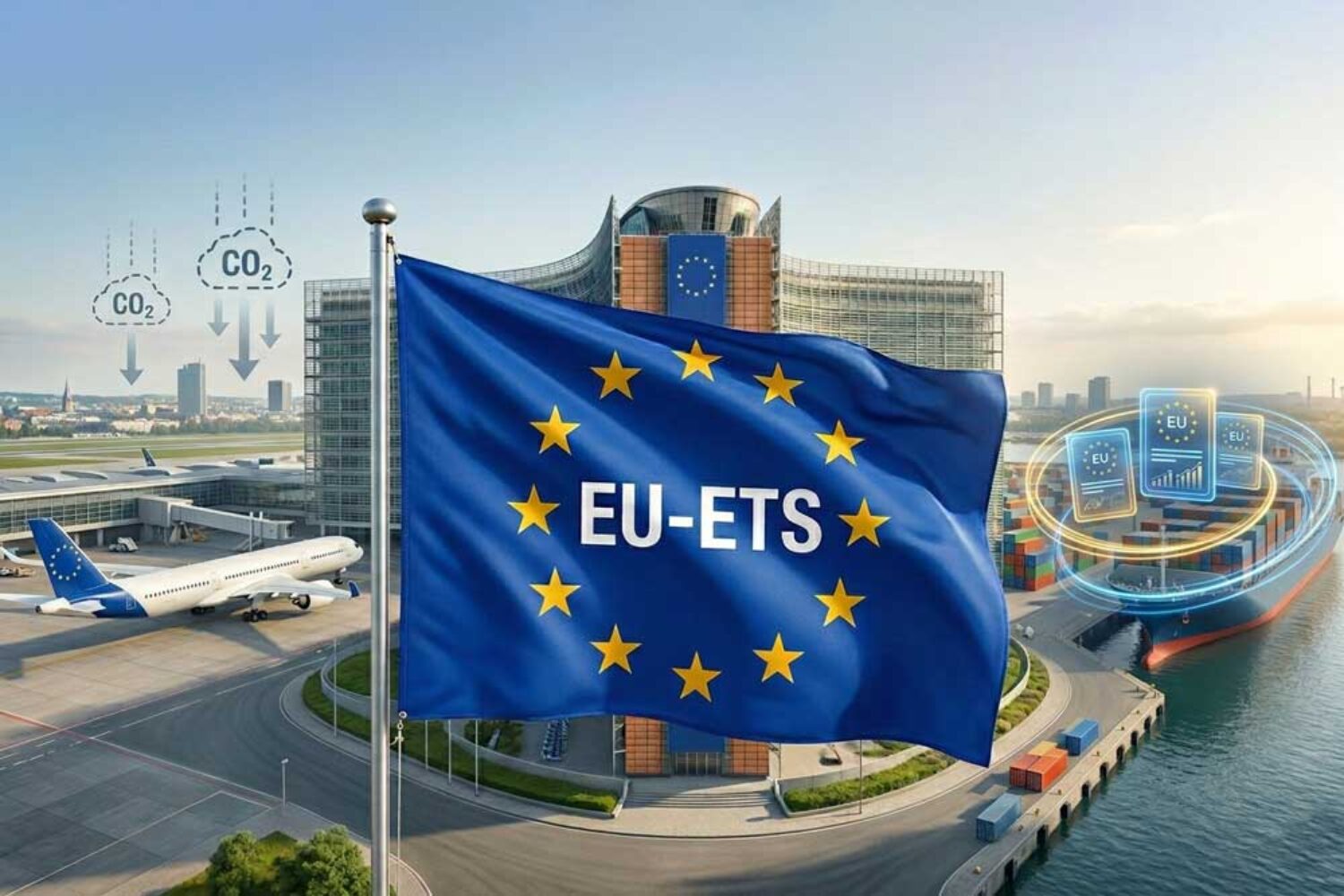
The European Commission is planning to earmark revenue generated by the EU Emissions Trading Scheme (EU ETS). The shipping industry believes there is still room for improvement in the draft proposal.
The Commission’s proposal provides, amongst other things, that the revenue generated by the EU ETS is earmarked for specific purposes at both national and EU level. According to the European Community Shipowners’ Associations (ECSA), around 110 million emission allowances have been set aside for the shipping sector, corresponding to a value of around €10 billion. At national level, 50 per cent of the revenue will be earmarked for specific purposes by the Member States, with the decarbonisation of shipping being a top priority.
The association also supports the plan to introduce and make sustainable fuels available – describing this as “a long-awaited and important step in the right direction”. As alternative fuels are on average around four times more expensive than conventional fuel, the ECSA considers subsidies to be essential.
The association also praised the plans to simplify reporting requirements in the offshore sector – this applies to both the EU ETS and the FuelEU Maritime Regulation. This will reduce the administrative burden on shipping companies; furthermore, the proposal ensures a level playing field for European offshore operators.
Clean technologies not sufficiently taken into account
However, in the ECSA’s view, the proposal fails to provide sufficient support for energy efficiency projects and the introduction of clean technologies; it falls short of promoting the full spectrum of technologies, as envisaged in the Commission’s proposal for the ‘Industrial Accelerator Act’.
The exemptions for small islands, ice-class vessels and outermost regions are merely extended until 2035, rather than applying for the entire duration of the scheme. Furthermore, according to ECSA, any proposal to strengthen the competitiveness of EU ports must preserve the integrity of the system and ensure a level playing field for all segments of the shipping industry.
The proposal makes progress with regard to the IMO process by committing to avoiding double payments in the event of an international agreement. However, it has failed to send a “strong signal” to international partners that the EU ETS will be repealed as soon as an IMO agreement is adopted.
“A clear signal is missing”
“The Commission has today taken a first step towards earmarking ETS revenues at EU and national level,” said Sotiris Raptis, Secretary-General of ECSA. “Support for sustainable fuels is welcome and necessary to ensure their availability at European and global level. In this context, the support for the availability of fuels in third countries is encouraging.”
However, according to Raptis, the proposal falls short when it comes to introducing clean technologies, as it limits support to wind power and electricity. Technologies that can rapidly increase energy efficiency and deliver immediate emissions reductions are not taken into account.
With regard to the IMO process, progress has been made through the commitment to avoid double payments. “However, there is still no clear signal to the international community that the EU ETS will be phased out once a global agreement has been reached,” said Raptis.
Reducing the price differential is an “effective method”
The World Shipping Council (WSC) also welcomed the revisions to the emissions trading scheme. The announced mechanism follows the logic already applied in the aviation sector: by reducing the price difference between conventional and alternative fuels, their use can be promoted, investment in production supported, and Europe established as a leading hub for refuelling with alternative fuels.
“The liner shipping industry has already invested more than 160 billion euros in ships capable of running on renewable fuels; however, these cleaner ships also require cleaner fuels,” said Simon Bergulf, Vice President for Environment and Climate at the World Shipping Council. “Reducing the price differential is one of the most practical ways of getting these fuels into ships’ tanks.”
However, the WSC views with concern the Commission’s proposal to expand the list of neighbouring non-EU ports designated as transhipment ports solely on the basis of infrastructure. Ports within 150 sm of the EU could be disadvantaged simply because they have deep-water areas, long berths and container gantry cranes – regardless of whether transhipment actually takes place there.
“The focus of the ETS should be on reducing emissions, not on undermining the competitiveness of neighbouring non-EU ports,” said Bergulf.
Stable framework remains in place
The Danish Shipowners’ Association, Danish Shipping, also reacted largely positively to the planned changes. “It is to be welcomed that the Commission is maintaining a stable framework for the EU Emissions Trading System (EU ETS). Shipping companies need clear and long-term rules when making substantial investments in the green transition,” explained Nina Porst, Head of Sustainable Ships and Skills at Danish Shipping.
The Commission has listened to the industry. Shipping companies have already invested billions in ships capable of running on green fuels; however, no such fuels are currently available for refuelling. “It is therefore positive that funds from the ETS are now to be used more extensively to promote the green transition in areas where there were previously gaps in the value chain,” the association stated.
“If the industry is contributing billions, these funds should also help to drive change in shipping where the need is greatest – both through solutions that reduce emissions here and now, and through the technologies and infrastructure needed to scale up the green fuels of the future,” said Porst.
Danish Shipping also welcomed the Commission’s decision to maintain the current geographical scope of the EU ETS. This supports the aim of achieving global solutions through the UN’s International Maritime Organisation (IMO). At the same time, it is important that the Commission intends to adapt EU regulations as soon as a global climate agreement for shipping comes into force, to ensure that shipping companies do not have to pay twice for the same emissions.
The Commission’s revised proposal is due to be negotiated between the European Parliament and the Council in autumn 2026; a possible agreement is expected in the first half of 2027, with implementation scheduled for 2028.