





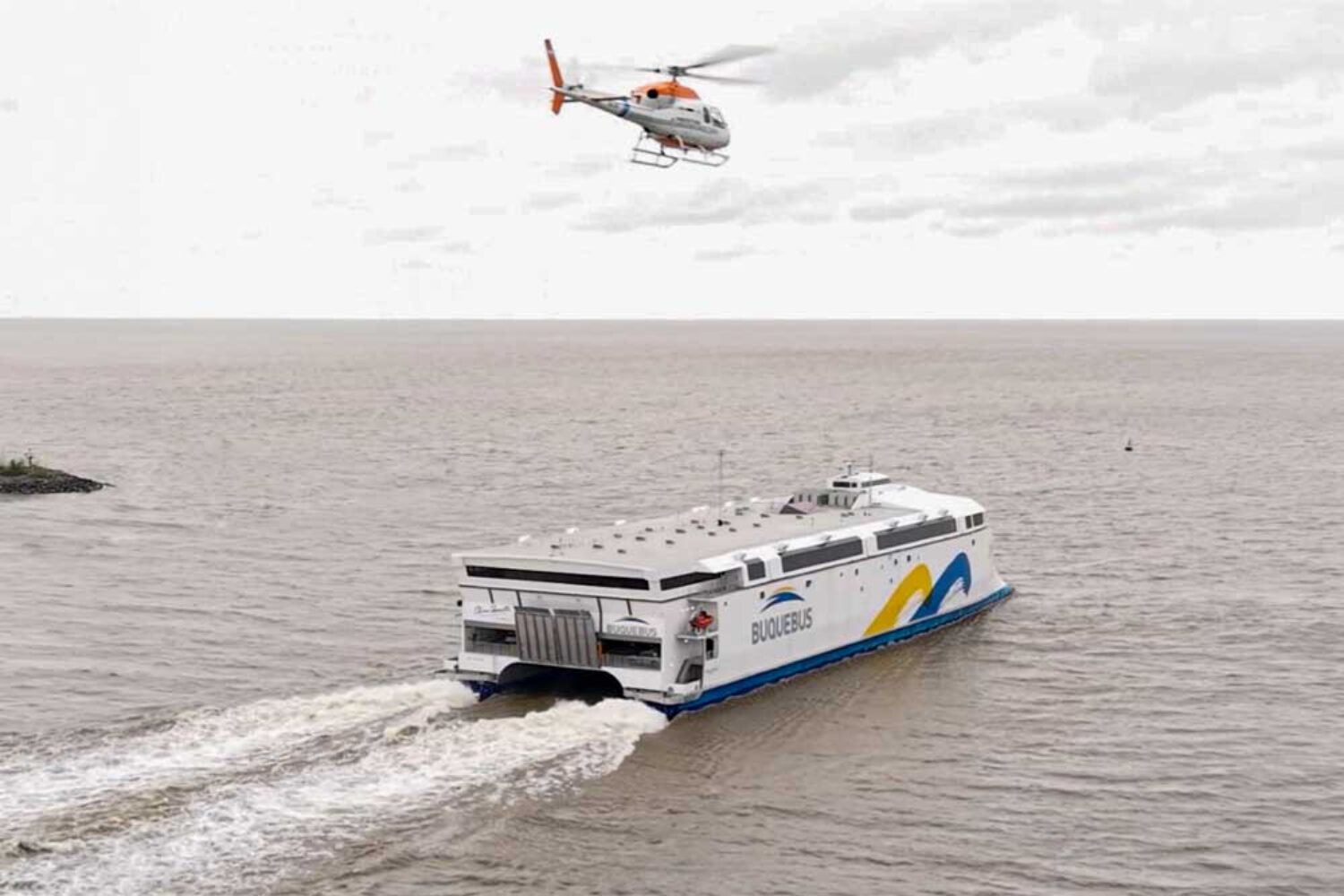
The “China Zorrilla” has completed its maiden voyage between Buenos Aires and Colonia. The battery-powered ferry was built by the Australian company Incat Tasmania.
Following a lengthy period of planning and construction, Incat Tasmania recently delivered the “China Zorrilla” to its client, Buquebus; the vessel has since completed its maiden voyage between Buenos Aires (Argentina) and Colonia (Uruguay), thereby commencing commercial passenger services.
Measuring 130 metres in length, the “China Zorrilla” is the largest electric vessel ever built to date. It can carry up to 2,100 passengers and 225 vehicles across the Río de la Plata. Originally, the vessel was intended to be powered by LNG; however, Buquebus ultimately opted for a fully electric battery-powered propulsion system.
The start of operations was preceded on 21 October by an official inauguration ceremony in Buenos Aires, attended by, amongst others, Craig Clifford, Managing Director of Incat, representatives from Buquebus, and maritime authorities from Argentina and Uruguay. The two companies have been working together for several years and intend to continue this partnership in the future.
Robert Clifford, Chairman of Incat, described the vessel’s commissioning as one of the proudest moments in the company’s history. “This is a truly historic day for Incat, for Tasmania and for the global maritime industry,” he said. Hundreds of employees had worked for years at the shipyard in Hobart to bring this vessel to fruition, overcoming major technical challenges in the process. “The fact that this vessel is now carrying passengers in commercial service – and running purely on battery power – is an incredible achievement and a moment of great pride for everyone who has been involved in this project,” said Clifford. The transition to electric shipping is therefore no longer merely a vision for the future.
“’China Zorrilla’ was an “extraordinary moment”
According to Incat, the “China Zorrilla” is proof that even large commercial vessels can be powered entirely by electricity. It also offers passengers a new kind of travel experience, free from noise, exhaust fumes and vibrations.
“What makes this achievement even more remarkable is the fact that it all began in Tasmania,” said Clifford. “The skill, ingenuity and determination of our workforce have produced something that will be talked about in the maritime industry for years to come.”
For Incat Managing Director Craig Clifford, the commissioning of the “China Zorrilla” was an “extraordinary moment”. “Having watched this vessel take shape in Hobart over so many years, it is now incredibly fulfilling to see it doing exactly what it was designed and built to do,” he said. “It’s one thing to talk about what electric shipping can achieve – it’s quite another to experience it for yourself. I think passengers will be genuinely surprised at how different this ship feels.”
The vessel is fitted with batteries weighing a total of more than 250 tonnes and an energy storage system with a capacity of over 40 MWh, which powers eight electrically driven water jets. The ferry, designated ‘Hull 096’, will not be the only large newbuild to come out of Tasmania: Incat is currently building three 129-metre-long electric ferries for the Danish shipping company Molslinjen. In addition, there are two 78-metre-long hybrid-electric vessels, the first of which is due to be available for charter operations from January 2027.