



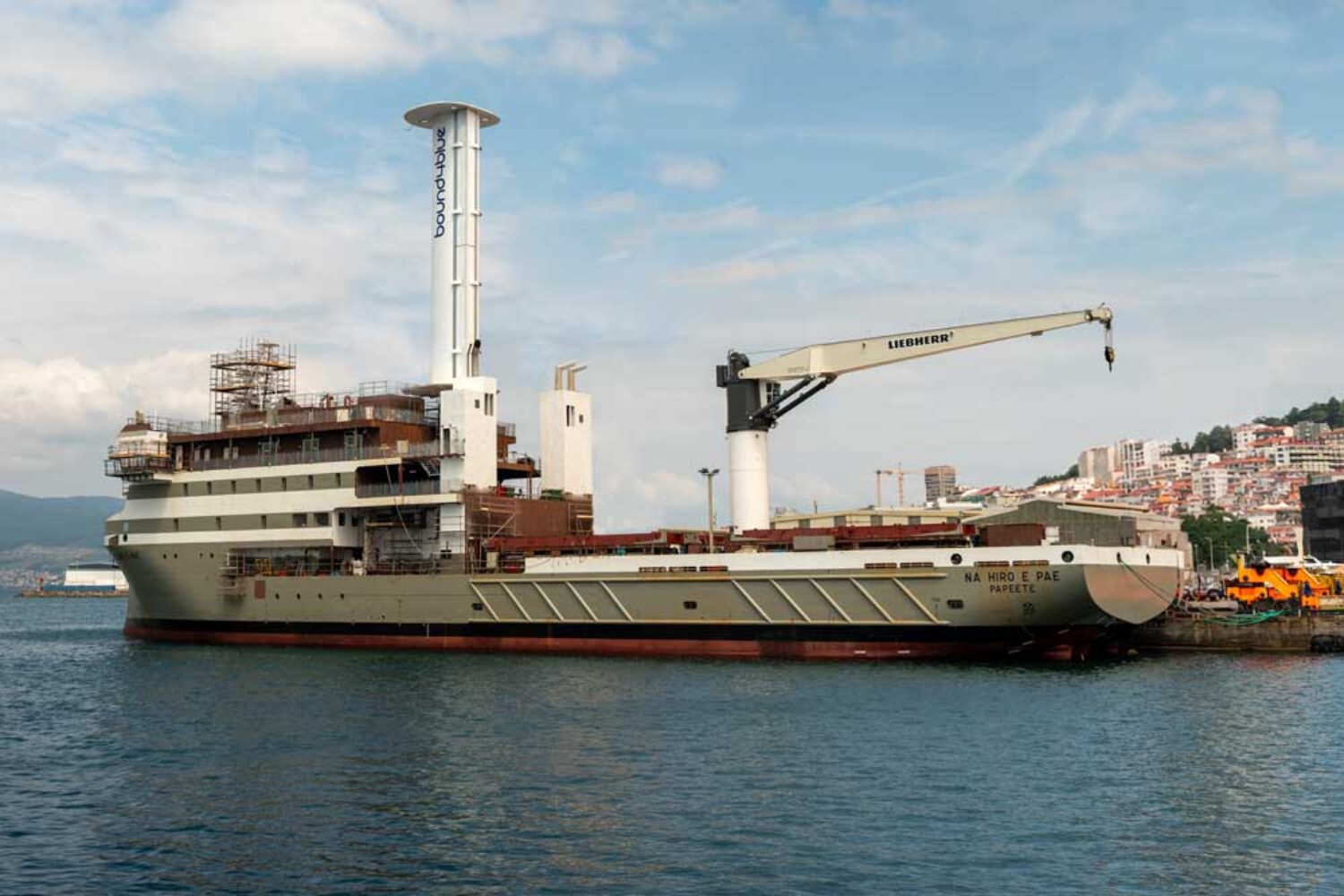
The new multi-purpose cargo ship “Na Hiro E Pae“ has set sail in remote Pacific regions. The ship ill be powered by wind energy and a “mix of green technologies“.
The “Na Hiro E Pae” (3,612 GT) was built at the Spanish shipyard Astilleros Armon Vigo. The multi-purpose freighter, operated by the shipowner Société de Navigation des Australes (SNA) Tuha’a Pae Shipping Company, connects the island of Tahiti with the remote Austral Islands in French Polynesia.
The vessel carries passengers, food and general cargo, and is thus intended to serve as a “vital transport link“ between the archipelagos. In the region, these cargo ships are known as “goelettes“, a term derived from the schooners that used to supply remote islands. Tahiti and the Austral Islands are separated by approximately 600 km of the Pacific Ocean (depending on the destination).
The “Na Hiro E Pae” is the first vessel of its kind to be fitted with a so-called “eSail” from Bound4Blue. It is 22 metres high and, according to the Spanish company, is capable of generating up to seven times more thrust than conventional, rigid sail technology. The suction sail is also intended to form part of a green tech-mix used to power the vessel. This includes engines that can run on biofuel or e-fuels, electric pod propulsion systems, efficient waste management and a self-sufficient fresh-water supply. According to Bound4Blue, this marks the first time that an advanced wind-assisted propulsion system (WAPS) has been installed on a multi-purpose vessel of this kind, and also the first use of such technology in this shipping segment.
An important service in the region
The “Na Hiro E Pae“ can accommodate up to 200 people and is intended to provide an “indispensable, affordable“ transport link for schoolchildren, families and workers. It also features efficient cargo handling processes that enable the rapid loading and unloading of up to 1,500 tonnes of goods for the South Pacific archipelago, making the project particularly valuable for the region.
“Multi-purpose vessels have traditionally been regarded as a challenging segment within the wind energy sector, due to the operational flexibility required and the associated integration demands,” said José Miguel Bermúdez, CEO and co-founder of Bound4Blue. “This project demonstrates how system suppliers, naval architects, shipowners and other key players can overcome such challenges through close collaboration and drive progress forward. We are particularly pleased to have been selected alongside so many complementary technologies. This is a concrete example of how shipowners can combine different solutions to optimise both their environmental footprint and economic efficiency. We hope that the ‘Na Hiro E Pae’ will serve as a model for other ambitious shipping companies seeking to realise sustainable benefits.”
Designed for performance
The eSail system is expected to reduce the vessel’s energy consumption by approximately 10%. It will also improve the EEDI and CII ratings of the newbuild, which was designed by the design firm Cotenaval.
The freighter forms part of a wider effort to modernise maritime transport links to the Austral Islands, whilst supporting sustainability goals and local economic development. The project has already received funding under the French Polynesian government’s “Appel à Manifestation d’Intérêt” initiative, recognising its contribution to fleet renewal, regional connectivity and environmental performance.
Boris Piel, Technical Director of the SNA Tuha’a Pae Shipping Company, said: “With the completion of this installation, we are one step closer to commissioning a new-generation vessel for the residents of the Austral Islands.” He added that sustainability had been a key objective throughout the development process. Piel described the eSail system as a key component of the technology package, which will help to reduce energy consumption and environmental impact whilst maintaining the reliable transport services on which island communities depend.
“This project demonstrates that innovation and practical application can go hand in hand,” he said. “We are proud to be leading the way in the use of wind propulsion technology on a vessel of this type, and look forward to seeing the benefits in day-to-day operations.”
Bound4Blue has now installed its eSail systems on twelve vessels, including, for example, Odfjell’s “Bow Olympus“. A further six vessels are on order, bringing the total number of sails to over 50. The autonomous units, which do not require ATEX certification, take the strain off the ship’s engines, lower fuel consumption (with savings in the double-digit percentage range) and reduce greenhouse gas emissions, bringing both regulatory and financial benefits.