





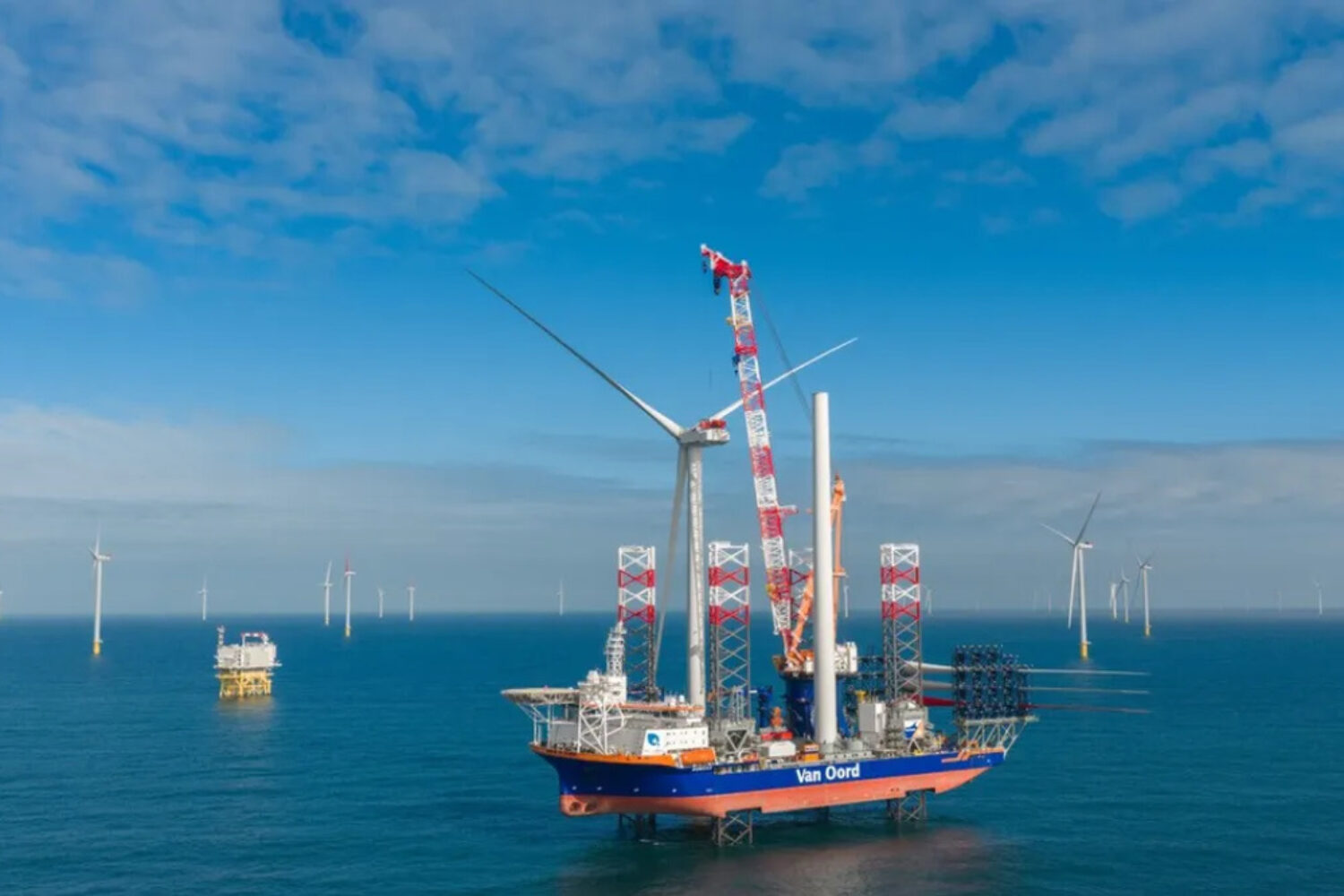
Dutch marine contractor Van Oord and wind turbine manufacturer Vestas have completed the installation of all 52 wind turbines at the “Ecowende” offshore wind farm. The installation vessel “Boreas” was used for the project.
With the installation of the final wind turbine, the “Ecowende” offshore wind farm off the Dutch coast has reached the final phase of construction. The wind farm is situated around 53 km off IJmuiden in the Hollandse Kust West wind energy zone, Lot VI. Full commissioning is scheduled for the end of 2026.
The first turbine was installed on 30 May. This means that the installation of all 52 turbines took around five months. The Danish manufacturer Vestas supplied the V236-15.0 MW wind turbines and is responsible for their installation and commissioning.
Van Oord handled the transport of the turbines from the port of Eemshaven to the wind farm using its new offshore installation vessel, the “Boreas”. The vessel is equipped with a main crane with a lifting capacity of 3,310 tonnes and was specially designed for the installation of large offshore wind turbines.
Van Oord had previously been responsible for the transport and installation of the 52 monopile foundations, the laying of the internal cables within the farm, and the construction of erosion protection on the seabed.
“The successful deployment of our new offshore installation vessel, the Boreas, demonstrates what the vessel is capable of during such a complex installation campaign,” emphasises Jan Willem Elleswijk, project manager at Van Oord.
Wind farm set to become fully operational by the end of 2026
“Ecowende” is a joint venture between Shell, Eneco and Chubu. The offshore wind farm is expected to have an installed capacity of around 760 MW, which would theoretically cover approximately 3% of the Netherlands’ current electricity demand. Electricity was generated for the first time as early as July 2026.
A distinctive feature of the project is the range of measures designed to protect the marine environment. These include greater distances between individual turbines, raised nacelles and radar-based monitoring systems with AI-supported species recognition. Furthermore, one rotor blade on each of seven wind turbines has been painted red to improve visibility for birds.
New concepts are also being trialled underwater. These include alternative designs for erosion protection, additional openings in monopiles to provide refuges for fish, and artificial reef structures at cable crossings. Whether these measures actually help to reduce bird collisions and promote biodiversity will be investigated during ongoing operations.