


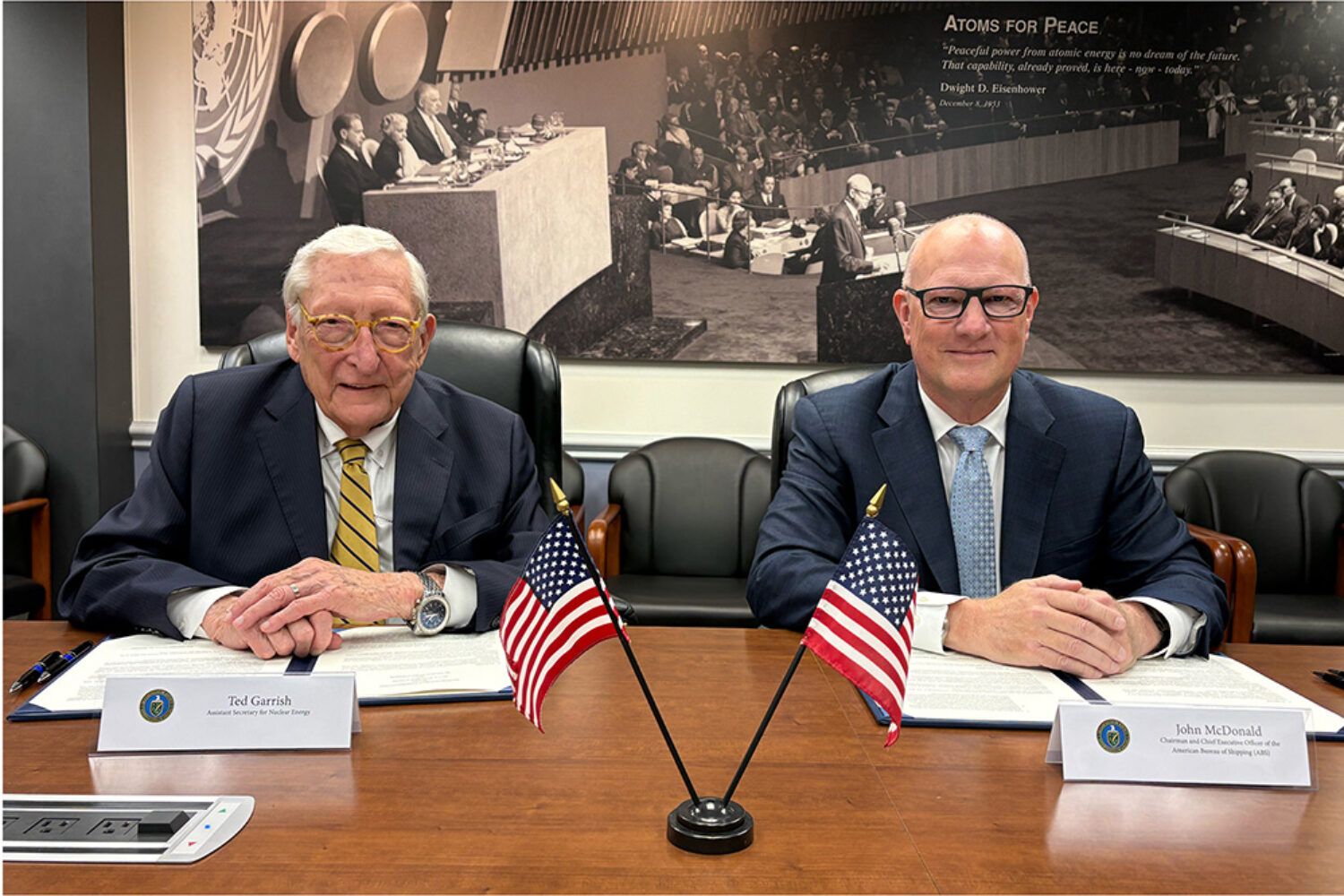
The US Department of Energy and the classification society American Bureau of Shipping (ABS) have signed a memorandum of understanding to advance ‘modern commercial nuclear technology’ in the maritime sector.
The agreement covers so-called ‘floating energy solutions’, nuclear-powered vessels and the development of the ports, shipyards and industrial infrastructure required for their construction and operation, as has now been announced.
This is not the Trump administration’s first initiative in this regard. Last summer, the US Maritime Administration (MARAD ) drew up a plan with the company Core Power, which also involved ships and a shipyard.
Key areas of focus in the collaboration with ABS now agreed upon include conceptual and feasibility studies for floating nuclear power plants and nuclear transport corridors, as well as support for the development of a US shipbuilding sector capable of safely build and operate nuclear-powered vessels. ABS is also to coordinate the associated work through MARAD’s “U.S. Centre for Maritime Innovation” (USCMI), for which ABS acts as secretariat.
“Advanced nuclear technology is evolving from concept to application, and the maritime industry must be prepared for this,” said John McDonald, Chairman and CEO of ABS. “This agreement with the DOE reflects the scope of the work already underway and establishes a framework for further steps. Through our collaboration with the DOE and leading industry representatives, ABS is playing a key role in shaping the future of nuclear energy in the maritime sector. We are ideally placed to help make this technology a safe, viable and practical option for commercial maritime applications.”
The DOE leads the US government’s initiatives on maritime nuclear applications. Under the memorandum of understanding, ABS will co-manage the ‘Maritime Nuclear Applications Group’ (MNAG) and provide technical, regulatory, economic and policy support for concept and feasibility studies. ABS will work with the DOE to promote inter-agency coordination aimed at developing a viable US maritime nuclear technology sector.
“Advanced nuclear technology has the potential to transform the commercial maritime industry and open up new markets for American innovation,” said Ted Garrish, Assistant Secretary for Nuclear Energy. “The Department of Energy’s partnership with the American Bureau of Shipping will help build on decades of experience to safely bring next-generation nuclear technologies into the maritime sector and position America as a leading force in this emerging industry.”
According to most experts, the challenge for the deployment of nuclear technology in the civilian sector lies in creating a comprehensive system that is safe, secure, licensable, insurable, financeable and operable on a fleet-scale basis – whilst ensuring clearly defined responsibilities for the integration of nuclear technology, fuel supply, port infrastructure, personnel and support throughout the entire life cycle.
In the shipbuilding sector in the US, construction of the first vessels is scheduled to begin from 2028 – as part of a concept that ‘links shipbuilding by allies with specialised US expertise in the integration of nuclear technology’, it was announced today. The whole initiative is seen as part of a strategy to make nuclear-powered ship propulsion a key component of the revival of US civil shipping – despite all the unresolved issues that still await a solution. The aim is to jointly accelerate the path towards a future fleet of US-flagged, nuclear-powered merchant ships – from a commercial, industrial and regulatory perspective.
Trump views Asian dominance in shipbuilding as a thorn in his side – he has his sights set on China in particular. At the same time, he is looking for ways to strengthen the industry at home. His ‘Maritime Action Plan’ aims to halt the decline of US shipping, mobilise private investment and rebuild an industrial base that the government regards as crucial to economic and national security.