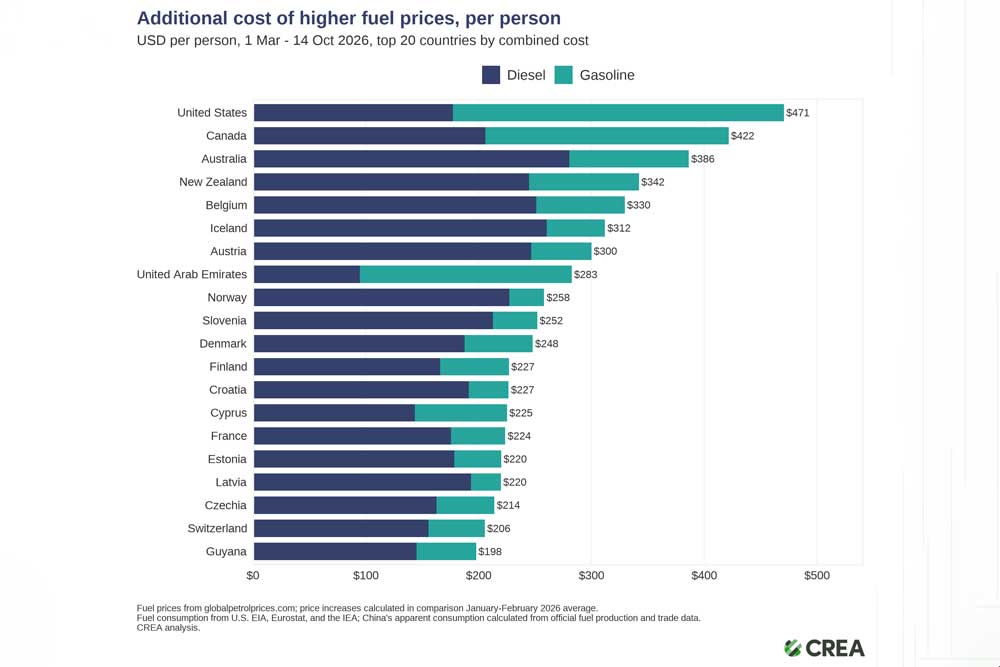







According to an analysis, Americans have been hardest hit by the crisis in the Strait of Hormuz and the resulting rise in fuel prices. Although the US is the world’s largest oil producer, it has had to bear additional costs of $471 per person – more than any other country.
The analysis was carried out by the Centre for Research on Energy and Clean Air (CREA). According to the analysis, the rise in diesel and petrol prices has cost US citizens an additional $471 per person since the start of the US and Israeli attacks on Iran at the end of February – almost eight times the global average of $60.
Canada and Australia, which also have high per capita fuel consumption and transport systems heavily reliant on cars, recorded the next highest per capita costs at $422 and $386 respectively.
Globally, according to the CREA study, the war has increased fuel bills by $468 billion. The US’s share, at $160, accounts for around a third of the total. China ranks second at 54¢, and Canada third at $17 billion.
The analysis also revealed that fuel price rises in the US were similarly high to those in other market economies. However, the US stands out because Americans consume more fuel per person and the country has made comparatively little progress in reducing its dependence on oil.
“America produces more oil and gas than any other country, but that has not protected Americans from the consequences of this war,” said Lauri Myllyvirta, co-founder of the Centre for Research on Energy and Clean Air (CREA). “US consumers are more severely affected than anyone else because they consume so much oil and are therefore exposed to price shocks over which they have no control. The lesson is clear: the best protection against fluctuating oil prices is not to produce more oil, but to need less of it.”
President Trump’s decision to temporarily lift sanctions on Russian diesel earlier this month highlighted the limitations of attempts to lower prices by increasing the supply of fuel. Despite this measure, average diesel prices in the US have risen, reaching $6.28 per gallon on 19 October.
Trump lifts sanctions, price continues to rise
“This war has hit Americans in their pockets,” said Leila Aly El Deen, CEO of the Secure Energy Project. “For families who rely on their cars to get to work, school and the shops, this means additional costs they hadn’t anticipated and which they often cannot afford. Electric vehicles offer a way out, but their upfront costs are high. Trump could make the switch to electric vehicles more affordable so that families aren’t at the mercy of the next global oil price shock, but he only cares about himself and his own class. Trump said he doesn’t think about Americans’ financial situation, and this analysis proves it.”
According to CREA, the average US driver of a petrol car has paid $440 more for fuel since March, based on average mileage and average fuel consumption. The average electric vehicle driver has paid around $17 more for charging.
Sales of electric cars on the decline
Electric vehicles accounted for a total of 7.3 per cent of new car sales in the US in the first eight months of 2026, a fall of three percentage points compared with the previous year. In China, the share stood at 57 per cent, in the European Union at 32 per cent and in Norway at 98 per cent.
Countries that have reduced their fuel consumption since 2023 have been able to cut their costs, according to the analysis. Thanks to lower consumption, China has saved around $10.8 billion and Germany $3.7 billion. Savings in the US totalled $5.7 billion.
According to CREA, the analysis compared retail prices for diesel and petrol in January and February with prices from 1 March to 14 October across 169 countries. Price data from GlobalPetrolPrices.com was used, along with fuel consumption data from the US Energy Information Administration, Eurostat, the International Energy Agency and Chinese government authorities.