


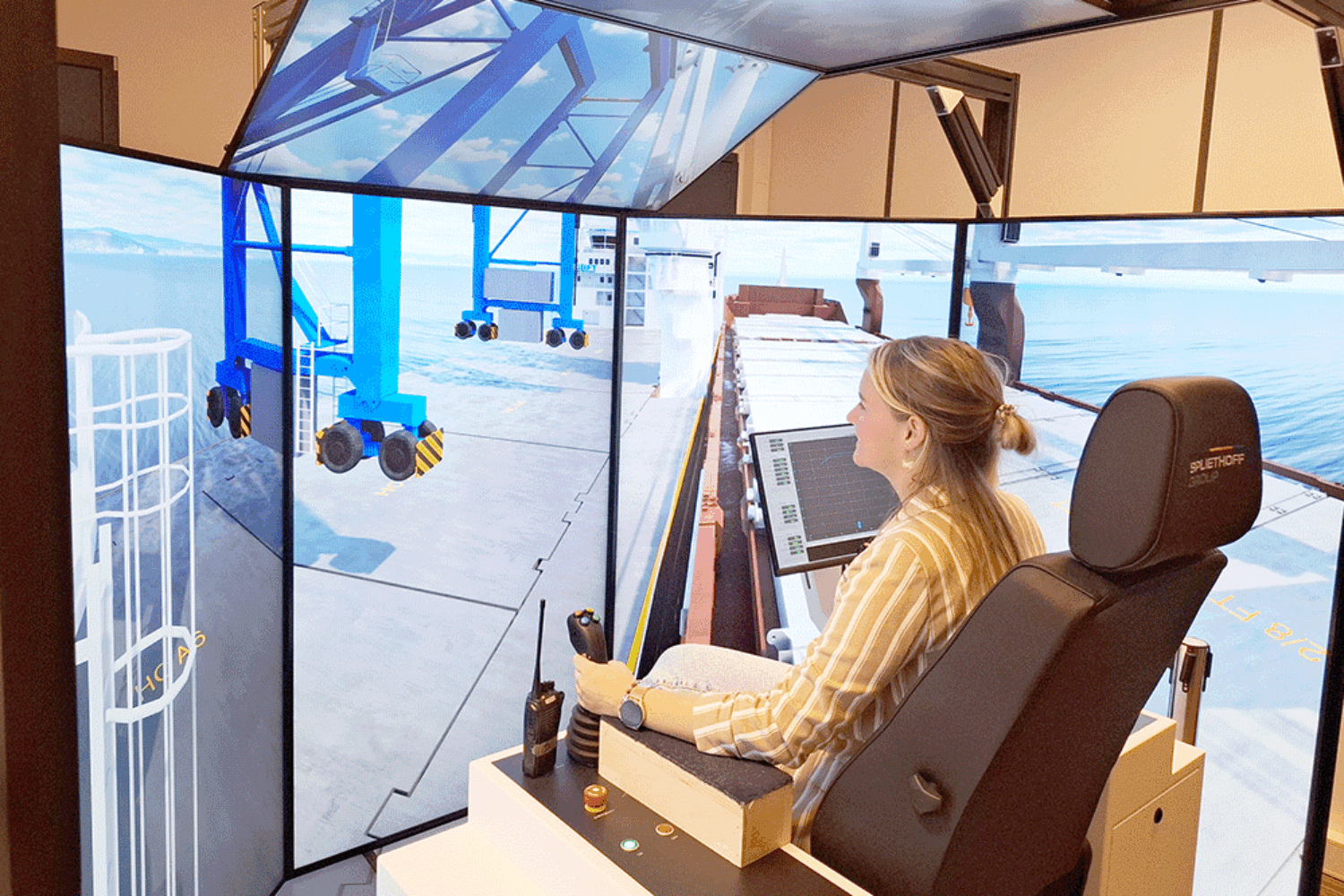
Spliethoff, a shipping company specialising in MPP and heavy-lift operations, aims to better prepare its crews for the demanding crane and cargo operations on board. To this end, a new simulator has now been commissioned.
The Dutch shipping company operates a fleet of 145 vessels – including multi-purpose, heavy-lift, RoRo and semi-submersible vessels. In the global MPP market, it ranks second or third – depending on the calculation – behind BBC Chartering from Leer and the Chinese state-owned shipping company Cosco.
In collaboration with the Maritime Research Institute Netherlands (Marin), a new simulator has now been developed to enable seafarers to practise complex procedures involving cargo handling, heavy-lift loading and ballast management ‘in an extremely realistic and safe environment’. It has now been officially inaugurated in Amsterdam. This is already the second new facility of its kind to have been commissioned within a year. A similar inauguration took place in Manila, in the Philippines, in December 2025.
“Given the increasing complexity and specialisation of maritime operations, the facility strengthens our ability to prepare our crews to carry out work procedures safely across the entire fleet,” according to a statement from the Dutch company.
Using Marin’s Dolphin software, ship movements – caused by waves, currents, wind and lifting operations – are simulated in real time, precisely replicating operational conditions at sea.
Thanks to five interconnected workstations for instructors and operational staff, entire teams can train together and develop the coordination required for critical operations. Four vessel types are available for simulation, including specialised heavy-lift and DP2 vessels from the Spliethoff Group’s fleet.
Beyond training alone, the facility also supports project preparation. Operational teams can carry out virtual dry runs for complex loading operations to assess procedures and operational limits even before they are actually carried out on board. “The Group has been using crane and ballast simulators since 2015 to promote the further development of crews and operational readiness. The new generation of simulators significantly expands the range of procedures that can be practised in a realistic environment,” the statement continues.