







The container shipping industry has been undergoing structural change for several years. Shipping companies are moving away from shared services, but in doing so are taking on greater operational risk.
The last decade of liner shipping has been characterised by highly standardised networks. As the industry service Sea-Intelligence reported in a recent market report, the deep-sea shipping network was still highly consolidated prior to 2017. Shipping companies relied heavily on closely interlinked ‘Vessel Sharing Agreements’ (VSAs), i.e. agreements on the shared use of a vessel. This operational strategy led to a largely homogenised market in which the same physical transport capacity was offered by different shipping companies under different brand names. For charterers, this created the illusion of genuine choice; despite differing offers, they ultimately always booked the same service.
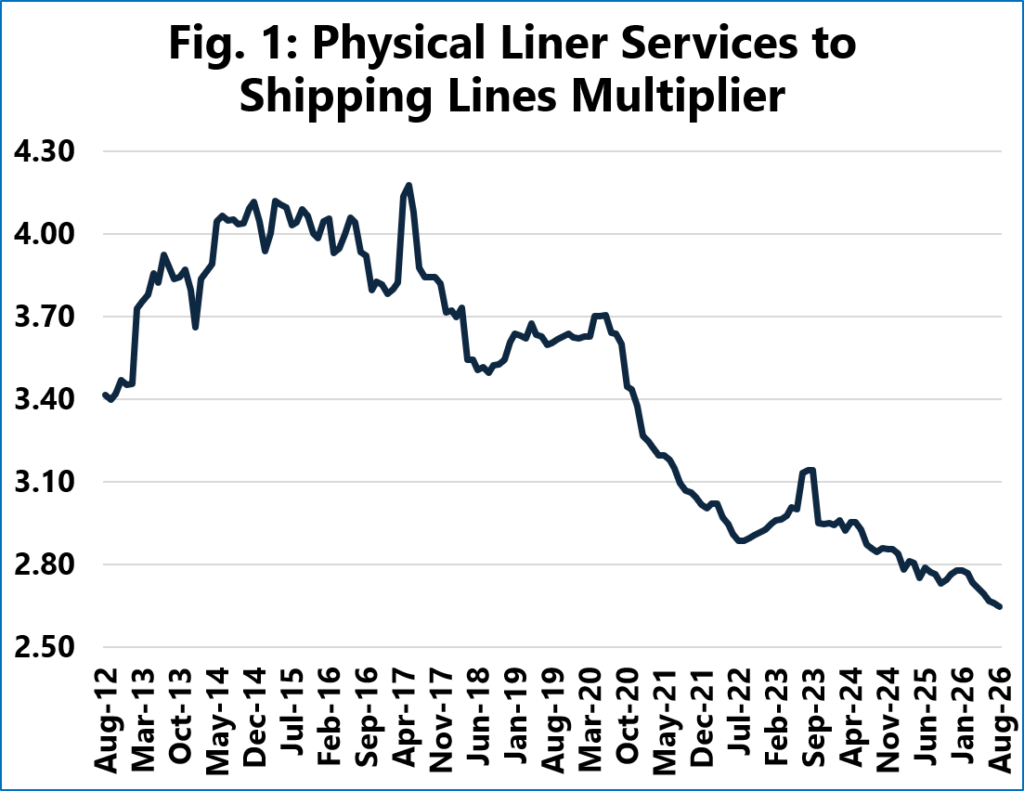
For some years now, however, a change has been observable in the market. As the Sea-Intelligence report indicates, developments in recent years reveal a ‘significant discrepancy’ between the physical expansion of liner networks and the available supply. Whilst there were still around 250 active deep-sea services in 2012 and 2013, this figure is set to rise to over 380 by the end of 2026. At the same time, however, the number of shipping lines actively offering cargo space on these routes has steadily declined. The chart illustrates the average density of shared vessel utilisation in the market.
At the peak of market homogenisation between 2014 and 2016, an average liner service was a heavily shared offering: a single physical liner service was marketed as a product by an average of 4.12 shipping companies. By August 2026, this figure had fallen to just 2.65.
“This demonstrates that shipping lines are reducing their reliance on shared capacity and are instead increasingly moving towards bearing a larger share of the operational risk themselves,” Sea-Intelligence stated. “As a result, the physical route options are becoming increasingly distinct from one another – a sign of the return of genuine operational competition in the market.”