


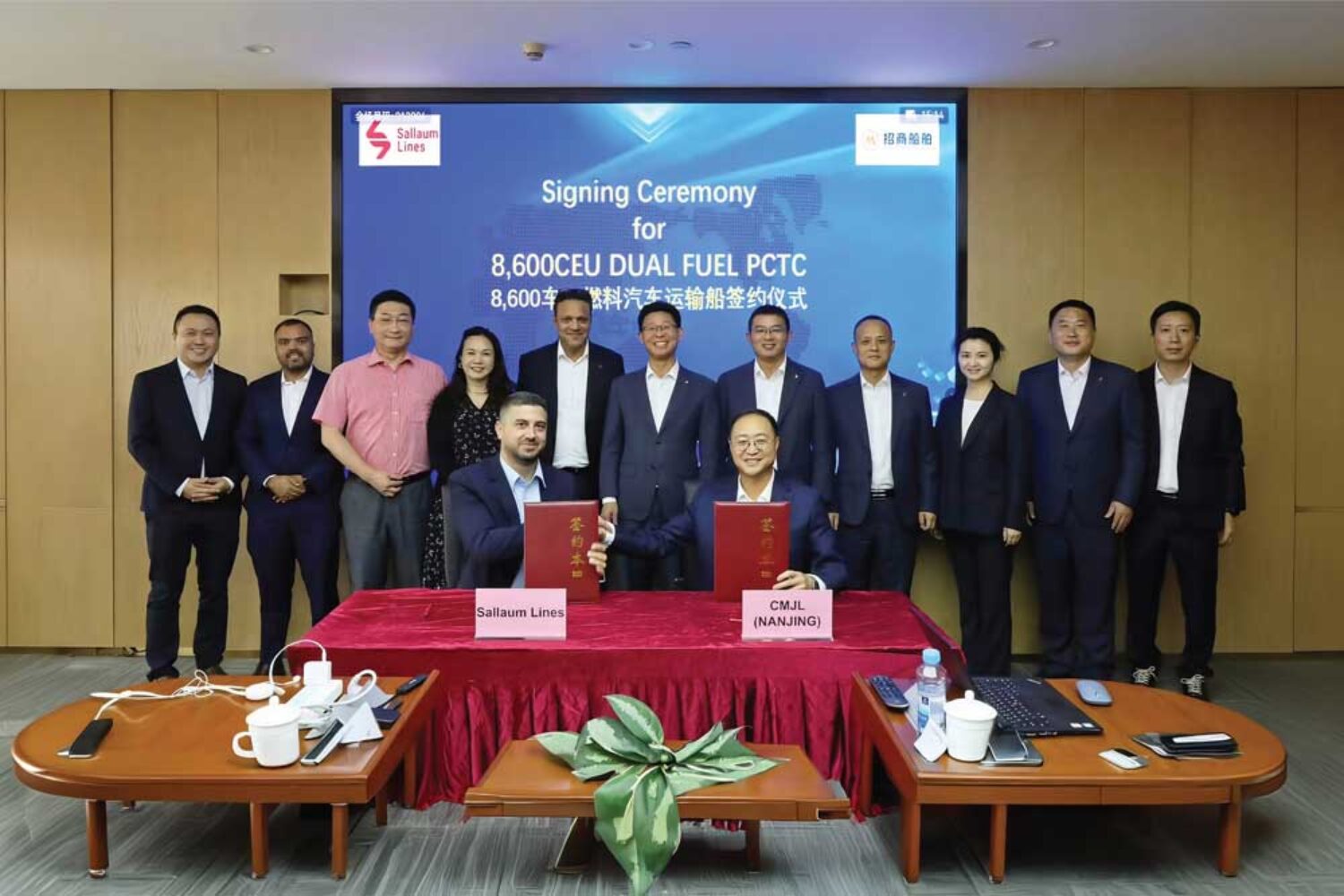
Just a few weeks after its last order, the shipping company Sallaum Lines is placing another order: the next car carrier, with a capacity of 8,600 CEU, is being built at China Merchant Shipyards.
The new vessel will be fitted with a dual-fuel propulsion system and is designed to be capable of running on ammonia in future. Delivery is scheduled for 2029. Sallaum Lines has also included options for a further newbuild in the contract.
The vessel will be designed to carry a wide range of cargo types, including passenger cars, light commercial vehicles, lorries, heavy rolling stock and project cargo. Sallaum Lines’ global trade network serves routes across Europe, Africa, Asia, the Middle East and the Americas.
The company had only recently placed an order for two further vessels with the Xiamen Shipbuilding Industry shipyard. Like the newly ordered vessel, these have a capacity of 8,600 CEU, and there is also an option for two further vessels. In total, the Belgian-based shipping company’s latest order book now comprises nine vessels, with the order value amounting to $850 million. The new-build programme comprises four vessels that have already been delivered, one vessel each scheduled for delivery in August 2026 and December 2026, and three vessels scheduled for delivery in 2029.
The largest vessels in the fleet
The recently announced order for two plus two vessels from Xiamen Shipbuilding marks the next phase of this expansion for Sallaum Lines and introduces larger vessels with a capacity of 8,600 CEU into the company’s future fleet, the shipping company announced.
Hasan Sallaum, Managing Director of Sallaum Lines, regards this new order placed with China Merchants Shipyard as another important step in the expansion of the future fleet: “Just a few weeks after our order for two plus two vessels from Xiamen Shipbuilding, we are delighted to confirm a further order for one vessel with a capacity of 8,600 CEU – with an option for a second,” he said. “This underlines the momentum of our fleet renewal programme and our confidence in the long-term fundamentals of the PCTC market. The automotive logistics market is undergoing change. Customers expect their logistics partners to deliver capacity, reliability, flexibility and a clear commitment to environmental protection. With this new-build programme, we are making targeted investments in all these areas. The new vessel will be fitted with an LNG dual-fuel propulsion system and can be retrofitted to run on ammonia; thereby offering a practical solution for the present whilst also being prepared for the future. This is exactly how we envisage modern fleet development: characterised by scale, discipline and flexibility.”