

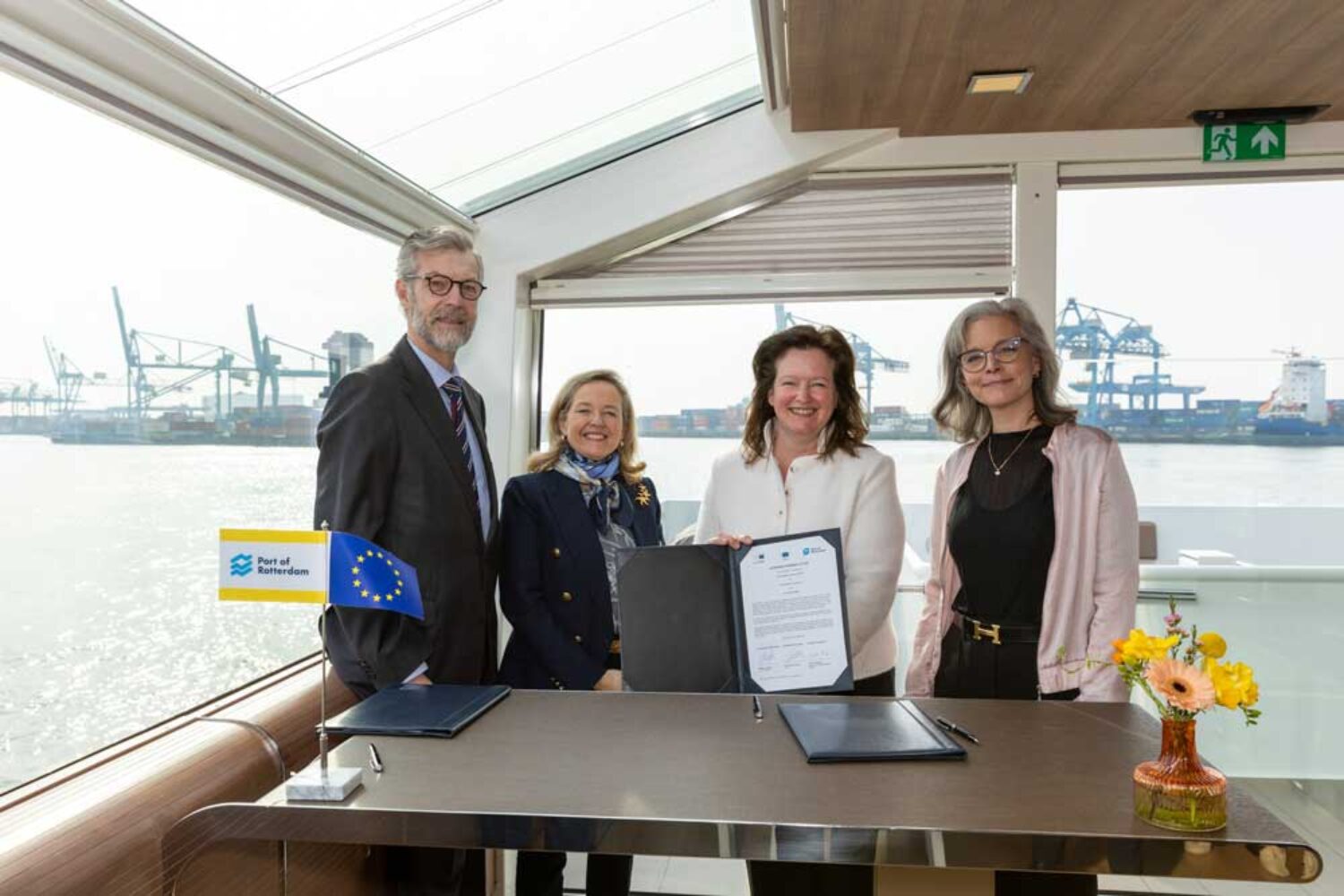
The Port of Rotterdam Authority is planning shore power facilities at three deep-sea container terminals. The European Investment Bank (EIB) is providing a loan of €90 million for the project.
The loan will be granted to the joint venture Rotterdam Shore Power, in which the port authority holds a stake together with the energy company Eneco. Rotterdam Shore Power will install the shore power systems, install the grid connection and carry out additional cable, construction and earthworks. In total, quay facilities over a length of 8 km will be equipped with shore power. 35 connection points for container ships are planned. They are to be gradually put into operation from the second half of 2028.
In addition to the EIB loan, the project will receive a grant from the European Commission, as the port authority announced. This additional €70 million will be made available through the Alternative Fuels Infrastructure Facility, which is part of the Commission’s Connecting Europe Facility.
“Rotterdam is Europe’s most important port and continues to focus on innovation to maintain its leading position,” said EIB Vice-President Robert de Groot about the loan. “Connecting large container ships to shore power is an important step away from fossil fuels. It’s good for the environment, air quality and public health. And it’s good for our economy because it makes Europe less dependent on energy imports from distant regions. The geopolitical situation shows that Europe needs more autonomy in its energy supply.”
Vivienne de Leeuw, CFO Port of Rotterdam, called shore-side power an important building block of the energy transition – and for the port’s competitiveness, which aims to be climate-neutral by 2050. “Investments like these are essential for this,” she said. “They bring our climate targets within reach and strengthen the port’s role as a sustainable, future-proof container hub in north-western Europe.”
“The geopolitical environment is forcing Europe to make important decisions,” said Cecilia Thorfinn, Acting Head of the European Commission Representation in the Netherlands. “We must remain competitive and at the same time become more energy independent. For Rotterdam as Europe’s largest port, more sustainable transport is crucial to stay connected. With grants from the Connecting Europe Facility, the European Commission is supporting the ambitious expansion of the infrastructure for alternative fuels that is necessary for this.”