




More than one in ten cargo units inspected last year were found to have safety defects. This is according to new data from the World Shipping Council (WSC).
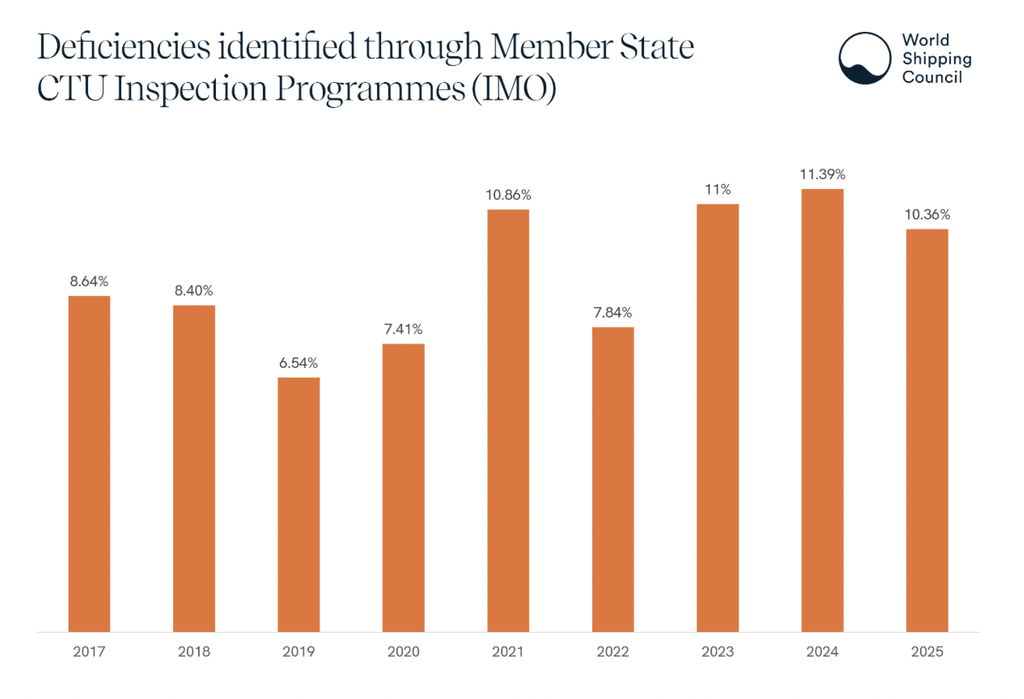
Authorities from seven countries reported a total of 93,079 inspections of Cargo Transport Units (CTUs) in 2025. Defects were identified in 9,645 cases. This corresponds to a rate of 10.36 per cent.
The issues identified included, amongst other things, incorrect documentation, markings and dangerous goods labels, as well as improper packaging or inadequate load securing. According to the WSC, such shortcomings can increase the risk of cargo damage, container loss and fires on board.
“The fact that defects are found in more than one in ten units inspected is far too many,” explained WSC President and CEO Joe Kramek. Correct declaration, packaging, securing and labelling are fundamental safety requirements. Failure to comply with these could endanger human lives.
The data comes from Chile, Finland, Germany, the Netherlands, South Korea, Sweden and the USA. However, the WSC also notes that the low number of reporting states is striking: of the more than 170 member states of the International Maritime Organisation (IMO), only seven submitted the results of their container inspections for 2025. This creates significant gaps in the assessment of the global safety situation.
The defect rate did fall slightly compared with 2024. At that time, it stood at 11.39 per cent; in 2023, it was 11.00 per cent. In 2021, 10.86 per cent of the vessels inspected had been found to have defects.
The WSC has taken over the task of compiling and publishing the inspection results following the IMO’s decision to discontinue its annual consolidated report in 2024. At the same time, the association highlights its Cargo Safety Programme. This combines shared screening technologies, uniform inspection standards and operational feedback to, amongst other things, identify incorrectly declared or undeclared dangerous goods prior to loading.