



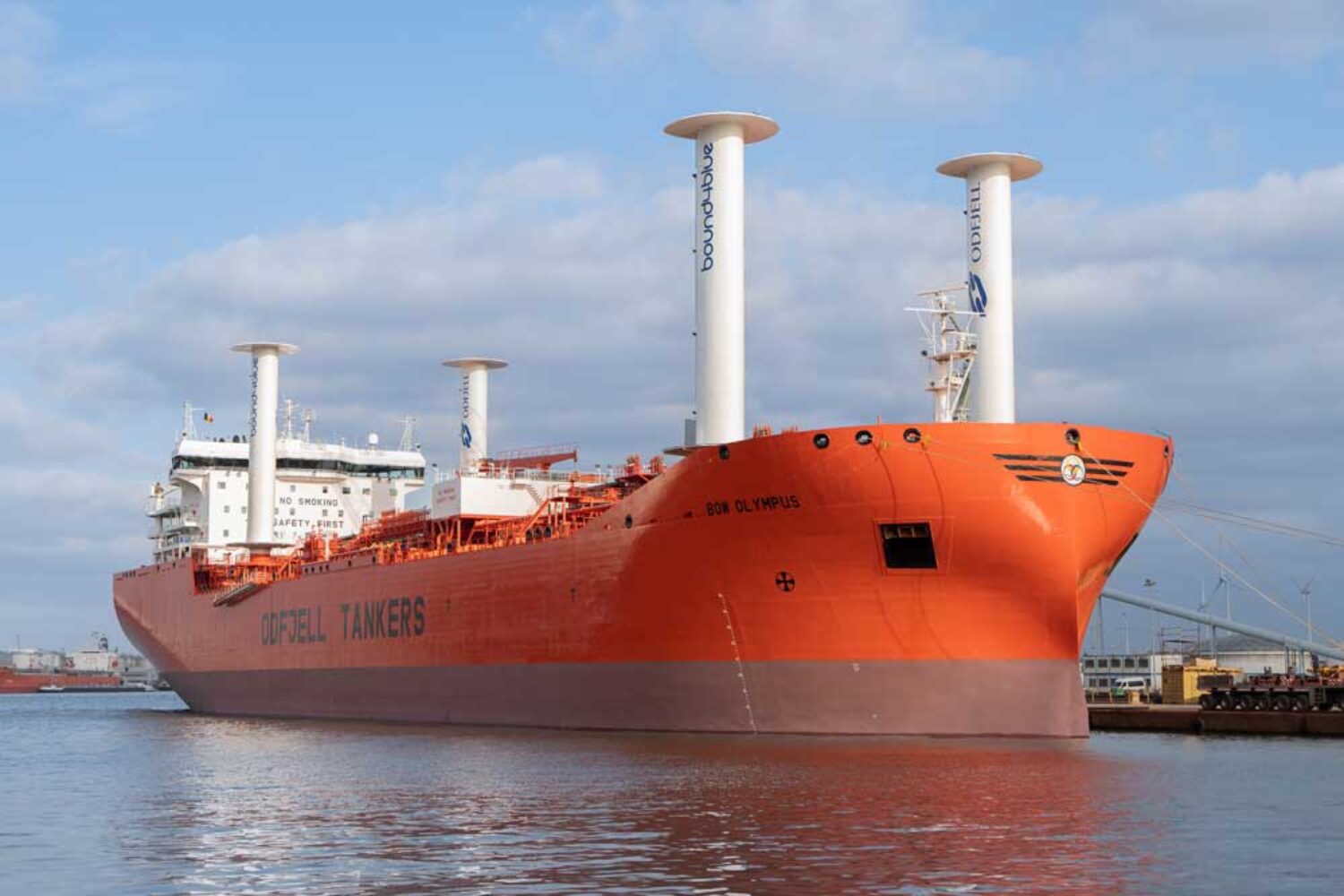
The number of ships equipped with wind propulsion technology has increased fivefold in recent years. The technology has become established and the market is developing rapidly.
The installation of wind-assisted propulsion systems (WAPS) on large merchant ships has increased the global wind-powered fleet to over 100 vessels. This corresponds to a tonnage of around 5 million dwt, according to the International Windship Association (IWSA). Spread across these 100 ships are over 230 individual wind propulsion systems, which save more than 100,000 tons of CO2 across the fleet.
The technology has thus reached a “significant turning point”. What was considered a niche product or historical form of maritime transport is now developing into one of the fastest growing solutions for decarbonizing shipping.
The statistics do not yet include twelve cargo ships that already have the necessary infrastructure on deck but have not yet installed any systems. Similarly, smaller cargo ships (under 400 GT) and traditionally rigged cruise ships have not been included.
A look back shows how quickly WAPS have developed: in May 2022, 21 merchant ships were still equipped with wind propulsion systems, with a tonnage of around 1 million tdw. Four years later, this figure has increased fivefold. The 100 ships also include six units with lengths between 80 and 220 m that use wind not only as a supporting but also as a primary propulsion force. This number is also set to increase significantly in the future, according to the IWSA.
Tankers and bulkers dominate the WAPS market
Tankers and bulkers currently lead the market in terms of the number of ships with installed wind propulsion systems. Currently, 37 tankers and 24 bulkers are equipped with this technology. In addition, there are 24 RoRo and RoPax ships and 19 general cargo ships. The forms of WAPS used are diverse: in addition to “traditional” sails, shipowners can also choose from rigid and semi-rigid wing sails, rotor sails(Flettner rotors), kite sails and so-called “suction sails“.
“This boom in installations is due to the continued increase in comprehensive testing, independent verification and commercial validation of systems over the last five years,” said Gavin Allwright, IWSA Secretary General. “This is boosting shipowners’ confidence in the operational and financial benefits of deploying wind turbines. However, we can accelerate these installations even further as everyone focuses on scaling up to 1,000 vessels and beyond.”
Despite current uncertainties related to the IMO’s global decarbonization framework and geopolitical upheaval, the association continues to see a “good order situation” for retrofits and new builds as well as ongoing construction projects. The wind fleet is expected to double again within the next twelve months, meaning that around 200 merchant ships will already be using WAPS by next year.
Further forecasts from previous EU contract studies and the British Clean Maritime Plan estimate that up to 15% of the fleet will be powered by wind energy by the early 2030s. By the 2050s, it could be as high as 40-45%. “If the shipping industry and the regulatory authorities embark on an ambitious course towards zero emissions, these forecasts could even prove to be conservative,” estimates the IWSA.
High fuel prices accelerate acceptance
For Secretary General Allwright, the current milestone of 100 ships is an important indicator of market acceptance. “From this point onwards, we can expect to see a steady reduction in payback periods, particularly if fuel prices remain high, as production expands and installation experience increases,” he said. “It’s becoming increasingly clear why wind power is such an attractive option for shipping companies: it offers positive financial returns, increased energy security, measurable decarbonization gains and technology pathways that support compliance with today’s increasingly stringent emissions regulations.”
Depending on the system installed, WAPS have been shown to provide between 5 and 20% of a ship’s propulsion energy. While optimized and fully integrated systems achieve the highest savings in new builds, retrofitted installations are also expected to contribute significantly to ship efficiency. According to the IWSA, wind power therefore represents a valuable pathway for renewable energies that is “exclusively available to the shipping industry”.
With fuel costs remaining volatile, growing regulatory pressures and the increasing need for shipowners to reduce emissions without having to wait for alternative fuels to become available in the future, wind energy is establishing itself as an integral part of the decarbonization process in the global shipping industry.