


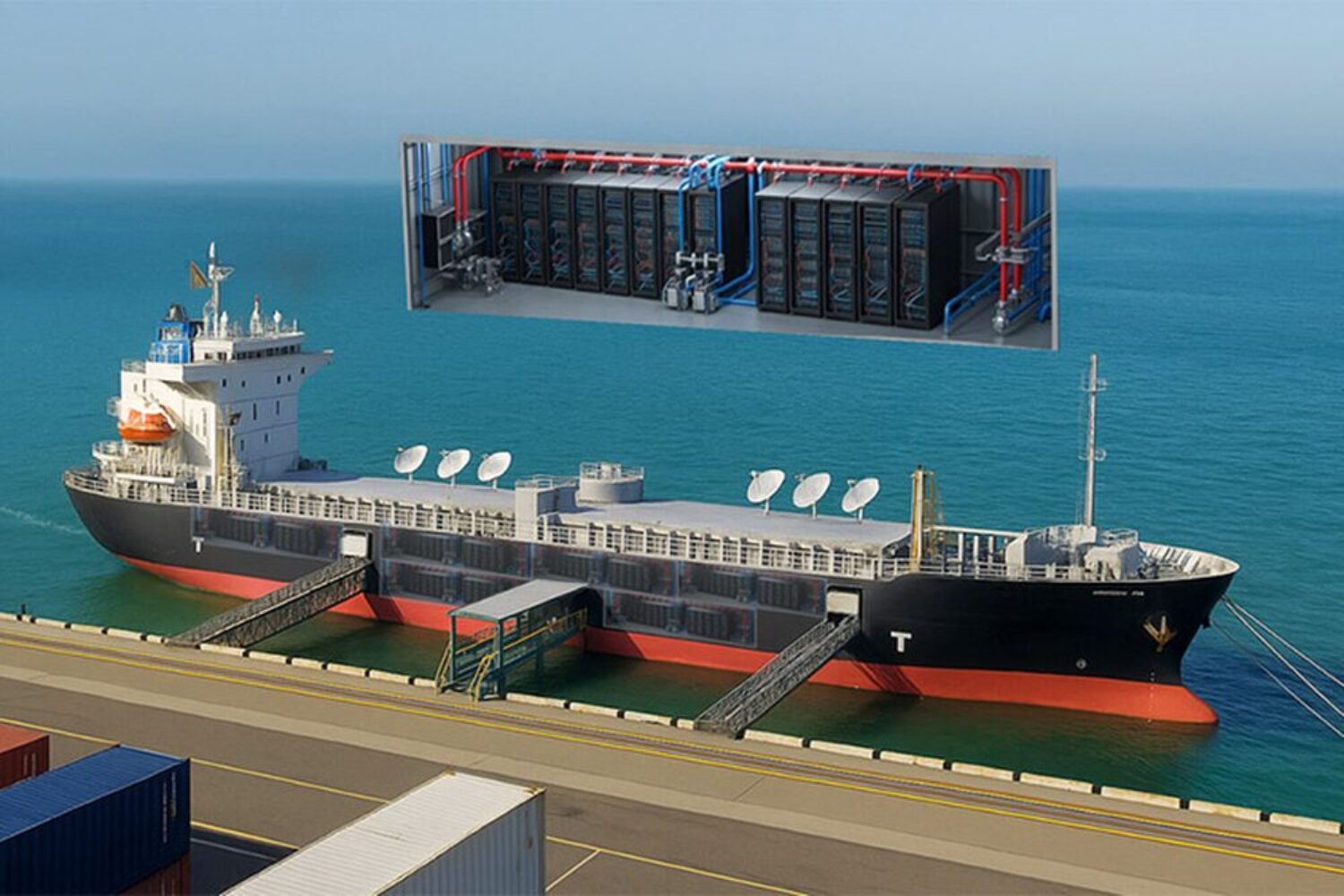
The Japanese shipping company Mitsui O.S.K. Lines (MOL) has signed a letter of intent with Hitachi and the IT service provider Hitachi Systems to develop, operate and market floating data centers.
The plan is to convert used ships into so-called “Floating Data Centers” (FDC). In the next step, the partners want to examine demand, define basic technical requirements and carry out feasibility studies for subsequent commercialization. The initial focus will be on Japan, Malaysia and the USA. According to the Hitachi Group, it already has experience there with land-based data centers and corresponding services.
AI boom creates demand for data center capacity
The background to this is the sharp rise in demand for data center capacity as a result of the boom in generative AI. According to company estimates, this is also increasing the need for alternative location and infrastructure concepts. Floating data centers are said to offer advantages where large areas on land are scarce, access to cooling water is limited or risks from natural disasters have to be taken into account.
According to the partners, the conversion of existing and old ships could bring several advantages. They cite shorter implementation times, lower initial investments and better use of space. In addition, sea or river water could be used for cooling, which should reduce the energy required for cooling. Mobility is cited as a further advantage: Floating data centers could be moved to other locations if demand changes.
MOL responsible for the maritime side
MOL will primarily cover the maritime side of the project. This includes planning possible ship conversions, discussions with port authorities and other stakeholders, mooring and maintenance requirements and financing models. Hitachi and Hitachi Systems will be responsible in particular for the technical design of the data center, the IT infrastructure including networks and security, as well as approaching potential customers.
According to the company, a car carrier with a deck area of around 54,000 m² could be on the scale of one of the largest land-based data centers in Japan. With this project, the partners want to examine whether a new business model can be developed from older tonnage at the interface of shipping, energy and digital infrastructure.