



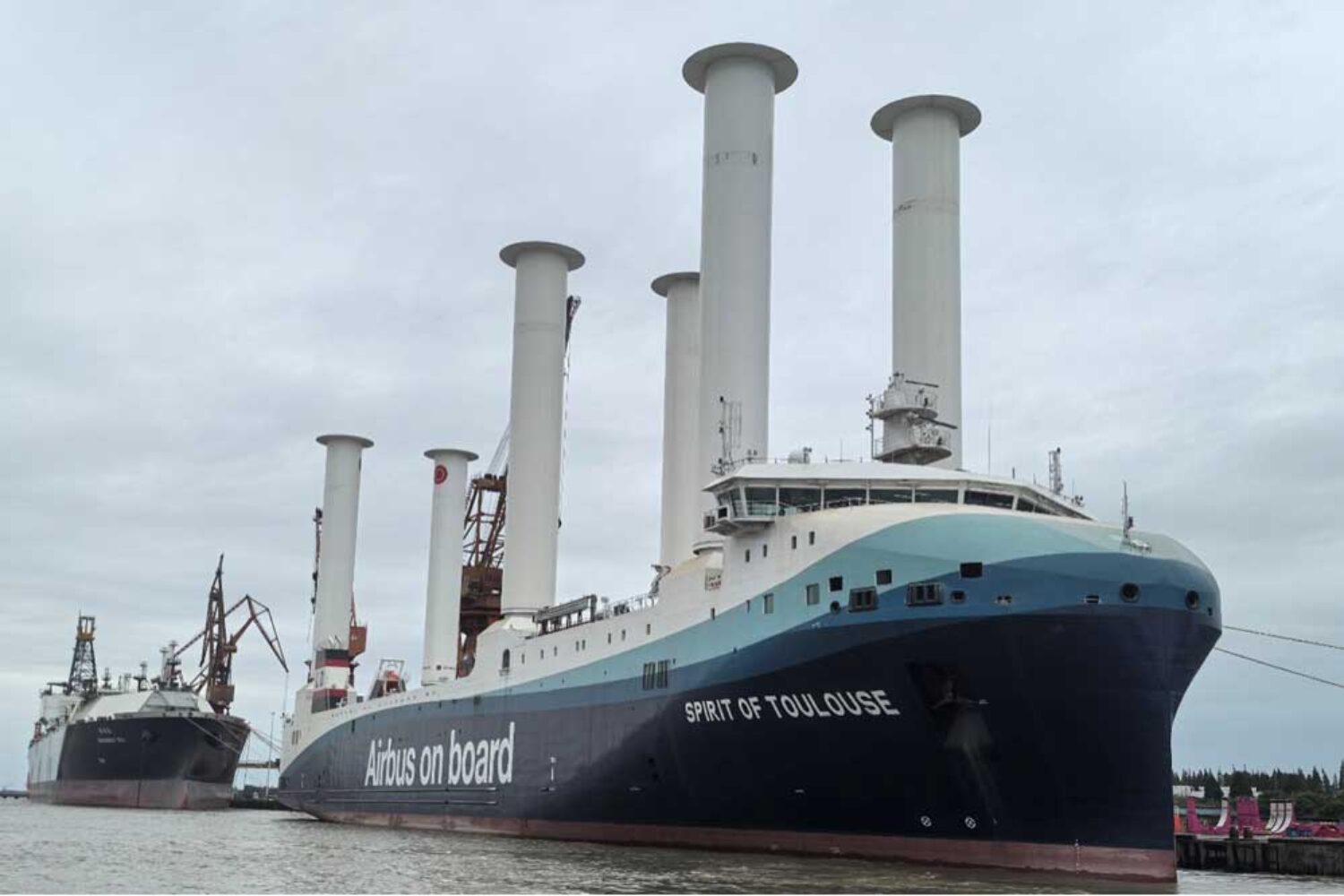
The shipping company Louis Dreyfus Armateurs (LDA) has had its cargo ship, the “Spirit of Toulouse”, fitted with a total of six rotor sails. These were supplied by the technology firm Norsepower.
The ‘Spirit of Toulouse’ is the first of a total of three new vessels built for LDA to support Airbus’s transport logistics. The ‘Spirit of Mobile’ and ‘Spirit of Mirabel’ are yet to follow. The RoRo vessels are designed to transport large aircraft assemblies between the manufacturer’s production sites in Europe and North America.
To reduce emissions, the vessels are fitted with dual-fuel main engines and two dual-fuel generator sets that can run on e-methanol, bio-methanol or marine diesel. They are supported by wind power: a total of six so-called ‘rotor sails’ from Norsepower have been installed on the ‘Spirit of Toulouse’. Measuring 35 m x 5 m, the work was carried out at the Wuchang Shipbuilding yard in China. This makes it not only the largest wind-powered RoRo vessel currently in operation, but also the vessel with the world’s largest number of mechanical sails.
Norsepower and LDA had already announced their collaboration in early 2024. Construction at the shipyard began in October of the same year, and the first vessel was launched in February 2026. The installation of the rotor sails has now been completed ahead of the start of sea trials.
Proof of the industry’s transformation
“The ‘Spirit of Toulouse’ is far more than just a new ship,” said Samira Draoua, CEO of LDA. “It is concrete proof of how the maritime industry can accelerate its transformation – through a combination of innovation, operational expertise and strong industrial partnerships. The fact that six rotor sails have been combined with a methanol dual-fuel propulsion system on a vessel of this size is a world first. This underlines LD Armateurs’ commitment to playing a pioneering role in developing tangible solutions for lower-carbon shipping.”
Heikki Pöntynen, CEO of Norsepower, added: “The installation of six Norsepower Rotor Sails on the ‘Spirit of Toulouse’ is a significant milestone for wind propulsion in the RoRo segment. In combination with the ship’s methanol dual-fuel engines, the rotor sails enable a reduction in fuel consumption and emissions – right from the very first voyage. We are proud of how smoothly this project has progressed, from the initial agreement right through to installation, and are keen to see how the technology will perform on the transatlantic route.”
The partners stated that fitting the rotor sails to a single ship’s hull had been a “challenging undertaking”. To this end, the shipyard’s project team drew up a special construction plan, which was reviewed by experts before work began on site and refined with clearly defined responsibilities.
Commissioning began immediately after the installation of the first rotor sail. Once all the sails have been fully fitted, they will be extensively tested during the upcoming sea trials to confirm their performance and seamless integration into the ship’s systems. During the maiden voyage from China to France, further optimisations and fine-tuning will take place to ensure the technology can “realise its full operational potential”, according to the statement.
“The collaboration with Norsepower on this project went extremely smoothly and sets a high standard for the next two vessels,” said Jean-Baptiste Boutillier, COO at LDA. The coastal installation site posed significant challenges in terms of working conditions; however, thanks to careful planning and efficient execution, the sails were installed safely and precisely. “We look forward to continuing this collaboration on the two further vessels, which are also due to be fitted in the future,” said Boutillier.