



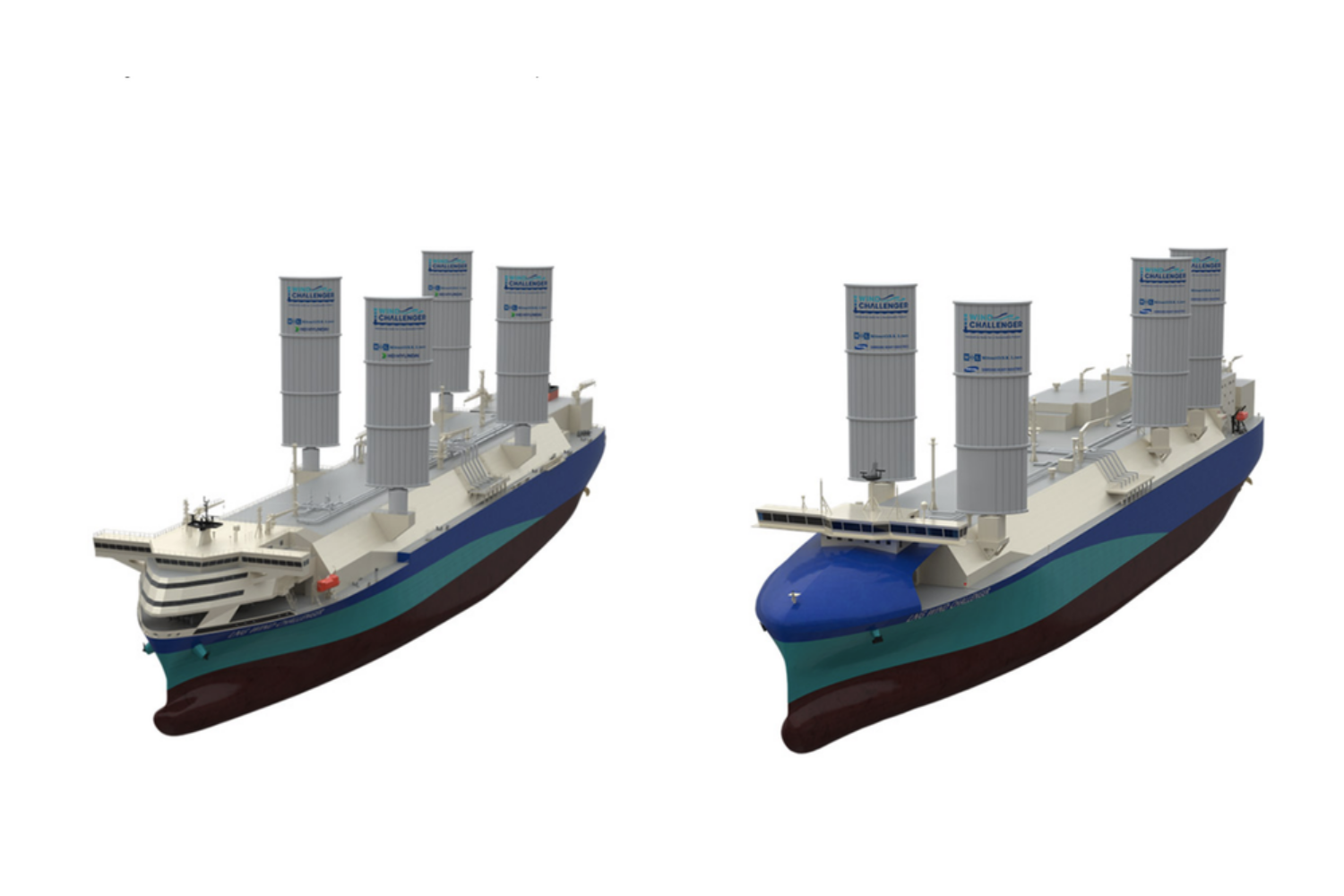
An LNG carrier concept developed by HD Hyundai Heavy Industries (HHI) and Mitsui O.S.K. Lines (MOL), featuring four Wind-Challenger rigid sails, has reached a further stage of development.
The British classification society Lloyd’s Register (LR) has issued a design appraisal for the concept.
The concept envisages an LNG tanker with a cargo capacity of around 174,000 m³. The vessel, approximately 289.9 m long and 46.1 m wide, is to be fitted with four Wind Challenger systems developed by MOL.
The automatically controllable and telescopic hard sails are made of fibre-reinforced plastic. Each sail can be extended to a height of up to 49 metres and is approximately 15 metres wide. The additional wind propulsion is intended to reduce fuel consumption and, consequently, the emissions of the LNG carrier.
A distinctive feature of the design is the arrangement of the bridge and accommodation block in the fore section. This frees up more space amidships and aft for the four Wind Challenger systems. At the same time, it is said that the rigid sails can be positioned there more effectively for harnessing wind energy.
Up to 30 per cent less fuel
MOL had already published calculations in 2025 on the potential savings for the underlying design. According to these, on a route between North America and Europe, up to around 30 per cent of fuel could be saved per voyage under suitable conditions. On an annual average, MOL estimates a potential saving of around 15 to 20 per cent. The actual figures depend, amongst other things, on the route, speed, and wind and sea conditions.
As part of the design review, the project partners examined, amongst other things, visibility from the bridge, the ship’s stability and the structural loads imposed by the hard sails. The integration of emergency shutdown systems, as well as safety and risk analyses, were also part of the assessment.
According to LR, the design meets the requirements for its Wind-Assisted Propulsion Systems (WAPS) notation. In addition to HHI, MOL and LR, the Marshall Islands Maritime Administration is also involved in the development project. An Approval in Principle (AiP) for the concept had already been granted in 2025.
Next step: commercial application
There is as yet no specific newbuilding contract for the LNG carrier. HHI describes the design appraisal instead as a further step towards the future commercial application of the concept.
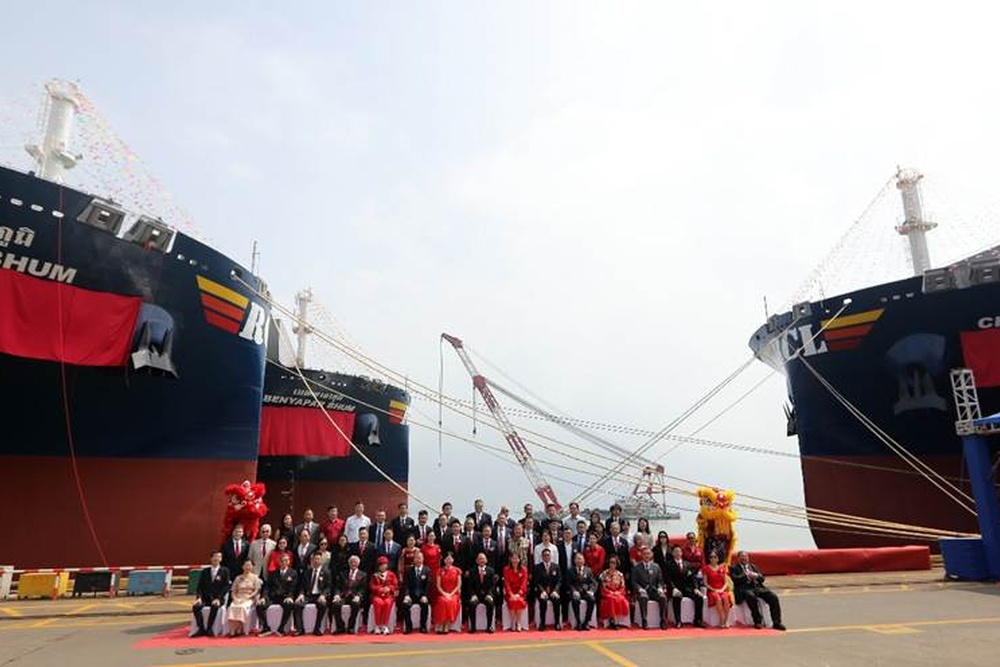
MOL is already using the Wind Challenger on other vessels and is driving forward the application of the technology on LNG carriers. Just at the beginning of September, the “Fujin Sailor” was christened at Hanwha Ocean. The LNG carrier is equipped with two Wind Challenger rigid sails and is due to commence a long-term charter for Chevron at the end of September. The concept developed jointly with HHI, however, envisages four rigid sails.