




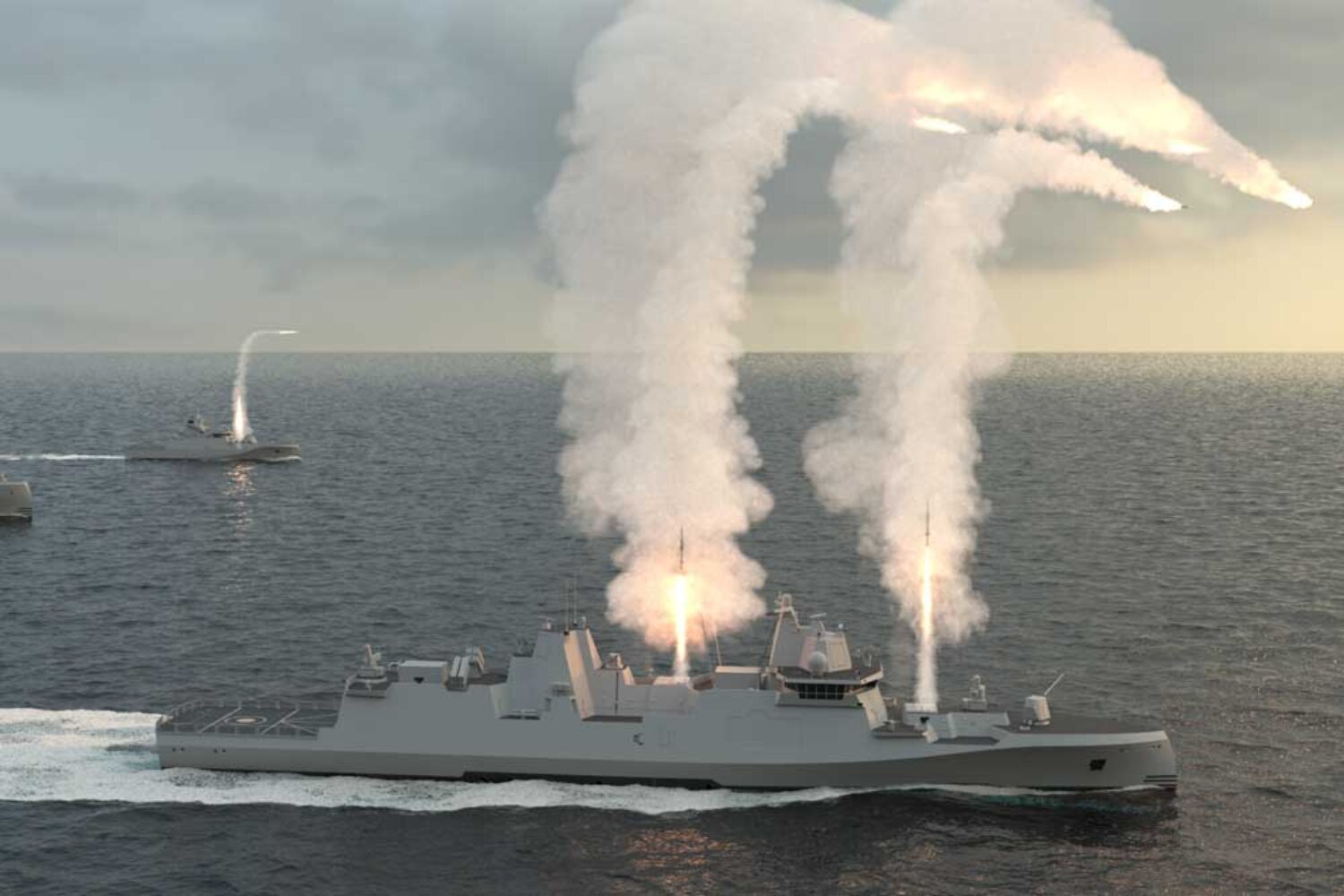
The defence group Rheinmetall has developed a new frigate. According to the company, the GMF140 (Guided Missile Frigate) sets new standards in operational flexibility and combat capability.
With a length of 140 m and a displacement of more than 6,000 t, the GMF140 has been specifically developed to meet the evolving requirements of NATO and allied navies. It covers the entire spectrum of modern maritime operations. Rheinmetall is targeting international markets with the GMF140 and intends to offer it initially as part of a procurement programme in North America.
Reduced manning requirements
The GMF140 is designed for operations in highly complex threat scenarios and combines capabilities for air defence, ballistic missile defence, anti-submarine warfare and long-range precision strikes in a highly integrated, digitalised platform designed to require a reduced crew.
The vessel is optimised for worldwide open-sea operations and is equally suited to operations in coastal waters and to multinational missions within an alliance framework.
Designed for American radar systems
A key feature of the GMF140 is its ability to integrate state-of-the-art US primary radar systems. These enable the effective detection, tracking and engagement of conventional air targets as well as hypersonic weapons and ballistic missiles.
In conjunction with the tried-and-tested AEGIS Combat System and 64 vertical launch cells (Strike-Length Vertical Launch System), the frigate can deploy the full spectrum of modern missiles for air defence, ballistic missile defence and land-target engagement. This gives it command and fire control capabilities that were previously reserved almost exclusively for significantly larger surface combatants.
The AEGIS Combat System installed on the GMF140 can be combined with various command and weapon-handling systems, including Lockheed Martin’s CMS330 Combat Management System. Its open, interoperable and scalable architecture enables the seamless integration of European sensor and weapon systems and supports joint operations within multinational naval task forces.
As a multi-domain platform, the GMF140 possesses comprehensive anti-submarine warfare capabilities. These include a low-signature hull, integrated acoustic management, hull-mounted and towed sonar systems, and the capability to deploy manned and unmanned airborne systems of European or US origin.
Developed for NATO and partner nations
The GMF140 was specifically developed to meet the requirements of modern NATO and partner nations seeking to procure a high-performance, cost-effective and interoperable next-generation frigate. The concept is particularly well-suited to nations modernising their fleets in the face of growing security challenges in Europe, the North Atlantic and the Indo-Pacific.
With its combination of integrated air and missile defence, ballistic missile defence, high-performance anti-submarine warfare and long-range precision strike capabilities, the GMF140 is, according to Rheinmetall, one of the most modern and capable frigates in its weight class.
Rheinmetall intends to initially offer the GMF140 as part of a procurement programme in North America. Furthermore, the offer is aimed at other allied navies seeking a future-proof, highly interoperable surface combatant that can be seamlessly integrated into the operational formations of the world’s leading naval forces.
Technical specifications GMF140
- Length: 140 m
- Displacement: over 6,000 t
- Main roles: air defence (Anti-Air Warfare – AAW), ballistic missile defence
- (Ballistic Missile Defence – BMD), anti-submarine warfare (ASW) and long-range precision strikes
- Command and control system: AEGIS Combat System, optionally supplemented by CMS330
- Primary radar: US air defence radar in various configurations, including full capability for tracking ballistic missiles
- Vertical launch system: 64 Strike-Length VLS cells
- Armament and sensors: anti-ship missiles, torpedo launchers, 5-inch main gun, laser weapon system, secondary armament, close-in weapon system (CIWS), electro-optical sensors (EO), electronic warfare (EW) systems, hull-mounted and towed sonar, and decoy systems
- Missile compatibility: Support for the full spectrum of modern missiles for air defence, ballistic missile defence and land-target engagement
- Design philosophy: Open system architecture, high future-proofing and NATO interoperability