

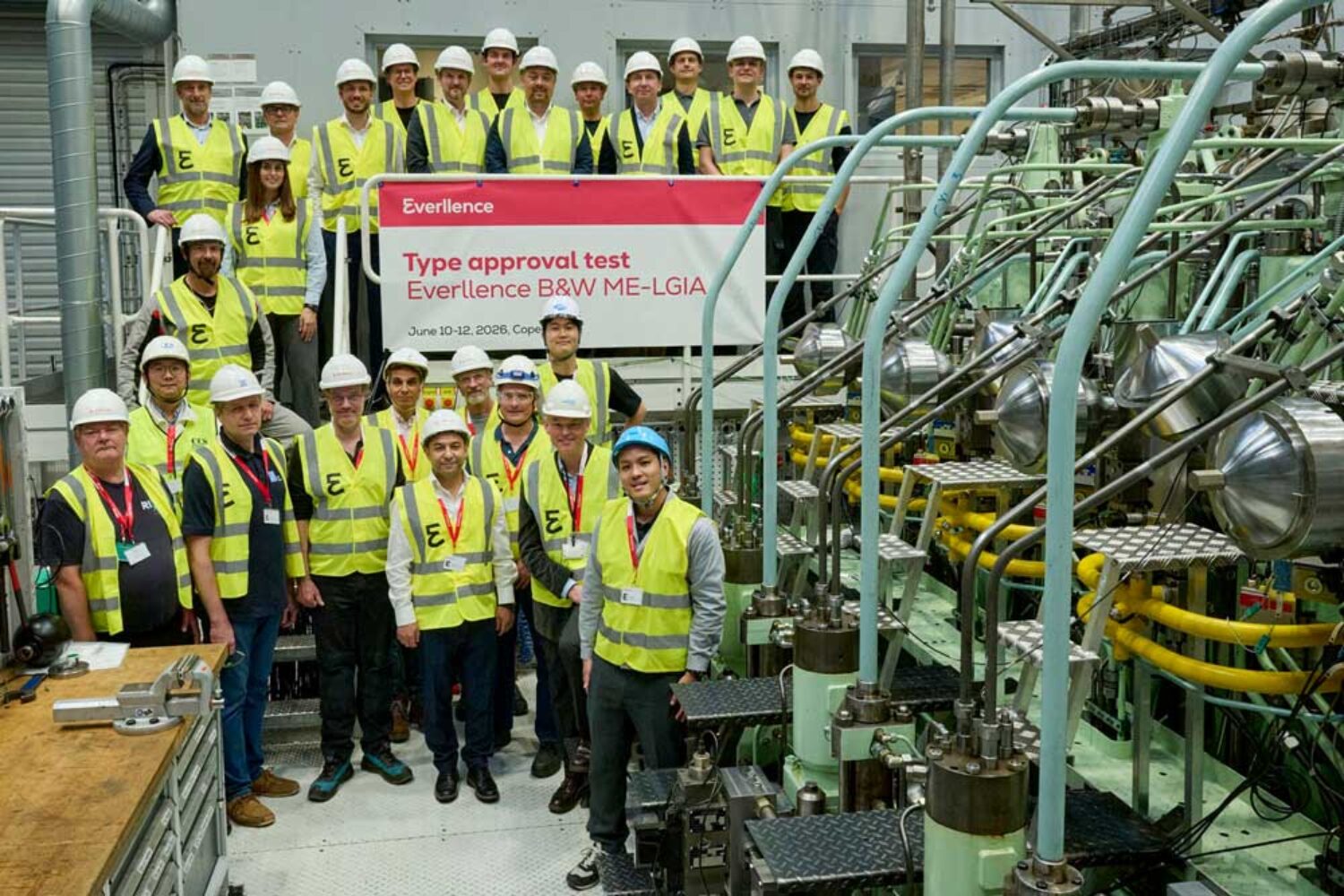
Everllence has successfully completed the type approval tests (TAT) for its ammonia-powered engine at its in-house research centre in Copenhagen. This is also the final test of its kind to be carried out at this site.
According to the propulsion manufacturer, eight classification societies supervised the tests, which took place from 10 to 12 June. According to Bjarne Foldager, Head of Two-Stroke Business at Everllence, the TAT is another important step on the path from concept development to the final commissioning of the marine engine.
The test confirmed the ME-LGIA’s certification and is the final hurdle before the actual sea and gas trials. The engine sets new standards for climate-neutral propulsion and digital connectivity, according to Foldager. Since its initial announcement in 2019, the technology has attracted considerable interest.
According to Ole Pyndt Hansen, Senior Vice President and Head of Two-Stroke R&D at Everllence, the TAT is also of great significance in view of the further development of the IMO’s ammonia regulations. The requirements and guidelines must be realistic in order to further enhance safety on board. These insights came from the industry. “The first ammonia-powered ships, which are expected to set sail in 2026, will provide important insights for the further development of these guidelines,” said Hansen.
Everllence, then still operating under the name MAN Energy Solutions, announced the development of the ammonia-powered engine in 2019. In November 2025, the company officially unveiled the ME-LGIA engines. Thanks to the diesel principle and proven dual-fuel liquefied gas injection, the engine has, according to the manufacturer, a proven track record of several hundred thousand operating hours.
The completion of the TAT also marks the end of an era at the RCC research centre in Copenhagen. The company plans to move to a new site outside the Danish capital as early as the end of 2027.
Read more about the launch of the ammonia engine: