





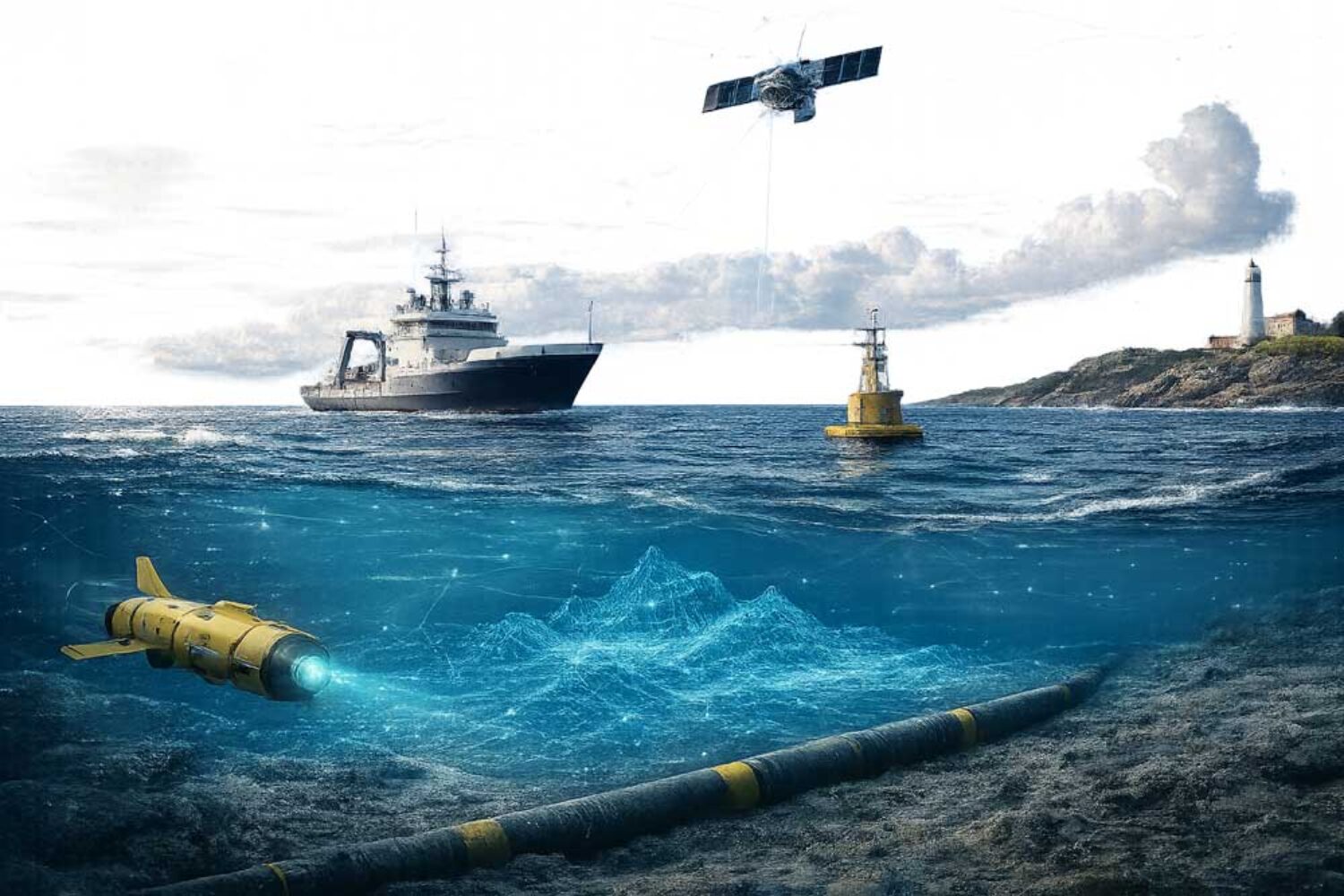
With OceanEye, the EU is strengthening maritime situational awareness, ocean observation and the protection of critical infrastructure. An initial €92 million will be made available for the program, with further investments to follow.
With OceanEye, the European Commission has launched a new ocean observation initiative that has security policy relevance beyond environmental and climate issues (COM(2026) 268 final, June 3, 2026). The program aims to strengthen Europe’s maritime database, identify risks at sea earlier and position the EU as a leading provider of ocean intelligence by 2035.
Part of the Ocean Pact
OceanEye is a core element of the European Ocean Pact, in which maritime security and defense are named as one of six priority areas. Ocean observation is moving closer to issues relating to the protection of critical maritime infrastructure.
€62 million boost
Brussels wants to mobilize a total of €92 million. Of this, €62 million will be used to strengthen the EU contribution to the Global Ocean Observing System and global ocean data systems. The funds come from “Horizon Europe”, the EU’s central research and innovation framework program for the period 2021 – 2027.
A call for funding from the European Innovation Council for new ocean observation technologies will provide a further €30 million. The focus here is on start-ups and deep-tech solutions in areas such as underwater robotics, sensor technology and AI-supported data analysis.
Ambition
Brussels is pursuing the goal of providing around 35% of the global ocean observation system by 2035 and positioning Europe as a leading player in the field of “ocean intelligence”.
The Commission admits this: ‘These amounts are only a starting point. In order to achieve OceanEye’s goals – namely 35% of the global observation system by 2035 – annual investment must be increased three to fourfold. A clear appeal to the member states to adjust their national budgets accordingly.
Geopolitics drives “dual use”
Officially, OceanEye remains a civilian initiative, but its utility extends to security and defense tasks. Improved sensor technology, networked data rooms, digital twins and reliable maritime situational awareness are not only relevant for research and business, but also for surveillance, early hazard detection and the protection of undersea and coastal infrastructure. And therefore for coast guards and navies.
With regard to its geopolitical significance, the text of the communication states: “The ocean is also an important geopolitical space for maritime transport, energy and digital infrastructure, as well as for maritime security and defense. In an era of evolving hybrid threats, the resilience of these critical maritime infrastructures has become a strategic priority, making a sustainable knowledge of the ocean essential to safeguard Europe’s interests, strategic autonomy and leadership in a rapidly changing world.”
Ultimately, for Brussels, OceanEye is also motivated by industrial policy. In accompanying statements from the Commission, ocean observation is described as a growth market worth 10 to 20 billion euros a year. At the same time, the aim is to expand the EU’s technological sovereignty in the field of maritime data, sensor technology and digital applications.