


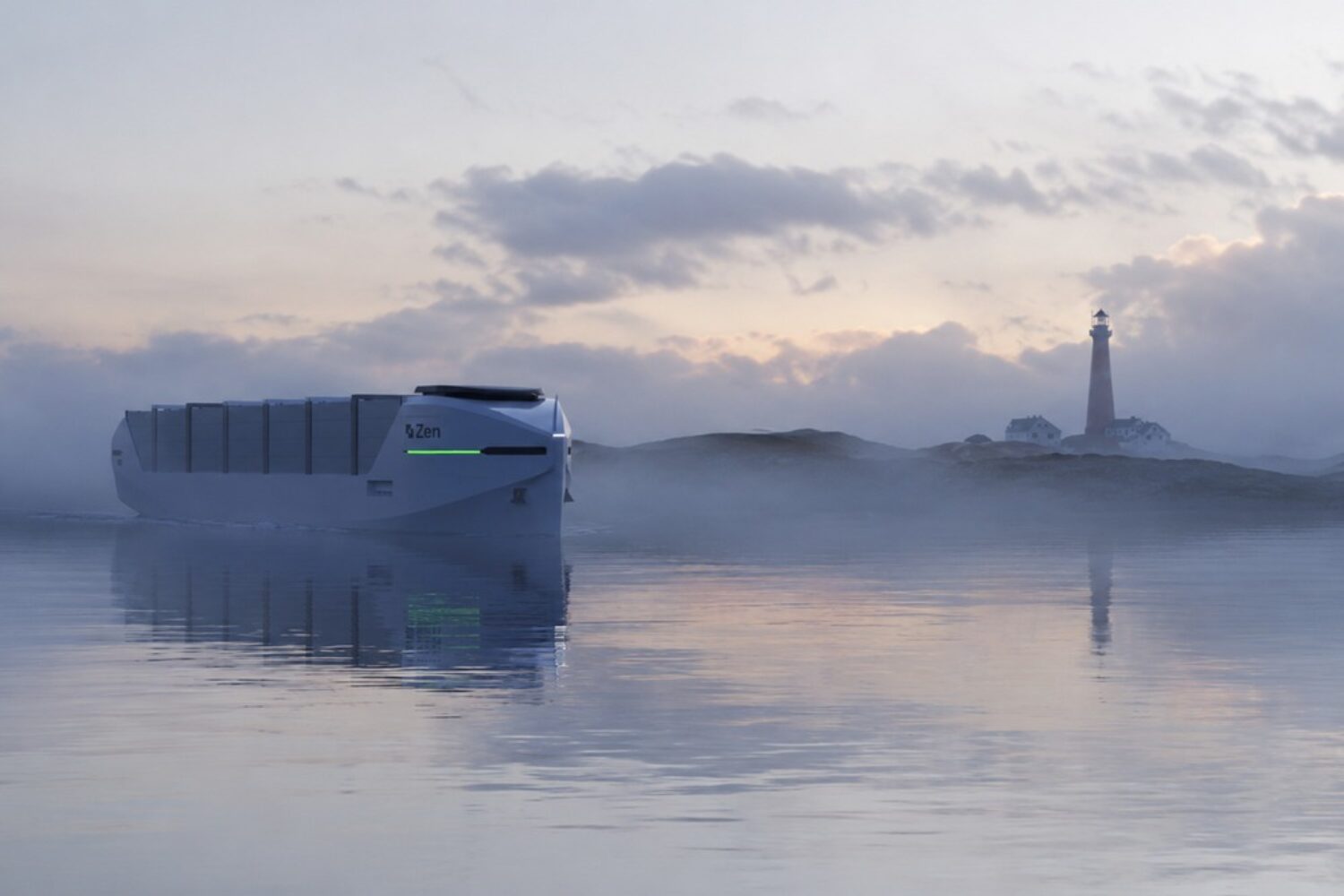
The Norwegian Eitzen Group is consolidating its maritime electrification activities under Zen. The company has placed an order for two fully electric container ships with a Chinese shipyard.
The Eitzen Group, a family-run shipping company headquartered in Oslo, is pressing ahead with its plans for battery-electric container shipping in Northern Europe. The company is consolidating its maritime electrification activities within the company Zen. Zen has now ordered two fully electric container ships.
The vessels are set to transport containers between Hamburg, Gothenburg and Oslo with zero emissions. According to Eitzen, they are set to be among the largest electric container ships to have been used commercially to date. They will also form the basis for electric freight corridors between key ports in Northern Europe.
Zen signed a contract with Zhejiang Dongpeng Shipbuilding & Repairing on Friday. The Chinese shipyard is due to deliver the first electric container ship in 24 months. The second ship is scheduled to follow three months later.
According to the company, the newbuilds will be equipped with battery packs of more than 100 MWh. Each is expected to be capable of carrying 900 TEU and achieving a range of 500 to 600 sm.
“Electrification is no longer a concept for the future. It is already becoming commercially viable on selected trade routes,” emphasises Fridtjof C. Eitzen, co-founder and CEO of Zen. Zen was founded to drive this development forward and build the necessary infrastructure.
Oslo Port plans high-voltage charging facility
Oslo Havn is also involved in the project. The port intends to build a high-voltage charging facility for container ships on Sjursøya. According to the port, the initiative is directly linked to the Eitzen Group’s project.
In June 2025, Eitzen received a grant of NOK 200 million (approximately €18.2 million) from Enova for the construction of the two battery-powered container ships. In the same funding round, Oslo Havn received NOK 20.6 million (approx. €1.9 million) to build a high-voltage shore power facility for battery-electric container ships at Yilport Oslo. The planned charging facility is to be designed for a voltage of 6.6 kV and a capacity of 7.5 MVA.
Port Director Ingvar M. Mathisen described Eitzen and Zen’s investment decision as an important step towards reducing emissions in the shipping industry. For Oslo Havn, the project also represents a further step from shore power supply towards the development of charging infrastructure for large battery-powered ships.
In-house-produced batteries
According to Zen, the batteries for the ships are to be produced at the company’s own factory in Tønsberg. They are waterproof, designed for permanent immersion in water and are expected to achieve twice the energy density per volume of comparable solutions.
Eitzen has been active in shipping, logistics and maritime industry activities for more than 140 years. According to Zen, the company develops electric vessels, battery systems for maritime applications, charging infrastructure, fleet management systems and autonomous operating models.